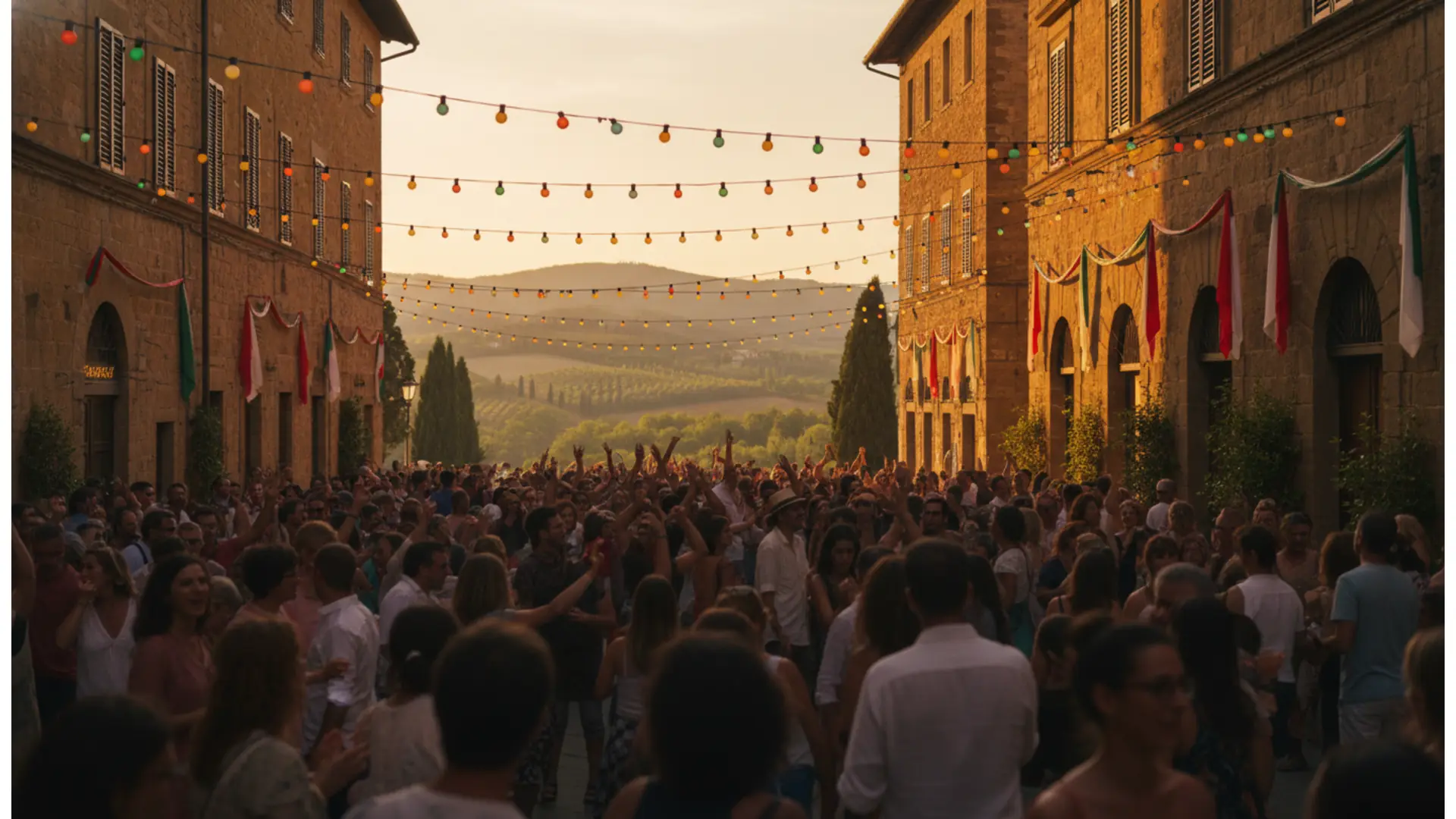
Gran Carnevale di Montoro
Allegorical floats, Mascarata and Zeza across the Irpinia hamlets
About Montoro Carnival
A carnival spread across the hamlets of Montoro
The Gran Carnevale di Montoro is not just a single parade, but a long season of festivities that spans the entire municipal territory. Montoro, in the province of Avellino, is one of the most extensive and complex municipalities in inland Campania: fifteen hamlets—including Piano (the municipal seat), Borgo, Piazza di Pandola, Banzano, Figlioli, Torchiati, Aterrana, Caliano, Misciano, Preturo, San Pietro, and Sant'Eustachio—are scattered along the valley connecting Irpinia to the Salerno area. Each village preserves its own way of celebrating Carnival, which is why the event unfolds over several Sundays, moving from square to square until the grand finale.
The result is a deeply participatory event: in the weeks leading up to Shrove Tuesday, the town fills with allegorical floats, masked groups, music, and processions that involve children and adults alike, turning streets and squares into an open-air stage.
The Mascarata, the Zeza, and the Death of Carnival
What makes the Montoro Carnival different from a simple costume party is the survival of ancient rites. At its heart is the Mascarata, the traditional procession that repeats in the hamlets of Piazza di Pandola, Borgo, Figlioli, and Banzano, featuring recognizable symbolic figures: Pulcinella on horseback and 'a vecchia ro carnuale (the old woman of the Carnival). The processional dances accompanying the parade have an apotropaic value—intended to ward off evil—and their movements harken back to archaic fertility and seasonal rebirth rituals, in a line of continuity that scholars trace back to the Saturnalia.
In the Borgo hamlet, the Zeza play is also preserved: a sung farce from the Campania region that features Pulcinella, his wife Zeza, and their daughter Vastianella, along with the 'ntreccio dance. The cycle concludes with the Death of Carnival, the final rite that marks the end of the time of reversal and the entry into Lent.
Allegorical floats and masked groups
Alongside the ritual aspect is the more spectacular component: the parade of allegorical floats, built in the preceding months by local associations and those from neighboring towns. The parade typically includes groups such as Borgo Carnevale, I Ragazzi di Capriglia, Maria Santissima delle Grazie, Casal Barone, ALVAA, ASD Madre Terra, Sogno e Realtà, Insieme Per, Rione Capo Solofra, Gli amici di Baronissi, Iris Figlioli, I ragazzi di Montoro, Sant'Anna, and Il Gabbiano. It is a valley carnival that gathers groups from across the Irno Valley and beyond, having built a network of collaborations over the years with other carnival festivals in Irpinia and the Salerno area.
The Museum of Masks and Carnival
The Montoro tradition also has a permanent cultural center: the MuMasCa — Museum of Masks and Carnival of Montoro, established in the Borgo hamlet to collect masks, costumes, photographs, musical instruments, and memorabilia related to local festivals. The museum focuses on documenting and studying the Carnival as intangible heritage, with collaborations involving the university sector. Visitors to Montoro out of season will find here the key to understanding what really happens during the February parades.
Organizers
The event is promoted by the Municipality of Montoro together with local associations, in particular the Pro Loco Mont'oro & Sapori and the APS Palio Montoro, with the support of the Campania Region and the Ministry of Labour and Social Policies. The detailed program, with dates and times of individual parades, is published every year on the Municipality's official website and on the organizers' channels.
How to experience it
- Period: From late January or early February until the Sunday following Shrove Tuesday.
- Where: Parades move between the hamlets; the main hubs are Piazza di Pandola, Piano (Piazza Michele Pironti), and Borgo.
- Admission: Free; parades take place on public streets and squares.
- Tip: If you want to see the ritual aspect—Mascarata, Zeza, Death of Carnival—head to the Borgo hamlet, while for allegorical floats and the children's party, the reference point is Piano.
Montoro Carnival — edition 2026
The Gran Carnevale di Montoro 2026 confirmed the formula of the widespread carnival: not just one big procession, but a succession of events that crossed the hamlets of the Irpinia municipality from the first Sunday of February until the 22nd of the same month.
The opening, on Sunday, February 1st, took place at Piazza di Pandola with the Carnival gathering, which attracted groups from all over the Irno Valley and neighboring towns. On Saturday, February 7th, the center of gravity shifted to the Piano hamlet, in Piazza Michele Pironti, in front of the town hall, for the most attended day of the event. This was followed by gatherings in the Borgo hamlet and Mascarata events in the other villages, until Shrove Tuesday, February 17th, dedicated to traditional rites. The closing, on Sunday, February 22nd, brought the festival back to the Borgo with the grand final parade.
All stages took place outdoors, in public streets and squares, with free admission.
Programme Montoro Carnival 2026
2026 Program
- Sunday, February 1st, 3:00 PM — Piazza di Pandola: Carnival gathering, official opening of the 2026 edition with masked groups from the Irno Valley and neighboring towns.
- Saturday, February 7th — Piano hamlet, Piazza Michele Pironti: «The big party for everyone», the highlight day with gatherings, parades, masks, music, and colors in the streets and squares.
- Sunday, February 8th, 3:00 PM — Borgo hamlet: gathering and Mascarata.
- Sunday, February 15th — Montoro hamlets: the Mascarata continues between Figlioli and Banzano, with the traditional figures of Pulcinella on horseback and 'a vecchia ro carnuale.
- Tuesday, February 17th (Shrove Tuesday) — Borgo hamlet: performance of the Zeza, 'ntreccio dance, and the Death of Carnival rite.
- Sunday, February 22nd, 3:00 PM — Borgo hamlet: grand closing of the Carnival with the parade of allegorical floats and masked groups; the party then concluded in Banzano.
The times indicated are those communicated by the organizers; some stages took place throughout the day.
Highlights Montoro Carnival 2026
- The inaugural gathering at Piazza di Pandola, the first major event of the Montoro carnival season.
- The day of February 7th in Piazza Michele Pironti, in Piano: the most attended party, open to families and children.
- The Mascarata with Pulcinella on horseback and 'a vecchia ro carnuale, a procession with strong ritual value.
- The Zeza play in the Borgo hamlet, a sung farce of the Campania tradition.
- The Death of Carnival rite, which symbolically closes the time of the festival.
- The parade of allegorical floats on February 22nd, with associations from Montoro and the Irno Valley towns.
Prices Montoro Carnival 2026
Practical information — Montoro Carnival
How to get there
By car: Montoro can be reached from the A2 del Mediterraneo motorway (Fisciano or Mercato San Severino exit) or from the Avellino-Salerno motorway junction, Montoro exit. On parade days, several roads in the affected hamlets are closed to traffic: it is advisable to arrive early and park in the areas indicated by the organizers.
By train: The Montoro-Forino station is served by the Avellino-Salerno line; alternatively, use the Mercato San Severino and Salerno stations, which are connected by bus lines.
Admission and hours
The parades take place outdoors, in public streets and squares, with free admission. Events are concentrated in the afternoon, usually starting from 3:00 PM, while the main days may occupy the entire day.
Information
Municipality of Montoro, Piazza Michele Pironti 2, Piano hamlet — phone +39 0825 502021. Updated program on comune.montoro.av.it and on the Pro Loco Mont'oro & Sapori channels.
Tips
- Dress in layers: in February, in the Irpinia valley, afternoon temperatures are cool.
- The event is very family-friendly: many stops include moments dedicated to children.
- For accommodation, you can count on Montoro and the nearby towns of Solofra, Mercato San Severino, and Avellino, all just a few kilometers away.
Festival-goer photos
No photos yet. Share yours!
Share your photos
5 photos max, 5 MB per photo (JPG, PNG, WebP)
Noticed an error or missing information?
Help us keep this listing up to date. Every proposal is verified by our team before publication.
Festival-goer reviews
No rating yet — be the first!
No comments yet. Be the first!
Were you there?
Share your experience with the community.
Published by Valentin Contard, festival listings writer. Reviewed, corrected and approved by Christophe Contard, editor-in-chief. .
Where does it take place — Montoro Carnival
Frazioni di Montoro (Piazza di Pandola, Piano, Borgo, Figlioli, Banzano)