Taurano Carnival
Quadrille, ribbon dance, and the funeral of the Carnival in the Vallo di Lauro
About Taurano Carnival
A rural carnival in the heart of the Vallo di Lauro
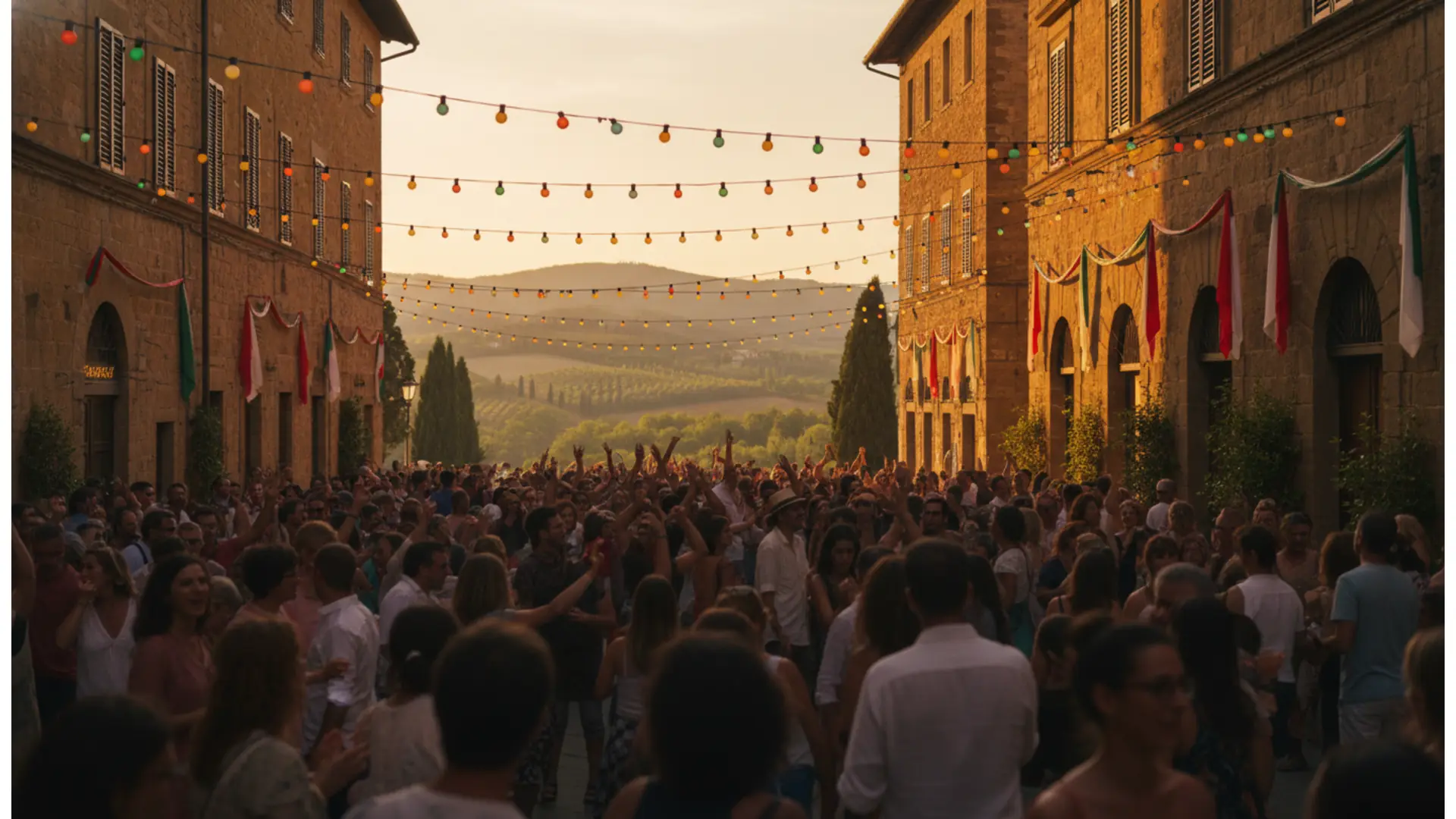
The Taurano Carnival is much more than a costume parade: it is the enactment of a rural heritage that has never truly faded in Taurano, in the province of Avellino. Nestled in the Vallo di Lauro, at the foot of the mountains separating Irpinia from the Nola area, the town preserves a repertoire of dances, songs, and carnival rites that have been lost elsewhere. Every year, in the days leading up to Lent, the streets of the historic center and the main square fill with costumed groups, decorated tractors, and entire families who participate in the festival not as spectators, but as protagonists.
The Quadrille, a dance from 1799
The heart of the event is the quadrille, a folk dance that local tradition traces back to the French presence in Campania during the days of the Parthenopean Republic of 1799. In Taurano, it is performed by twelve couples and involves children, young people, and married couples from the town at different times of the day. The 'La Quadriglia' folk group has been preserving its figures, steps, and costumes for decades, passing them down from generation to generation through patient teaching that begins as early as school age.
The 'Laccio d'Amore', or 'ballintrezzo'
Alongside the quadrille, the Laccio d'Amore (Ribbon Dance) is performed, also known as the 'ballintrezzo': twenty-four colored ribbons are held by twelve dancers around a central pole. As they dance in a circle, they weave the ribbons until the pole is completely covered, then unwind them by retracing their steps. It is a dance of rural origin linked to rites of passage, the entry of young people into adulthood, and the earth's fertility cycle: one of the few remaining examples of this choreography in Campania, requiring absolute precision and extensive preparation.
'I mise': the parade of the twelve months
The day opens with the parade of the 'mise', which refers to the months of the year in the local dialect. Twelve young people, each dressed and characterized according to the month they represent, recite the qualities and flaws of their season in verse: the cold of January, the rains of April, the toil of the harvest, the abundance of autumn. The procession is accompanied by decorated tractors and floats created by the local districts, which are awarded prizes for originality, humor, and beauty. It is the most popular and photographed moment of the festival, as it combines local wit with the precision of an agricultural calendar told aloud.
The funeral of the Carnival
The event concludes with the funeral of the Carnival, a closing rite of great dramatic power. Once the performances are over, the funeral procession of the deceased Carnival leaves the square: the coffin and catafalque, the mourning women, the figures scattering incense, and the mayor wearing the tricolor sash who officially certifies the 'death' of the king of the festival. Behind the parody lies the deep meaning of the carnival cycle: the end of excess, the transition to Lent, and the return to the ordinary time of working in the fields.
A rediscovered and protected tradition
The Taurano Carnival in its current form stems from a conscious rediscovery project carried out by the Pro Loco Taurano together with the municipal administration, which over the years has recovered repertoires, texts, and costumes that were at risk of disappearing. The event has also taken on a dimension of exchange between communities, hosting folk groups from other towns and dedicating an award, the Premio Olindo Aprano, to the historic organizer who linked his name to the festival. Admission is always free, in keeping with the community spirit of the event.
Taurano and the surrounding area
Taurano has just over 1,500 inhabitants and is one of the smallest municipalities in the province of Avellino, overlooking the Vallo di Lauro plain. The town is also known for the San Giovanni del Palco convent and the Gnocchi Festival that enlivens its summer. Visitors arriving for the Carnival will find a compact village, easily explored on foot, where the festival stages follow one another just a few dozen meters apart, amidst Irpinian cuisine and traditional carnival fritters.
Tips for participants
- The center of Taurano is small and partially closed to traffic during the parades: it is best to leave your car in the parking areas on the outskirts of the town.
- The performances take place outdoors in the afternoon: it is advisable to arrive early and dress in layers.
- The quadrille and the ribbon dance are group dances: those who wish can join the final rounds by following the dancers' instructions.
Taurano Carnival — edition 2026
The 2026 Taurano Carnival
On February 17, 2026, Shrove Tuesday, Taurano renewed its Carnival before a crowded square. The day opened with the parade of the 'mise': twelve young people impersonated the months of the year, reciting their qualities and flaws, followed by a procession of decorated tractors and floats prepared by the town's districts.
The committee awarded three vehicles: the October float for humor, those of April and December for originality, and the January float as the most beautiful of the parade. In the center of the square, the performances of the allegorical float and the quadrille followed, danced by both children and adults around the traditional pole with the ribbon dance, featuring the weaving and subsequent unwinding of the twenty-four colored ribbons.
The closing was entrusted to the funeral of the Carnival: the procession left the square with the coffin and catafalque, weeping women, figures scattering incense, and the mayor in his tricolor sash, who officially certified the death of the Carnival before the return to the ordinary time of Lent. Admission to all events was free.
Programme Taurano Carnival 2026
Tuesday, February 17, 2026 — Shrove Tuesday
- Parade of the 'mise': the twelve months of the year impersonated by local youth, with a procession of decorated tractors and district floats through the streets of Taurano.
- Float awards: recognition for the October float (humor), April and December floats (originality), and the January float (best overall).
- Performance of the allegorical float and the quadrille in the square, danced by children and adults around the traditional ribbon-covered pole.
- Funeral of the Carnival: funeral procession with coffin and catafalque, mourners, incense, and the mayor in his tricolor sash certifying the 'death' of the Carnival in the square.
Event organized by Pro Loco Taurano with the Municipal Administration. Free admission.
Highlights Taurano Carnival 2026
- The parade of the 'mise', the twelve months of the year recounted in verse by the youth of Taurano
- Decorated tractors and district floats competing for originality, humor, and beauty
- The quadrille danced by children and adults around the ribbon-covered pole
- The funeral of the Carnival in the square, with the mayor certifying its 'death'
- An entirely free event, open and accessible to all
Prices Taurano Carnival 2026
Practical information — Taurano Carnival
How to get there
By car: take the Nola exit on the A16 Naples-Canosa motorway, then the state road towards Vallo di Lauro and the provincial road to Taurano; the town is about 40 km from Avellino and 45 km from Naples. By train: Nola station on the Circumvesuviana line or Baiano station, then take local buses to Vallo di Lauro. By plane: Naples-Capodichino airport, about an hour's drive away.
Parking
During the parades, the historic center is closed to traffic: it is recommended to park in the designated areas at the entrance to the town and continue on foot.
Admission
All Taurano Carnival events are free and open to the public. The spaces are accessible to people with disabilities.
Information and contacts
Pro Loco Taurano, Via Acquaro 6, 83020 Taurano (AV) — phone +39 081 8240433 or +39 081 8240070, e-mail [email protected]. Updates on dates and the program are published on the Pro Loco's social media channels and on the Sistema Irpinia portal of the Province of Avellino.
Where to sleep and eat
Accommodation options in Taurano are limited: agritourisms and bed and breakfasts can be found in the neighboring towns of the Vallo di Lauro (Lauro, Marzano di Nola, Domicella) and in the Nola area. Local trattorias offer Irpinian cuisine, from gnocchi to mountain dishes, and during the Carnival days, traditional fritters and 'chiacchiere' pastries.
Festival-goer photos
No photos yet. Share yours!
Share your photos
5 photos max, 5 MB per photo (JPG, PNG, WebP)
Noticed an error or missing information?
Help us keep this listing up to date. Every proposal is verified by our team before publication.
Festival-goer reviews
No rating yet — be the first!
No comments yet. Be the first!
Were you there?
Share your experience with the community.
Published by Valentin Contard, festival listings writer. Reviewed, corrected and approved by Christophe Contard, editor-in-chief. .
Where does it take place — Taurano Carnival
Centro storico e piazza di Taurano
Via Acquaro, 6, 83020 Taurano