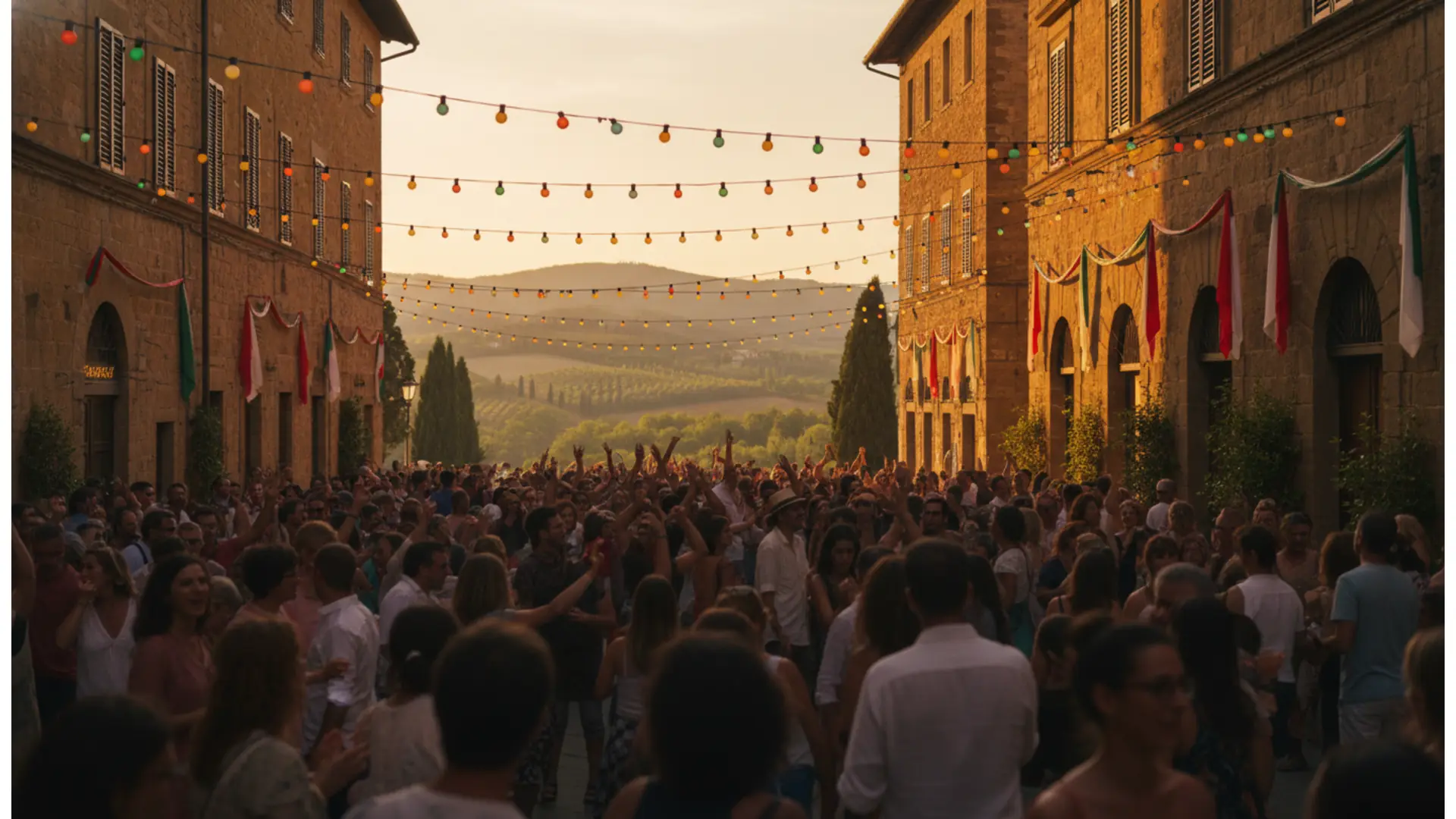
Paghese Carnival
The 'laccio d'amore' and the quadrille in the heart of the Vallo di Lauro
About Paghese Carnival
The Paghese Carnival, living memory of the Vallo di Lauro
In Pago del Vallo di Lauro, a small town in the province of Avellino overlooking the Vallo di Lauro basin, Carnival is not just a brief moment of fun: it is an identity ritual that spans generations. The Paghese Carnival was recognized as Intangible Cultural Heritage of the Campania Region by regional decree on October 7, 2019, and is organized by the Pro Loco Pago del Vallo di Lauro with the patronage of the Municipality. Its strength lies not in monumental floats, but in two folk dances passed down from generation to generation: the laccio d'amore (love ribbon dance) and the quadrille.
The 'laccio d'amore': twelve couples, twenty-four ribbons
The laccio d'amore is the most spectacular dance in the entire Vallo di Lauro and has ancient origins, which scholars trace back to propitiatory rites linked to the fertility of the land and courtship. Twelve couples, symbolizing the twelve months of the year, arrange themselves in a circle around a pole from which twenty-four colored ribbons hang. While dancing, the dancers weave and unweave the ribbons, creating increasingly complex geometric figures: the most famous and anticipated is the diamond. Everything happens under the guidance of a master who calls out the movements, because a single wrong step is enough to ruin the pattern.
The quadrille, an 18th-century French legacy
The quadrille is a figured country dance that arrived in Campania with the French in the 18th century and was later absorbed by the local rural culture, which made it its own. It is danced in opposing pairs, always in even numbers, and the master calls the figures with French-derived commands still preserved today in the local dialect pronunciation: the star, the bridge, the circles. It is a choral dance in which the continuous crossing of the couples tells, with irony, the game of village courtship. Local figures such as Angelo Scafuro contributed to the codification and transmission of these dances as early as the 1940s and 1950s.
Costumes, masks, and the allegorical float
The Paghese Carnival procession is a small open-air museum of Irpinian rural civilization. Each community in the Vallo is recognized by its own attire, so that spectators can distinguish the arriving groups at a glance.
- The men wear knickerbockers, a white shirt, a waistcoat, and a hat.
- The women parade in long skirts, white aprons, and knotted shawls.
- The masked followers accompany the dancers and distribute sprigs of mimosa to the spectators along the route.
- The allegorical float leads the procession of folk groups through the town streets.
Rehearsals begin immediately after the Christmas holidays and involve the entire town: children, teenagers, adults, and the elderly dance together, and it is precisely this intergenerational continuity that has ensured the survival of the tradition.
A traveling carnival among the Vallo municipalities
The Paghese Carnival does not remain confined within municipal boundaries. In the days leading up to Shrove Tuesday, the groups travel to neighboring towns — from Marzano di Nola to Taurano, up to Avellino and other Irpinian centers — in a relay of reciprocal hospitality that unites the entire Vallo di Lauro. The grand finale, however, always remains at home: on the morning of Shrove Tuesday in Pernosano, a hamlet of Pago, and in the afternoon in the center of the municipal capital, when the whole town pours into the streets.
When to go and what to expect
The event falls between February and March, according to the movable Lenten calendar, with the heart of the festival on Carnival Monday and Tuesday. Visitors will find a free and informal street show, made of live music, colors, and square chatter. It is one of the best opportunities to understand the most authentic Irpinia, that of the agricultural villages of inland Campania, where folklore is not a reconstruction for tourists but a still-living practice.
Paghese Carnival — edition 2026
Paghese Carnival 2K26: four days, six stages
Promoted by the Pro Loco Pago del Vallo di Lauro, the 2026 edition of the Paghese Carnival brought energy and colors well beyond the municipal borders, involving various centers in the province of Avellino with outdoor events. Masks, music, entertainment, and traveling shows accompanied the four days, offering opportunities for fun and socialization to an audience of all ages.
The Shrove Tuesday closing
As per the Vallo di Lauro tradition, the most anticipated moment arrived on February 17, Shrove Tuesday: at 11:00 AM the procession enlivened Pernosano, a hamlet of Pago del Vallo di Lauro, before moving at 4:00 PM to the center of the town, where the folk groups performed the laccio d'amore and the quadrille, accompanying the allegorical float along the main streets.
A traveling heritage
The traveling formula confirms the vocation of the Paghese Carnival, recognized as Intangible Cultural Heritage of the Campania Region: not an event closed in a square, but a tradition that sets off on a journey and brings the rural dances of the Vallo di Lauro to the squares of other Irpinian municipalities, up to the capital Avellino.
Programme Paghese Carnival 2026
Saturday, February 14, 2026
- 3:00 PM — Marzano di Nola
Sunday, February 15, 2026
- 9:00 AM — Avellino
- 3:00 PM — Santa Paolina
Monday, February 16, 2026
- 3:00 PM — Taurano
Tuesday, February 17, 2026 (Shrove Tuesday)
- 11:00 AM — Pernosano, hamlet of Pago del Vallo di Lauro
- 4:00 PM — Center of Pago del Vallo di Lauro, grand finale
At each stage: masks, music, entertainment, and traveling shows with the Pro Loco folk groups.
Highlights Paghese Carnival 2026
- The laccio d'amore: twelve couples and twenty-four colored ribbons woven around the pole, up to the diamond figure.
- The quadrille, an 18th-century country dance of French origin, with the star and bridge figures called by the master.
- The allegorical float that leads the procession of folk groups.
- The trip to Avellino on Sunday, February 15, which brought the Vallo di Lauro tradition to the Irpinian capital.
- The grand finale of Shrove Tuesday between Pernosano and the center of Pago del Vallo di Lauro.
Prices Paghese Carnival 2026
Practical information — Paghese Carnival
How to get there
Pago del Vallo di Lauro can be reached by car from the A16 Naples-Canosa motorway (Baiano exit, then SS 7 bis towards Vallo di Lauro) or from the A30 Caserta-Salerno (Nola exit). From Naples, the journey takes about an hour. The nearest train station is Nola, served by the Circumvesuviana, from where you can continue by bus or taxi.
Tickets and access
Parades and dances take place in the streets and town squares: participation is free and there is no ticketing. During the event days, the center undergoes temporary traffic closures: it is advisable to leave the car in parking areas on the outskirts of the town and continue on foot.
Tips
Arrive an hour before the indicated time for the 'laccio d'amore': the diamond figure is the most photographed moment and the square fills up quickly. Dress in layers, because in February the evenings in the Vallo di Lauro are cold. For updated information on times and stages, it is advisable to contact the Pro Loco Pago del Vallo di Lauro.
Where to stay
Local accommodation is essentially spread among bed and breakfasts and farmhouses in the Vallo di Lauro and Baianese areas; alternatively, you can stay in Nola or Avellino, both a short drive away.
Festival-goer photos
No photos yet. Share yours!
Share your photos
5 photos max, 5 MB per photo (JPG, PNG, WebP)
Noticed an error or missing information?
Help us keep this listing up to date. Every proposal is verified by our team before publication.
Festival-goer reviews
No rating yet — be the first!
No comments yet. Be the first!
Were you there?
Share your experience with the community.
Published by Valentin Contard, festival listings writer. Reviewed, corrected and approved by Christophe Contard, editor-in-chief. .
Where does it take place — Paghese Carnival
Centro storico di Pago del Vallo di Lauro e frazione Pernosano
Via Roma 29, 83020 Pago del Vallo di Lauro