Byzantine New Year
The re-enactment of the Byzantine New Year between Amalfi and Atrani
About Byzantine New Year
The New Year celebrated on September 1st
In Amalfi, in the Province of Salerno, there is a New Year that does not begin in winter: it starts on September 1st. This is the date that, in the Byzantine world, marked the start of the fiscal and legal year, the moment when the indiction—the fifteen-year cycle used by notaries and officials to date public and private documents—began. Amalfi, a peripheral and autonomous territory of the Eastern Empire before establishing itself as an independent Duchy, has preserved the memory of that temporal cycle: the Byzantine New Year restores it to the city every year in the form of a grand historical re-enactment.
A festival born from research, since 1999
The event took shape in 1999 from an idea by medievalist Giuseppe Gargano and has since grown to become one of the defining identity events of the Amalfi Coast. It is organized by the Municipality of Amalfi together with the Municipality of Atrani and is listed in the national catalog of historical re-enactments curated by the Central Institute for Intangible Heritage of the Ministry of Culture. It is therefore not a festival manufactured for visitors: it is a civic ritual that the city has chosen for itself, with a solid historiographical foundation and a scholarly conference that renews its contents every year.
The historical pageant from Amalfi to Atrani
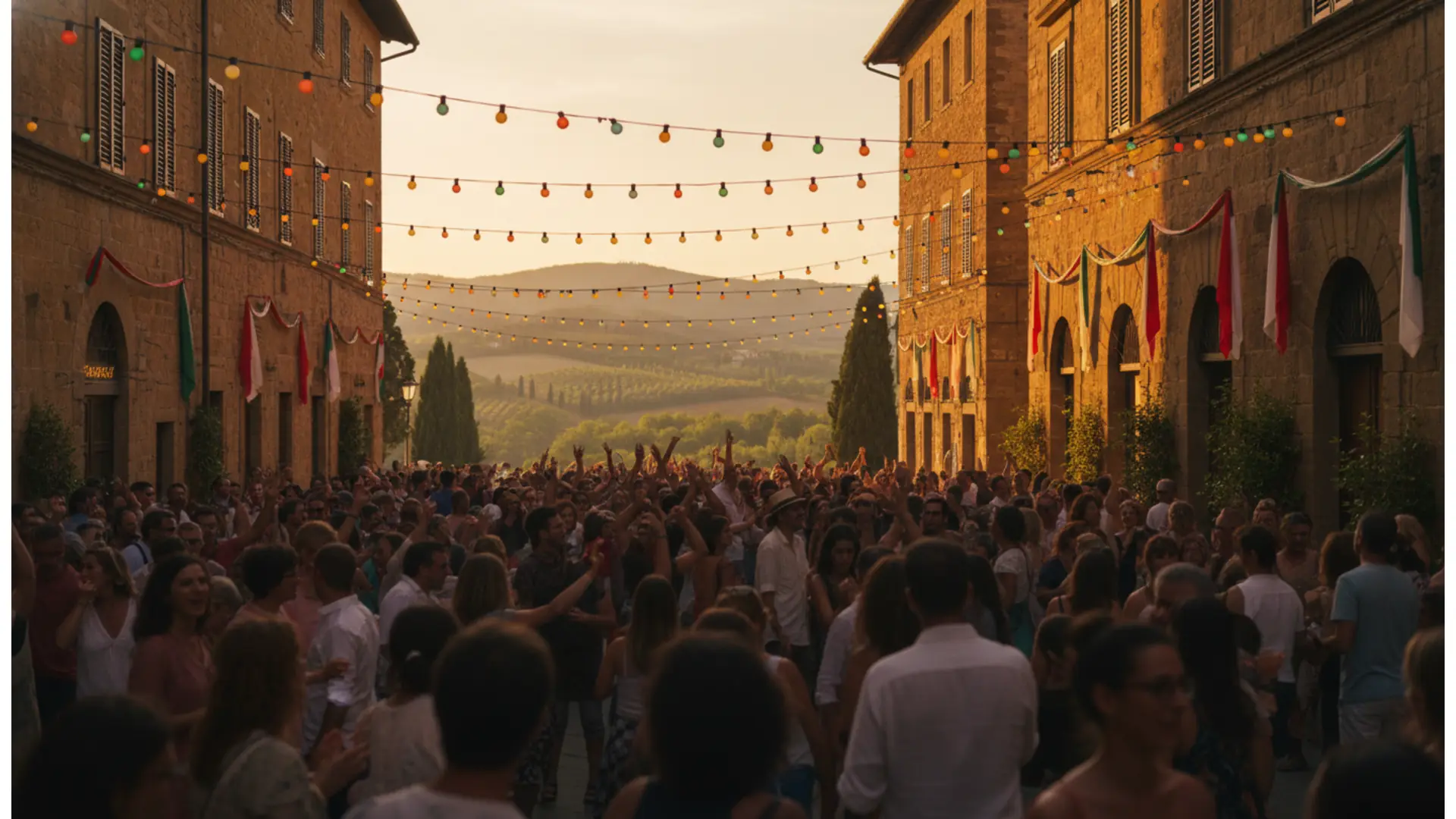
The heart of the festival is the procession on September 1st. In the late afternoon, the Sbandieratori e Musici Città Regia (Flag-wavers and Musicians) depart from the Valle dei Mulini to announce the parade; shortly after, in Piazza Duomo, the historical pageant takes shape with over a hundred participants in medieval costumes: representatives of the ducal government, nobles, knights, ladies, pages, valets, archers, sailors, commoners, and flower girls. The group crosses the historic center of Amalfi and walks to nearby Atrani, along the short stretch of coast that connects the two villages. It is one of the most photographed moments of the Amalfitan summer: alleys, arches, stairways, and the sea as the natural backdrop of the scene.
The investiture of the Magister of Amalfitan Civilization
The halfway point of the procession is the chapel of San Salvatore de' Birecto in Atrani, the ancient ducal chapel where the doges of Amalfi were crowned. The name derives from the birecto, the ducal cap that was the symbol of power. Here, in the presence of the Archbishop of Amalfi-Cava de' Tirreni, the new Magister of Amalfitan Civilization is invested: a title conferred upon an Amalfitan personality, by birth or adoption, who has distinguished themselves in one of the fields characteristic of medieval Amalfitan civilization, from entrepreneurship to religion, politics to science, law to art, seafaring to solidarity and diplomacy. The Magister is then presented to the citizens on the steps of the Cathedral of Sant'Andrea. In 2025, the recognition went to historian Giuseppe Gargano, and in 2024 to entrepreneur Franco Nuschese.
Conferences, music, and entertainment
The Byzantine New Year is not just a procession. The first day, August 31st, is dedicated to the conference on medieval Amalfi and the public interview with the new Magister, held between the Arsenale of the Maritime Republic and Largo Duca Piccolomini. The evenings bring fire shows to the square, performances by the Pistonieri di Santa Maria del Rovo with their traditional muskets, medieval events for families with falconry demonstrations, and a grand free closing concert: in recent years, artists like Arisa, Mario Biondi, and, in 2026, Tosca have performed in Amalfi.
Amalfi, Atrani, and the landscape of Campania
The re-enactment takes place within a UNESCO World Heritage site: the Amalfi Coast, in Campania, with its two villages overlooking the Tyrrhenian Sea. Amalfi, capital of one of the Maritime Republics, preserves the Cathedral of Sant'Andrea with the Cloister of Paradise, the medieval Arsenale, and the tradition of handmade paper; Atrani, with just over a thousand inhabitants, is one of the most intact villages on the coast. Seeing them crossed by a costumed procession helps one understand, better than any museum, what it meant to be a maritime duchy in the Mediterranean of the year 1000.
How to make the most of it
- Arrive early: Piazza Duomo and the cathedral steps are the best spots for the procession, but they fill up well in advance.
- Comfortable shoes: following the procession to Atrani involves walking, with inclines and stairways.
- Everything is free: the conference, procession, investiture, and concerts are free to attend.
- Stay for the evening: the presentation of the Magister and the evening shows are the most spectacular part of the festival.
Byzantine New Year — edition 2026
Confirmed dates, program coming soon
The 2026 Byzantine New Year takes place in Amalfi and Atrani, in the Province of Salerno, with celebrations concentrated on August 31 and September 1, and the final evening on September 2. The dates were announced by the Municipality of Amalfi along with the summer schedule of the Amalfi Summer Fest, which this year covers the entire period from July 13 to September 11.
What we already know
The structure of the event remains the established one: on August 31, the study conference on medieval Amalfi and the public interview with the new Magister; on September 1, the historical pageant with over a hundred participants from Amalfi to the chapel of San Salvatore de' Birecto in Atrani, where the investiture of the Magister of Amalfitan Civilization takes place in the presence of the Archbishop, followed by the presentation to the citizens on the steps of the Cathedral of Sant'Andrea.
The closing concert
On September 2, 2026, to close the celebrations, Tosca is expected on the stage of the Teatro di Piazza Municipio with the project Le Feminæ, an intimate show dedicated to the strength and determination of women. Like all events of the Amalfi Summer Fest, promoted by the Municipality of Amalfi, admission is free.
Detailed program
The exact times for August 31 and September 1, the theme of the conference, and the name of the 2026 Magister are usually announced by the Municipality of Amalfi in the weeks immediately preceding the event: they are not yet available.
Programme Byzantine New Year 2026
Highlights Byzantine New Year 2026
Prices Byzantine New Year 2026
Practical information — Byzantine New Year
How to get there
By train to Salerno or Vietri sul Mare, then take the SITA Sud bus along the SS163 Amalfitana road to Amalfi. From Naples, you can arrive via Salerno or Sorrento, again using the Coast buses. In summer, maritime connections are active from Salerno, Positano, Sorrento, and Capri, docking at the Amalfi pier: on festival days, this is the most comfortable and fastest solution.
By car
Take the A3 exit at Vietri sul Mare, then the SS163. The road is narrow and scenic, and traffic is heavy during the event: paid parking in Amalfi is limited and in high demand, so it is better to use public transport or park away from the center. Atrani can be reached from Amalfi on foot in about fifteen minutes.
Admission and hours
All Byzantine New Year events are free of charge, including the study conference and the closing concert. The historical pageant takes place in the late afternoon of September 1st and ends in the evening; celebrations open on August 31st and close on September 2nd.
Contacts
Cultural Services of the Municipality of Amalfi, tel. +39 089 8736222, e-mail [email protected]. The updated program is published on the Municipality of Amalfi website in the weeks leading up to the event.
Tips
Late August on the Coast is high season: it is advisable to book accommodation months in advance, in Amalfi, Atrani, or nearby towns like Ravello and Minori. Bring a light jacket for the evening and a water bottle: temperatures remain high and the routes involve uphill walking.
Festival-goer photos
No photos yet. Share yours!
Share your photos
5 photos max, 5 MB per photo (JPG, PNG, WebP)
Noticed an error or missing information?
Help us keep this listing up to date. Every proposal is verified by our team before publication.
Festival-goer reviews
No rating yet — be the first!
No comments yet. Be the first!
Were you there?
Share your experience with the community.
Published by Valentin Contard, festival listings writer. Reviewed, corrected and approved by Christophe Contard, editor-in-chief. .
Where does it take place — Byzantine New Year
Piazza Duomo e centro storico di Amalfi
Piazza Duomo, 84011 Amalfi