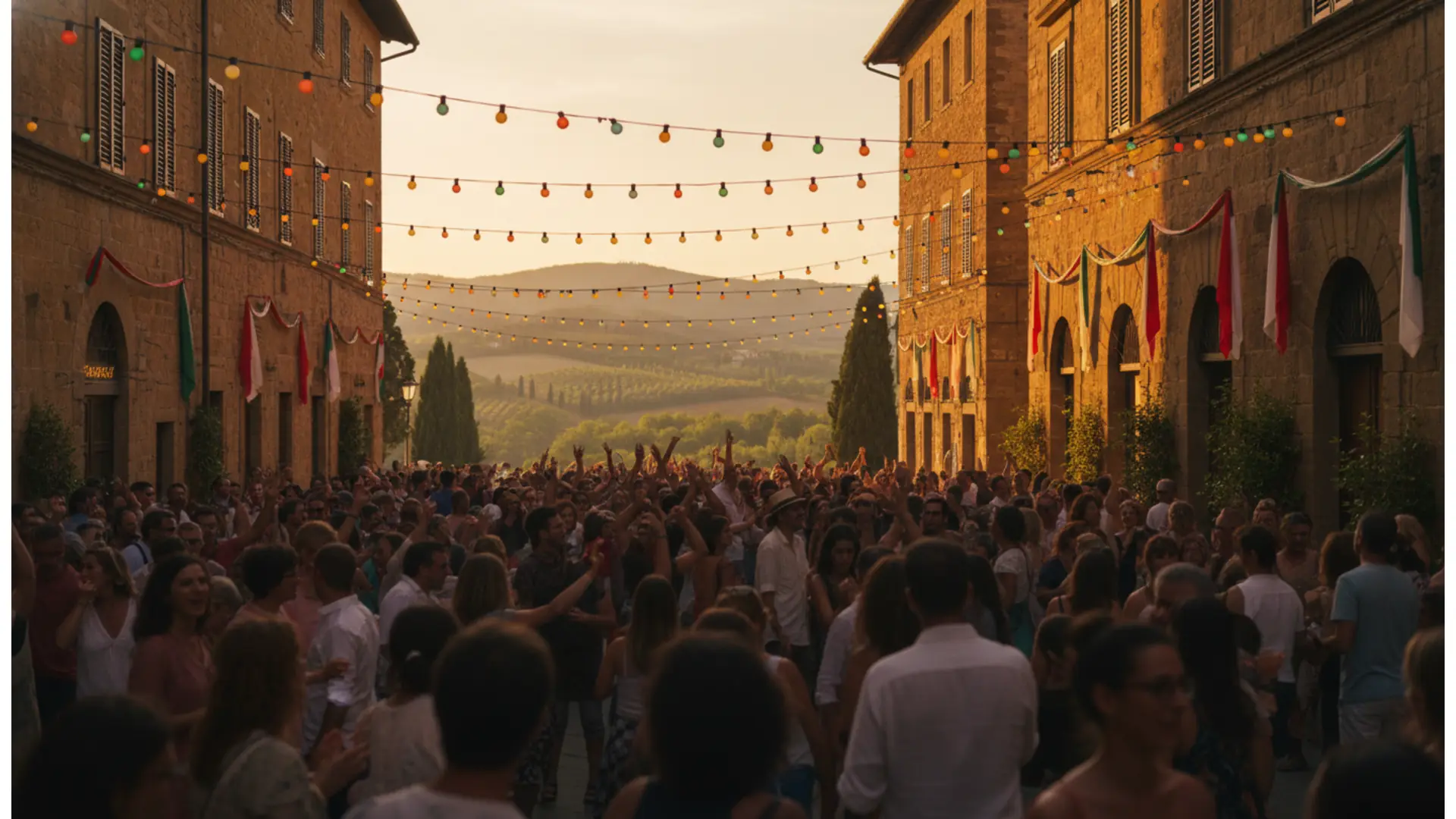
Sanleuciano Carnival
The fire-lit masquerades of San Leucio del Sannio, in the hills of Benevento
About Sanleuciano Carnival
A carnival that speaks the language of fire
In the Sannio area near Benevento, just a few kilometers from the provincial capital, the Sanleuciano Carnival is much more than a costume parade: it is a form of popular street theater that the community of San Leucio del Sannio (Province of Benevento, Campania) has passed down from generation to generation. The mascherate sanleuciane (Sanleuciano masquerades) are not meant to be watched from afar; they are meant to be experienced, following the groups as they move through the narrow streets, accompanied by drums, ritual shouts, and sudden flashes of light.
What makes this carnival instantly recognizable is its use of fire. Organizers refer to them as mascherate col fuoco (fire-lit masquerades): a deliberately excessive use of pyrotechnics and rudimentary stage effects to recreate flames, smoke, and infernal atmospheres. This is not merely a spectacular backdrop, but the very language of the performance, as the masquerades depict the struggle between good and evil, heaven and hell.
A tradition with ancient roots
The Sanleuciano masquerade is described as street theater with roots reaching back to the Middle Ages, in a territory that for centuries served as a borderland between the Kingdom of Naples and the Papal States. The first documented evidence dates back to the early 20th century, while its strongest growth occurred in the post-war period, when the masquerades multiplied and became structured, eventually defining the village's cultural identity.
The structure of the procession is codified: Pulcinella opens the path and leads the group, while the Abisso dell'Inferno (Abyss of Hell) moves at the rear—the most impressive and highly anticipated scene. In between, the performance recounts the overturning of the world, the chaos, and the suspension of rules that belong to the carnival season.
Groups and repertoire
The Sanleuciano Carnival is not the work of a single committee but a network of groups, some historic, each guarding their own masquerades. Recurring titles in the repertoire include:
- 'U Faust — the fire-lit masquerade performed by the Bamboccioni, a symbolic journey between light and darkness;
- 'A Zingarella — the grand fire-lit masquerade of the closing evening;
- 'A Zeza — the traditional mask of the Campania region, widespread throughout the area;
- 12 Mesi (12 Months) and Arrotino (Knife Grinder) — daytime masquerades performed by the youth of Casale Maccabei, one of the many districts of the municipality.
Over time, workshops aimed at younger generations have been added alongside the performances, such as the La Scintilla (The Spark) program, designed to pass on techniques, gestures, and the memory of the masquerades. The association is also working on a project for a Museum of Popular Traditions, supported by a fundraising campaign.
Rites, wine, and conviviality
The Sanleuciano Carnival also preserves its own rituals: the Chiamata d'i Fiaschi (Calling of the Flasks), a wine blessing ceremony at the Statue of Core Contento, opens the main day and recalls the festival's peasant roots. This is followed by a community lunch in the square—a moment of community as important as the masquerades themselves—and throughout the day, food and wine stalls remain open, offering local products accompanied by cooking workshops dedicated to typical Sannio dishes.
A traveling carnival
The distinctiveness of the Sanleuciano masquerades has taken the group beyond regional borders. In February 2026, the Sanleuciano Carnival was the only carnival from Campania invited to the 9th edition of Il Diavolo di Tufara – Maschere e Tradizioni in Molise. It has also participated in the Stati Generali della Zeza in Eboli, a meeting dedicated to the carnival and ritual traditions of the Campania and Southern Italian regions.
San Leucio del Sannio, the village of twenty-one districts
San Leucio del Sannio has just under three thousand inhabitants and is located at an altitude of about 369 meters, some ten kilometers from Benevento. The municipality is made up of about twenty districts scattered across the hills—Cavuoti, Casale Maccabei, Zolli, Vigne, Santa Maria, and many others—and this dispersed geography explains why the carnival is itinerant by nature: each district has its own groups, its own masquerades, and its own audience, and the calendar is built by moving from one to another before converging in Piazza Municipio.
Visitors arriving for the carnival find a double opportunity: to witness one of the most intense expressions of Campanian folklore and to discover a corner of the Sannio region rarely touched by tourism, featuring vineyards, olive groves, and the nearby city of Benevento with its Arch of Trajan and Roman Theater.
Sanleuciano Carnival — edition 2026
Sanleuciano Carnival 2026: a Sunday of fire in Piazza Municipio
The 2026 calendar for the Sanleuciano Carnival was built over two days, Saturday, February 14, and Sunday, February 15, but adverse weather conditions required a reorganization: the fire-lit masquerade «'A Zingarella», the heart of Saturday evening, was postponed to Sunday, February 15, at 7:30 PM in Piazza Municipio, San Leucio del Sannio.
Sunday thus became the highlight of the edition. It opened in the morning with «'A Chiamata d'i Fiaschi», the wine blessing ritual at the Statue of Core Contento, followed by the community lunch, entertainment for children and families, and the second part of the «La Scintilla» workshop, dedicated to passing on the tradition to younger generations.
In the afternoon, the daytime masquerades of the youth of Casale Maccabei took the stage — «12 Mesi», «Arrotino», and «Zeza» — while at 6:00 PM it was the turn of «'U Faust», performed by I Bamboccioni Zichi. The closing, at 7:30 PM, was entrusted to the grand fire-lit masquerade. Food and wine stalls and social spaces remained active throughout the day.
The carnival beyond the village
The 2026 edition was not limited to the February weekend. On January 24, in Contrada Cavuoti, the fire-lit masquerade «'U Faust» opened the celebrations with the groups I Bamboccioni, Mascherate Sanleuciane, and the Lanciatori di Fuoco Greco. On January 25, the carnival was in Eboli for the «Stati Generali della Zeza», and on February 7 in Tufara, Molise, as the only Campanian carnival invited to the 9th edition of «Il Diavolo di Tufara – Maschere e Tradizioni».
Programme Sanleuciano Carnival 2026
Saturday, February 14, 2026
- Evening dedicated to the fire-lit masquerade «'A Zingarella» — postponed to Sunday, February 15 due to adverse weather conditions.
Sunday, February 15, 2026 — San Leucio del Sannio, Piazza Municipio and village alleys
- Morning — «'A Chiamata d'i Fiaschi»: the wine blessing ritual at the Statue of Core Contento
- Community lunch
- Entertainment for children and families
- Second part of the «La Scintilla» workshop
- Daytime masquerades by the youth of Casale Maccabei: «12 Mesi», «Arrotino», «Zeza»
- 6:00 PM — «'U Faust», performed by I Bamboccioni Zichi
- 7:30 PM — «'A Zingarella», fire-lit masquerade, in Piazza Municipio
- Throughout the day: food and wine stalls and social spaces
Events preceding the weekend
- Saturday, January 24, 2026, from 6:30 PM (at sunset) — Contrada Cavuoti: fire-lit masquerade «'U Faust» with the groups I Bamboccioni, Mascherate Sanleuciane, and Lanciatori di Fuoco Greco
- Sunday, January 25, 2026 — Eboli: participation in the «Stati Generali della Zeza», a meeting on Campanian and Southern Italian carnival traditions
- Saturday, February 7, 2026 — Tufara (CB): Sanleuciano Carnival as a guest at the 9th edition of «Il Diavolo di Tufara – Maschere e Tradizioni», the only Campanian carnival invited
Highlights Sanleuciano Carnival 2026
- «'A Zingarella», the fire-lit masquerade in Piazza Municipio, Sunday, February 15 at 7:30 PM
- «'U Faust» by the Bamboccioni Zichi, at 6:00 PM
- The «Chiamata d'i Fiaschi» ritual and the wine blessing at the Statue of Core Contento
- Daytime masquerades by the youth of Casale Maccabei: «12 Mesi», «Arrotino», «Zeza»
- The «La Scintilla» workshop for younger generations
- The community lunch and food stalls in the square
Prices Sanleuciano Carnival 2026
Practical information — Sanleuciano Carnival
Getting there
By car — San Leucio del Sannio can be reached from Benevento in about ten minutes (approx. 9 km) via provincial roads; from Naples, take the A16 motorway to the Benevento exit. The town center is small, and roads are closed to traffic during the masquerade evenings: it is best to leave your car on the outskirts of the village and proceed on foot.
By train and bus — The reference station is Benevento Centrale, connected to Naples, Caserta, and Foggia; from there, continue via local bus connections to the hillside towns or by taxi.
Admission and costs
The masquerades take place in the streets and in Piazza Municipio: in the 2025 edition, admission to the events was free of charge. For the community lunch, workshops, and food stalls, it is best to inquire directly with the organizing association.
Tips
- The fire-lit masquerades take place at sunset and in the evening, when temperatures drop significantly in the hills: wear warm clothing and comfortable shoes for the sloping streets.
- The program may change due to bad weather—in 2026, the Saturday masquerade was postponed to Sunday: check for updates on official channels before departing.
- Maintain the safety distance indicated by the organizers during the fire scenes and follow the staff's instructions.
- For overnight stays, the most convenient base is Benevento, with the city's accommodation options just a few minutes' drive away.
Contacts
Official website: carnevalesanleuciano.it — e-mail: [email protected]
Festival-goer photos
No photos yet. Share yours!
Share your photos
5 photos max, 5 MB per photo (JPG, PNG, WebP)
Noticed an error or missing information?
Help us keep this listing up to date. Every proposal is verified by our team before publication.
Festival-goer reviews
No rating yet — be the first!
No comments yet. Be the first!
Were you there?
Share your experience with the community.
Published by Valentin Contard, festival listings writer. Reviewed, corrected and approved by Christophe Contard, editor-in-chief. .
Where does it take place — Sanleuciano Carnival
Piazza Municipio e vicoli del centro