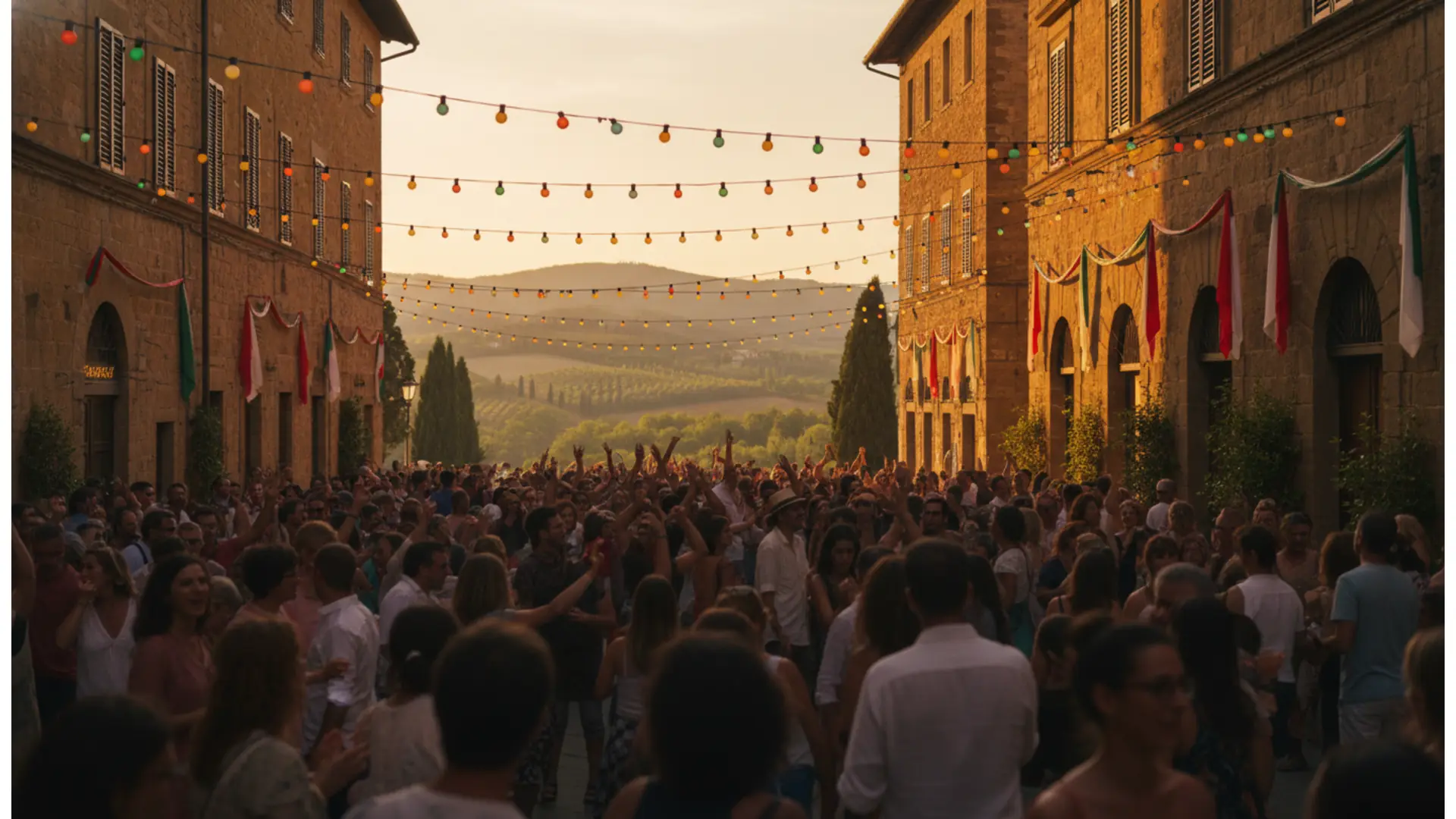
Roccapiemonte Music Festival
Three days of dialects, folk choirs, and live music at Palazzo Marciani
About Music Festival
A festival that starts with words and ends in song
The Roccapiemonte Music Festival is not just a simple concert lineup. It is a three-day journey that begins with a reflection on the language of our ancestors and ends with the audience on their feet in front of a band. In between, there are folk choirs: the musical form that, more than any other, binds words and community together. This structure, from the conference to live music, is the hallmark of an event that has chosen to tell the story of the territory rather than just entertaining it.
Palazzo Marciani, the setting
Everything takes place at Palazzo Marciani, in the Casali hamlet of Roccapiemonte. The historic building, owned by the municipality, has undergone renovation in recent years and is now one of the town's key cultural spaces: it hosts book presentations, meetings, tastings of local products, and concerts. The courtyard and the halls of the palace offer an intimate scale, very different from that of large summer squares: the audience is close to the performers, and choral music, in particular, benefits greatly from this.
The conference on dialects
The opening evening is dedicated to the history of dialects, with speakers and moderation provided by local scholars and cultural workers. This is not an overly academic side event: in the South, where people sing, dialect is the raw material of folk song, and understanding how it was formed helps one better appreciate what happens in the two following evenings. The meeting also includes the presentation of a poem in the vernacular, highlighting the thread that connects writing, orality, and music.
Folk choirs and songs
The second appointment is the identity-defining heart of the festival: two choral groups take turns performing repertoires of folk songs. The choice to have a choir from Campania engage with one from another Italian region is deliberate and produces the most interesting effect of the event: hearing how the same idea of communal singing changes voice, rhythm, and language depending on where it was born. It is the typical exchange of the Italian choral movement, which in June finds itself everywhere under the banner of the Music Festival.
The live finale
The final day changes register and shifts to light live music, with a band that brings a repertoire designed for a wider audience to Palazzo Marciani. It is the most festive moment, one that restores the character of a village feast to the event and closes the three days with the sign of the beginning of summer.
Who organizes it
The initiative is promoted by the Fedora Association, a cultural organization in Roccapiemonte active mainly on the literary front, in collaboration with the Pro Loco Roccapiemonte and the Mente Cuore Forza i 3 Castelli Association, and with the patronage of UISP – Sport for All. The opening evening features institutional greetings from the municipal administration: a structure that confirms how much the festival is the result of a local associative network rather than an external production.
Roccapiemonte and the Agro Nocerino Sarnese
The Municipality of Roccapiemonte is located in the province of Salerno, in Campania, at the foot of the mountain topped by the castle that gives the town its name, in that Agro Nocerino Sarnese which is both one of the most fertile agricultural areas in Italy and a very dense urban fabric. It is an area with a strong dialectal identity and deep-rooted musical traditions, from marching bands to tammurriate: the festival gathers this very legacy and gives it a contemporary form.
Who it is recommended for
- Those who love choral singing and want to hear folk repertoires performed by trained groups;
- Those interested in language, dialect, and poetry in the vernacular;
- Those looking for a village-scale cultural event, far from the crowds of large summer festivals;
- Those visiting the Agro Nocerino Sarnese who want to combine an evening of music with the discovery of a restored historic palace.
Music Festival — edition 2026
The 2026 edition of the Roccapiemonte Music Festival took place from June 19 to 21 at Palazzo Marciani, in the Casali hamlet, with a three-part format that featured words, choral singing, and live music.
The opening, on Friday, June 19 at 6:30 PM, was entrusted to the "History of Dialects" conference, with institutional greetings from Mayor Carmine Pagano and Pro Loco President Agostino Torino, moderated by Rosita Gargano, with contributions from Tito Di Domenico, Marco Rey, and Sebastiano Roscigno. During the meeting, the poem "'Na Poesia" by Gaetano Salvati was presented, with a focus dedicated to folk singing and choral singing.
Saturday, June 20 at 8:30 PM, the "Folk Choirs and Songs" evening took place: on stage were the Coro Matricanto of Materdomini di Nocera Superiore, directed by Maestro Andrea Donadio with percussion by Maestro Alessandro Ferrentino, and the Coro Policromae of Giaglione, in the province of Turin, directed by Maestro Giorgio Troisi with Michele Troisi on piano. A meeting between the choral traditions of Campania and the Alps that was the most identity-defining moment of the edition.
The closing, on Sunday, June 21, featured the live performance of "Tabasco – Pepper Music", a band composed of Alessandra Racioppi on vocals, Enzo De Angelis on piano and keyboards, Dino Truppa on guitar, Paolo Pisano on drums, and Enrico Lampo on bass.
The initiative was promoted by the Fedora Association in collaboration with the Pro Loco Roccapiemonte and the Mente Cuore Forza i 3 Castelli Association, with the patronage of UISP – Sport for All, in the Municipality of Roccapiemonte, in the province of Salerno.
Programme Music Festival 2026
Friday, June 19 — 6:30 PM
"History of Dialects" conference.
- Institutional greetings: Mayor Carmine Pagano and Pro Loco President Agostino Torino;
- Moderation: Rosita Gargano;
- Speakers: Tito Di Domenico, Marco Rey, Sebastiano Roscigno;
- Presentation of the poem "'Na Poesia" by Gaetano Salvati;
- Focus on folk singing and choral singing.
Saturday, June 20 — 8:30 PM
"Folk Choirs and Songs".
- Coro Matricanto of Materdomini (Nocera Superiore) — Director Maestro Andrea Donadio, percussion Maestro Alessandro Ferrentino;
- Coro Policromae of Giaglione (Turin) — Director Maestro Giorgio Troisi, piano Michele Troisi.
Sunday, June 21
Live performance "Tabasco – Pepper Music": Alessandra Racioppi (vocals), Enzo De Angelis (piano and keyboards), Dino Truppa (guitar), Paolo Pisano (drums), Enrico Lampo (bass).
All events were held at Palazzo Marciani, Casali hamlet of Roccapiemonte.
Highlights Music Festival 2026
- The "History of Dialects" conference, with the presentation of the poem in the vernacular "'Na Poesia" by Gaetano Salvati.
- The meeting between the Coro Matricanto of Materdomini and the Coro Policromae of Giaglione: Campanian and Alpine folk singing on the same stage.
- The final live performance of "Tabasco – Pepper Music", with Alessandra Racioppi on vocals.
- Palazzo Marciani, a renovated municipal historic residence, as the sole venue for the three days.
- A purely local network: Fedora Association, Pro Loco Roccapiemonte, and Mente Cuore Forza i 3 Castelli Association, with UISP patronage.
Prices Music Festival 2026
Practical information — Music Festival
How to get there
By car: Roccapiemonte is served by the A30 Caserta-Salerno motorway (Castel San Giorgio exit) and the Salerno-Avellino junction; from Salerno, it is just over twenty kilometers. Palazzo Marciani is located in the Casali hamlet, just outside the center: it is best to reach it using a GPS and park in the surrounding streets.
By train: the reference stations are Nocera Inferiore and Cava de' Tirreni, on the Naples-Salerno line, both a few kilometers away; from there, continue with local bus connections or by taxi. The town is also close to the stops of the Circumvesuviana line and the buses of the Agro area.
By plane: the most convenient airports are Salerno-Costa d'Amalfi and Naples Capodichino.
Admission
The events are held in a municipal public space and are designed for community participation. The available sources do not indicate a ticket: for confirmation of access methods and any seating, it is best to contact the organizers directly.
Contacts
- Associazione Fedora, Via Pasquale Grimaldi 4, Roccapiemonte (SA) — [email protected]
- Pro Loco Roccapiemonte (official Facebook page)
Tips
- The opening conference begins in the late afternoon, while the musical evenings start in the evening: those arriving from out of town can easily combine dinner and the concert.
- The evenings are held at the beginning of summer, but in the hilly area, the temperature drops after sunset: it is better to bring something light to wear.
- Nearby, you can visit the castle of Roccapiemonte, the historic center of Nocera Superiore with the early Christian baptistery of Santa Maria Maggiore, and, a short distance away, Cava de' Tirreni with its Benedictine abbey.
Festival-goer photos
No photos yet. Share yours!
Share your photos
5 photos max, 5 MB per photo (JPG, PNG, WebP)
Noticed an error or missing information?
Help us keep this listing up to date. Every proposal is verified by our team before publication.
Festival-goer reviews
No rating yet — be the first!
No comments yet. Be the first!
Were you there?
Share your experience with the community.
Published by Valentin Contard, festival listings writer. Reviewed, corrected and approved by Christophe Contard, editor-in-chief. .
Where does it take place — Music Festival
Palazzo Marciani (frazione Casali)