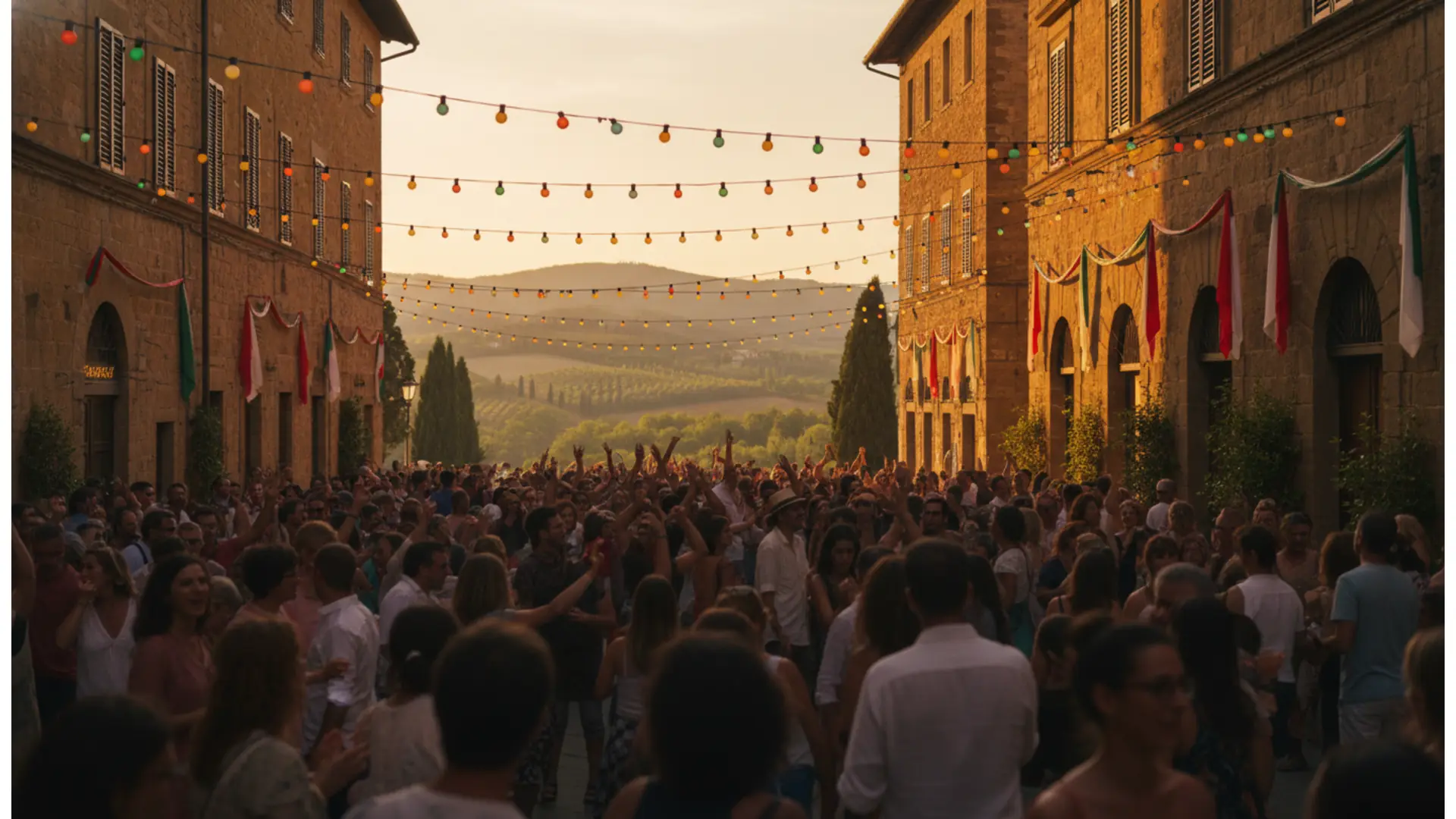
Feast of Saint John the Baptist (Procession of the Cente)
Votive boats and the Flight of the Angel in the village of Eredita, in the heart of Cilento
About Feast of Saint John the Baptist - The Cente
A patronal feast in the heart of Cilento
Every year, on June 24th, the small hamlet of Eredita, in the municipality of Ogliastro Cilento (Salerno province, Campania), celebrates its patron saint, Saint John the Baptist, with a festival that weaves together liturgy, collective memory, and devotional craftsmanship. Nestled among the olive groves of the Cilento hills, just a few kilometers from the sea, the village fills with families returning from afar for the occasion: it is the time of year when the entire community reconnects and shares its stories.
The Cente, votive boats offered to the saint
The feature that makes this festival unique is the Cente, considered one of the oldest expressions of Cilento's folk religion. These are votive structures with a characteristic boat shape, richly decorated and offered to the patron saint as ex-votos in a sign of devotion, gratitude, or to seek protection. On the day of the feast, the Cente are carried in procession alongside the statue of Saint John the Baptist, creating a ritual that unites spirituality, tradition, and collective identity.
Their creation is primarily entrusted to the women of the village, guardians of knowledge passed down from generation to generation: among them are Luigia Esposito, Luisa Marzocchi, Giovanna Abbruzzese, and Giovanna Ricci, who have been working for years to keep this artisanal practice alive. According to local tradition, the origin of the Cente dates back to the presence of Basilian monks who settled in Cilento around the year 1000, whose Eastern spirituality intertwined with the local farming customs: an intangible cultural heritage now recognized as part of the Cilento identity.
The Flight of the Angel
The most anticipated moment of the day is the Flight of the Angel, a sacred representation of ancient tradition. A local child, dressed as an angel with a white robe and wings, descends while suspended in the air on a rope for about thirty meters toward the church. During the descent, he makes nine stops, and at each one, he sings a quatrain dedicated to the life of the saint and his role as the precursor of Christ; at the end, he places a small bouquet of flowers at the feet of the statue. The faithful watch in deep, respectful silence, broken only by the applause that greets the end of each stanza. The ritual is repeated on August 29th, the feast of the Martyrdom of Saint John the Baptist.
How the festival unfolds
- Eve: Moments of prayer and, according to the village tradition, the procession of the saint's relic.
- Morning of June 24th: Solemn holy mass, followed by the procession along the main streets of the hamlet.
- The Cente: The votive boats accompany the patron saint's statue, carried by the families who commissioned or created them.
- Flight of the Angel: The sacred representation concludes the morning procession.
- Evening festivities: Live music and entertainment in the square, with events that vary from year to year.
History and legend of the village
Eredita is said to have been founded between the 10th and 11th centuries, when Saracen raids along the coast pushed the populations to seek refuge in the hilly hinterland; tradition holds that the Bishop of Paestum fled carrying the Tabernacle with him, giving rise to the settlement. A deeply rooted legend tells of a Saracen raid and the encounter between the leader of the raiders and a shepherd, identified as Saint John the Baptist: in a sign of respect and gratitude, the commander supposedly placed his golden belt on the saint's statue. The versions handed down vary in detail, but all confirm how deeply the figure of the Baptist is intertwined with the village's identity.
The village, the museum, and the territory
In Eredita, the memory of the festival is also preserved by the Kòmai Diffused Museum, which promotes the historical, artistic, and anthropological heritage of the area by offering a contemporary reading of ancient traditions. Around the village lies a part of Cilento less traveled by beach tourism: olive groves, rural churches, small historic centers, and a gastronomy of extra virgin olive oil, white figs, and homemade pasta. The festival is the best opportunity to discover this more intimate dimension of the province of Salerno.
Why it is worth attending
This is not an event staged for the public: the participation of the residents remains the true driving force. Visitors from outside will find a welcoming community and a rare, deeply identity-driven ritual that restores the profound sense of inland Cilento.
Feast of Saint John the Baptist - The Cente — edition 2026
Eredita 2026: The Cente return to parade
In 2026, the community of Eredita, a hamlet of Ogliastro Cilento (Salerno), gathered once again around its patron saint, Saint John the Baptist. The Cente, richly decorated boat-shaped votive structures, paraded in procession alongside the saint's statue in a ritual that unites spirituality, tradition, and collective identity.
The chronicle of the edition highlighted the guardians of the tradition — Luigia Esposito, Luisa Marzocchi, Giovanna Abbruzzese, and Giovanna Ricci — who are committed to passing down an artisanal practice that local tradition traces back to the Basilian monks who settled in Cilento around the year 1000. Alongside the liturgical moment, the festival confirmed itself as an important occasion for social gathering, capable of attracting emigrated families and visitors interested in Cilento traditions, with the contribution of the Kòmai Diffused Museum in promoting this intangible heritage.
Programme Feast of Saint John the Baptist - The Cente 2026
Traditional structure of the festival
The exact times for the 2026 edition were not released online; the program followed the schedule passed down for generations.
- Eve (June 23rd): Moments of prayer and procession of the saint's relic, according to the village custom.
- June 24th, morning: Solemn holy mass in honor of Saint John the Baptist.
- Following: Solemn procession along the main streets of Eredita, with the Cente carried alongside the patron saint's statue.
- At the end of the procession: Flight of the Angel — a local child, dressed as an angel, descends while suspended on a rope, making nine stops and singing a quatrain about the saint's life at each one, before placing flowers at the feet of the statue.
- Evenings: Moments of celebration and music in the square organized by the community.
Highlights Feast of Saint John the Baptist - The Cente 2026
- The Cente: Hand-decorated votive boats, carried in procession as ex-votos to the patron saint.
- The Flight of the Angel, with its nine stops and quatrains sung by the child suspended in the air.
- The solemn mass and the procession along the streets of the village of Eredita.
- The return of emigrated families: the festival as the main moment of community reunion.
- The link with the Kòmai Diffused Museum and the historical memory of inland Cilento.
Prices Feast of Saint John the Baptist - The Cente 2026
Practical information — Feast of Saint John the Baptist - The Cente
Where it takes place
The celebrations are held in the hamlet of Eredita, in the municipality of Ogliastro Cilento (Postal Code 84061), province of Salerno. The procession and the Flight of the Angel take place around the church and along the village streets.
How to get there
- By car: From the A2 del Mediterraneo motorway, continue towards the SS18 Tirrena Inferiore in the direction of Agropoli-Ogliastro Cilento; the hamlet is then reached via local roads.
- By train: The most convenient station is Agropoli-Castellabate, a few kilometers away, with a connection by car or taxi.
- By plane: Salerno-Costa d'Amalfi Airport, or Naples-Capodichino.
Useful tips
- The village is small: it is advisable to arrive early and park at the entrance of the hamlet, then move on foot.
- For the Flight of the Angel, very compact crowds form: you watch standing up, so comfortable shoes are recommended.
- As this is a religious ritual, discreet and respectful behavior is required during the procession.
- Exact times for individual events are released locally a few days beforehand via posters and parish channels.
Festival-goer photos
No photos yet. Share yours!
Share your photos
5 photos max, 5 MB per photo (JPG, PNG, WebP)
Noticed an error or missing information?
Help us keep this listing up to date. Every proposal is verified by our team before publication.
Festival-goer reviews
No rating yet — be the first!
No comments yet. Be the first!
Were you there?
Share your experience with the community.
Published by Valentin Contard, festival listings writer. Reviewed, corrected and approved by Christophe Contard, editor-in-chief. .
Where does it take place — Feast of Saint John the Baptist - The Cente
Eredita, frazione di Ogliastro Cilento