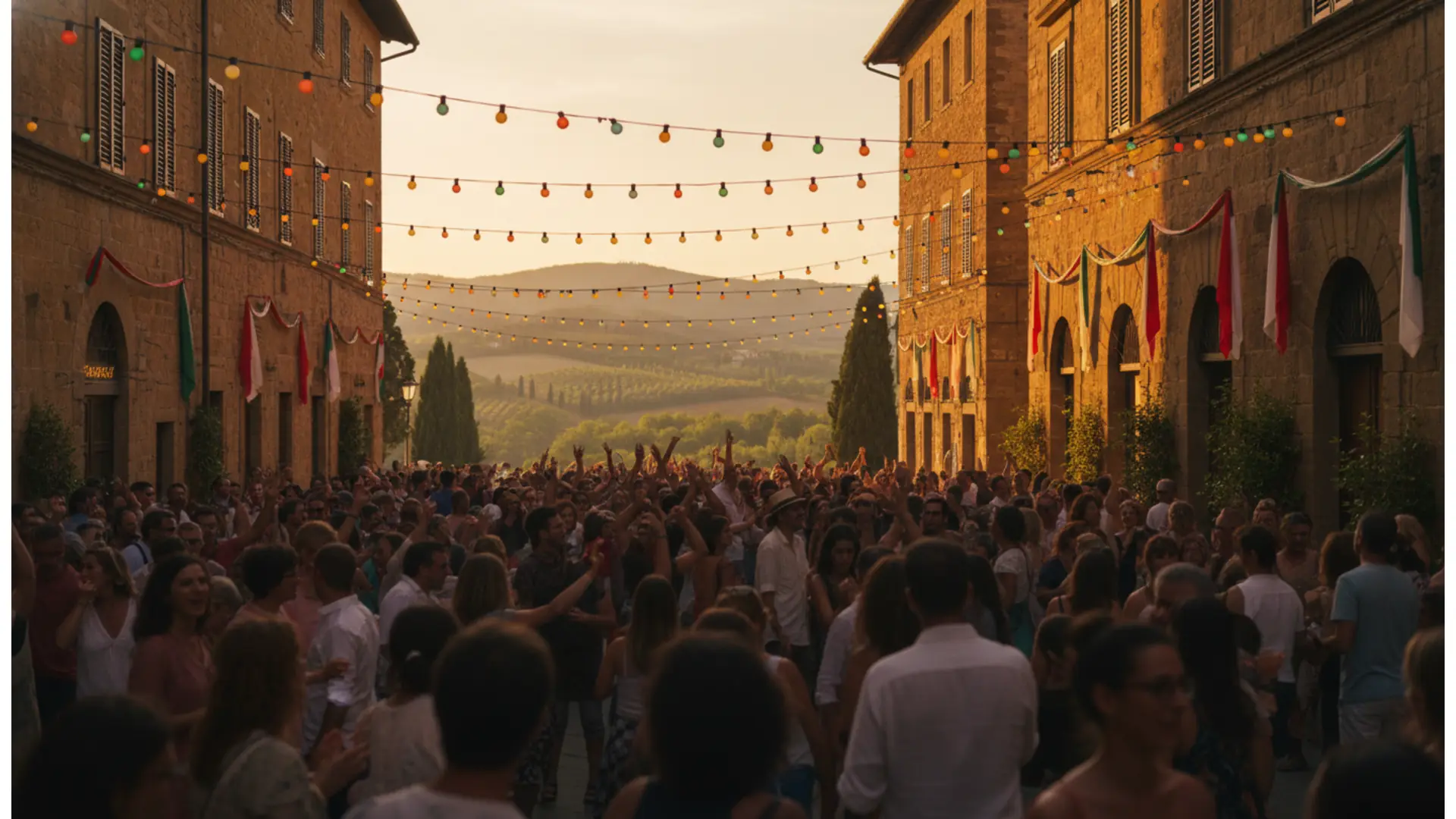
Castellese Carnival
Masked parade, tarantella, and the reading of the Testament in Castelfranci
About Castellese Carnival
A grassroots celebration in the heart of Irpinia
The Castellese Carnival is the annual event that, between February and March, brings Castelfranci to life in its most communal form. This small town in the province of Avellino, Campania, has just over 1,700 residents and sits at an altitude of 450 meters overlooking the Calore Valley. For one afternoon, its narrow streets become an open-air stage where makeshift masks, homemade costumes, and groups of friends mingle without hierarchy or reserved seating.
Masked parade to the rhythm of the tarantella
The heart of the day is the masked parade that winds through the historic center. This is not a procession of monumental floats like those seen in Italy's major carnival cities, but a local parade where the participants' creativity and live music take center stage. The groups are accompanied by the tarantella, which in Irpinia is not just a folk ornament but a living musical language. Accordions, frame drums, and singing set the pace, drawing even the spectators into the dance.
- Meeting point and departure from the town center, near Piazza Municipio
- Route through the village streets, with stops, music, and dancing
- Free participation: to join the parade, simply wear a mask
- Event designed for all ages, from families with children to groups of young people
The reading of the Testament
As evening falls, the most anticipated and identity-defining moment arrives: the reading of the Testament. A tradition shared by many Irpinian towns, it consists of a street theater performance where Carnival, now dying, dictates its last will and testament. Written in verse and local dialect, the testament distributes ironic bequests to the townspeople and reviews the year's events: gossip, administrative matters, romances, and mishaps become the subject of public satire. It is a closing ritual that combines collective laughter with community memory, ending with a final farewell to Carnival.
The Dead Carnival, an Irpinian peculiarity
In Castelfranci, as in other parts of Irpinia, the celebration does not end on Shrove Tuesday. The climax occurs in the following days with what is locally known as the Dead Carnival, traditionally celebrated on the Sunday after Shrove Tuesday. This is why the Castellese Carnival is often held once Lent has already begun, a unique feature that distinguishes these valleys from the more common carnival calendar, also found in variations in Montella, Castelvetere sul Calore, and other neighboring towns.
Who organizes the festival
The event is promoted by the Castelfranci Youth Forum, which manages the organization with the support of the Pro Loco and the Municipality of Castelfranci. The initiative is part of the events highlighted by the Sistema Irpinia portal of the Province of Avellino. It is a self-produced festival, free of charge, where the work of volunteers replaces large-scale productions; this artisanal dimension is its hallmark and explains why the town feels it so deeply as its own.
Castelfranci, a village in the Calore Valley
Visitors arriving for Carnival will find a village worth exploring even after the festivities end. Castelfranci—whose name is said to derive from Castrum Francorum, a frontier garrison between the duchies of Benevento and Salerno—preserves the Church of San Nicola, the 19th-century Palazzo Vittoli, and the Sanctuary of Santa Maria del Soccorso. We are also in the heart of the Taurasi DOCG wine region and the home of extra virgin olive oil made from Ravece olives. Local wineries and oil mills are happy to round off a day of celebration, alongside the handmade durum wheat pasta that is the local specialty.
Castellese Carnival — edition 2026
For the 2026 edition, the Castellese Carnival chose Saturday, February 21, with a meeting point in the center of Castelfranci, in the province of Avellino. The program released by the Youth Forum and promoted by the Province of Avellino's Sistema Irpinia portal featured two main moments.
In the afternoon, the village streets were filled with masked groups for the parade, accompanied by the music and dance of the tarantella: a procession open to anyone wishing to participate, without registration or tickets. In the evening, it was time for the reading of the Testament, the street performance where Carnival dictates its last will and the community tells its own story with irony, thus closing the festival.
In 2026, the event confirmed its nature as a self-produced and free festival, supported by local volunteers and designed for all ages, from families with children to the youngest participants.
Programme Castellese Carnival 2026
Saturday, February 21, 2026 — Castelfranci (AV), Piazza Municipio and town center streets
- 4:00 PM — Masked parade through the village streets, accompanied by tarantella music and dance.
- 7:00 PM — Reading of the Testament: the traditional performance used to bid farewell to Carnival with irony and satire.
Reference point: Piazza Municipio 1, 83040 Castelfranci (AV). Program released by the Castelfranci Youth Forum and published on the Province of Avellino's Sistema Irpinia portal.
Highlights Castellese Carnival 2026
- Masked parade open to all through the historic center
- Irpinian tarantella music and dance accompanying the procession
- Evening reading of the Testament, in dialect, featuring local irony and satire
- Completely free festival, suitable for families and children
- Organized by the Castelfranci Youth Forum
Prices Castellese Carnival 2026
Practical information — Castellese Carnival
Where it takes place
The streets of the historic center of Castelfranci (AV), with the main reference point being Piazza Municipio 1, 83040 Castelfranci, in the province of Avellino.
How to get there
- By car: from the A16 Naples-Canosa motorway, take the Avellino Est exit, then follow provincial roads towards the upper Calore Valley; Castelfranci is about 33 km from Avellino.
- By train and bus: reach Avellino station, then take provincial bus lines to the Calore Valley.
- By plane: Naples Capodichino Airport, approximately 90 km away.
Costs
Free admission. The parade and the reading of the Testament take place in the street and are free, with no booking required.
Tips
- The village is at an altitude of 450 meters and the festival takes place in mid-winter: it is best to dress in layers under your costume.
- The village streets are narrow and steep; it is advisable to park at the entrance to the village and continue on foot.
- The Testament is recited in the local Irpinian dialect: having a local translate a few passages is part of the fun.
Contacts
Municipality of Castelfranci, tel. +39 0827 72005, [email protected]. Updates and posters are available on the Castelfranci Youth Forum Facebook page and the Sistema Irpinia portal.
Festival-goer photos
No photos yet. Share yours!
Share your photos
5 photos max, 5 MB per photo (JPG, PNG, WebP)
Noticed an error or missing information?
Help us keep this listing up to date. Every proposal is verified by our team before publication.
Festival-goer reviews
No rating yet — be the first!
No comments yet. Be the first!
Were you there?
Share your experience with the community.
Published by Valentin Contard, festival listings writer. Reviewed, corrected and approved by Christophe Contard, editor-in-chief. .
Where does it take place — Castellese Carnival
Centro storico di Castelfranci
Piazza Municipio 1, 83040 Castelfranci