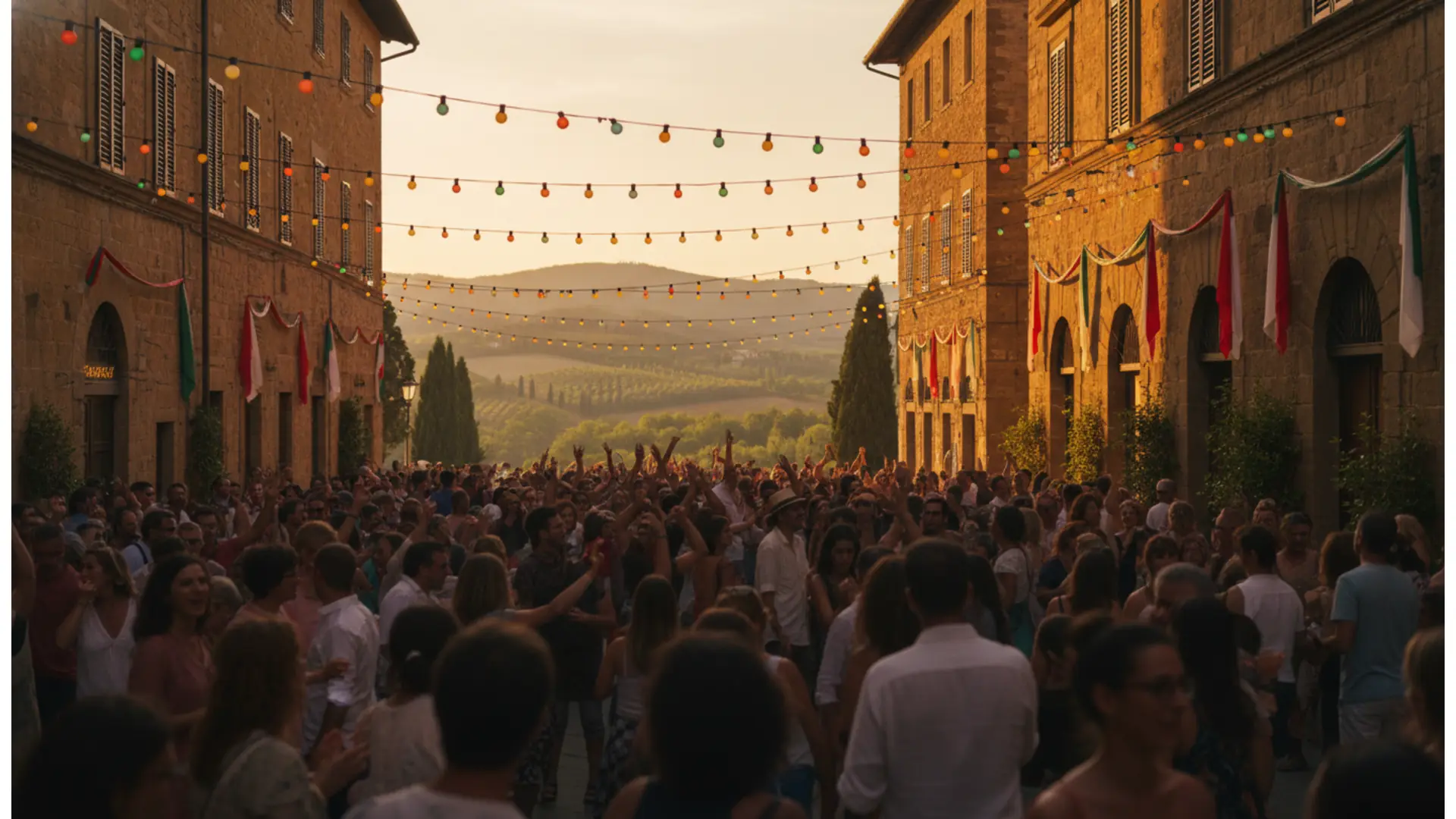
San Giacomo Fair — Historical Re-enactment of Marzano Appio
The oldest fair in Campania, granted in 1299 by Charles II of Anjou, comes to life with the Mastro Mercato, historical pageant, and archery contest
About San Giacomo Fair
The oldest fair in Campania
In 1299, the King of Naples Charles II of Anjou granted the University of Marzano — the ancient name of the municipality of Marzano Appio, in the province of Caserta — the privilege of holding a weekly market every Wednesday and a four-day annual fair for the feast of Saint James the Apostle on July 25th. That document gave birth to what is considered the oldest fair in Campania, still a vibrant part of the Alto Casertano calendar and recognized as one of the area's strongest identity markers.
The fair was originally held at Largo delle Corregge, at a crossroads of ancient roads near the Via Latina, where merchant traffic was intense even in Roman times: local tradition traces its most remote origins to a salt fair near the lake of Corree. In 1765, the event was moved to the center of Grottola, the municipal seat, near the Largo della Santissima Annunziata, where it still takes place today.
The Mastro Mercato, a symbolic figure
The central character of the event is the Mastro Mercato. In the medieval legal system, he was the head of the University of Marzano and, for the duration of the fair and the seven days before and after, he exercised civil and criminal jurisdiction over the entire market. His investiture took place in the presence of the population and authorities «armed for the decorum of said Fair», who accompanied the castle's banner to the traditional gathering place.
In the contemporary re-enactment, the role is entrusted to the incumbent mayor, who wears period clothing and publicly reads the ancient privileges and chapters of the fair. It is the most anticipated moment of the evening: a simple gesture that renews the collective memory of a community that recognizes itself in its own history every year.
Historical pageant and the court of Marino Marzano
After the reading of the privileges, the historical pageant forms, crossing the streets of the town center to Piazza Mercato with figures in medieval costume, flag-wavers, swordsmen, and historical groups invited from all over Campania. The narrative thread is the story of the Marzano family, a powerful feudal dynasty of the South: the theatrical performances staged in recent years recount the intrigues, alliances, and splendor of the court of Count Marino Marzano, a key figure in the events of the Kingdom of Naples in the 15th century.
Archery between the town center and hamlets
Alongside the re-enactment, the evening features an archery contest, which pits teams from the town center against those of the municipality's hamlets. It is the most participatory and lighthearted part of the festival, truly involving the villages scattered across the hills of Marzano Appio:
- Capoluogo and Cardoni
- Campagnola
- San Lorenzo and Sarcioni
- Ameglio and Pigne
- Carangi, Terracorpo, Macini and Torello
- Tuoro Funaro, Tuorocasale and Piedi Tuoro
Stalls, crafts, and flavors of the Alto Casertano
The fair's original vocation remains intact: in the afternoon, traditional stalls open with crafts, antiques, and local products, while in the evening, food and wine stands begin service. Among the specialties that have always accompanied the fair are marinated fish — a dish historically linked to this event — and fried desserts prepared by local associations. It is the perfect opportunity to taste the rustic cuisine of the Alto Casertano, made of simple ingredients and home-style recipes.
Why it is worth a visit
The San Giacomo Fair is not a staged reconstruction: it is the continuation of an economic and social event documented for over seven centuries. Those who arrive in Marzano Appio will find a hillside village a few kilometers from Teano, a compact center that for one evening fills with torches, drums, and banners, and a community that welcomes visitors without tourist filters. For those traveling in this part of Campania, between Roccamonfina and the Volturno river, it is a stop that tells much more than the size of the town might suggest.
San Giacomo Fair — edition 2026
2026 Edition
The 2026 edition of the San Giacomo Fair focused on Saturday, July 25, the feast day of Saint James the Apostle, with the Municipality of Marzano Appio's calendar listing the fair on July 25 and 26.
The morning had a historical and civic focus: after the Eucharistic celebration, the solemn blessing of the ancient fair took place in the «Norma Di Sandro» square, followed by a meeting with Professor Giuseppe Angelone, a scholar of Alto Casertano history, on the theme «Over seven centuries of history, places, and memories». Angelone is the same researcher who, in 1999, on the occasion of the seventh centenary, published the medieval documents attesting to the royal grant of 1299.
In the afternoon, traditional stalls opened with crafts, antiques, and local products. The evening was dedicated to the re-enactment: the performance «Intrigues and Splendor at the court of Marino Marzano», curated by Luigi Formicola, opened the historical pageant in medieval costumes; this was followed by the archery contest between the representatives of the town center and the hamlets, while food stands closed the day.
Programme San Giacomo Fair 2026
Saturday, July 25, 2026 — main day of the fair and historical re-enactment:
- 9:00 AM — Eucharistic celebration for the feast of Saint James the Apostle
- 9:30 AM — «Norma Di Sandro» Square: solemn blessing of the ancient Fair; followed by a meeting with Professor Giuseppe Angelone on the theme «Over seven centuries of history, places, and memories»
- 4:00 PM — Opening of traditional stalls: crafts, antiques, and local products
- 6:00 PM — «Intrigues and Splendor at the court of Marino Marzano», curated by Luigi Formicola, and start of the historical pageant
- 7:00 PM — Archery contest between the representatives of the town center and the hamlets: Capoluogo and Cardoni; Campagnola; San Lorenzo and Sarcioni; Ameglio and Pigne; Carangi, Terracorpo, Macini and Torello; Tuoro Funaro, Tuorocasale and Piedi Tuoro
- 8:30 PM — Opening of food and wine stands
The municipal calendar of Marzano Appio lists the San Giacomo Fair on July 25 and 26.
Highlights San Giacomo Fair 2026
- The oldest fair in Campania, established in 1299 by Charles II of Anjou
- Solemn blessing of the ancient Fair in «Norma Di Sandro» square
- Meeting with Professor Giuseppe Angelone: «Over seven centuries of history, places, and memories»
- Performance «Intrigues and Splendor at the court of Marino Marzano» and historical pageant in medieval costumes
- Archery challenge between the town center and the municipality's hamlets
- Craft and antique stalls and evening food stands
Prices San Giacomo Fair 2026
Practical information — San Giacomo Fair
How to get there
Marzano Appio is located in the Alto Casertano area, in Campania, a few kilometers from Teano. By car, take the A1 motorway exit at Caianello and continue for about ten minutes on provincial roads towards Marzano Appio. The reference railway station is Teano, on the Rome–Cassino–Naples line; the nearest airport is Naples-Capodichino.
Hours and admission
The day opens in the morning with religious and cultural events; the stalls open in the afternoon, the historical pageant starts in the early evening, and the food stands begin service after sunset. Access to the fair, the pageant, and the events in the square is free.
Useful tips
- The town center is closed to traffic during the pageant: it is advisable to arrive early and park on the outskirts.
- Wear comfortable shoes, as the re-enactment route crosses squares and sloping streets.
- The updated program is released through the channels of the Municipality of Marzano Appio and the Pro Loco a few days before the event.
Festival-goer photos
No photos yet. Share yours!
Share your photos
5 photos max, 5 MB per photo (JPG, PNG, WebP)
Noticed an error or missing information?
Help us keep this listing up to date. Every proposal is verified by our team before publication.
Festival-goer reviews
No rating yet — be the first!
No comments yet. Be the first!
Were you there?
Share your experience with the community.
Published by Valentin Contard, festival listings writer. Reviewed, corrected and approved by Christophe Contard, editor-in-chief. .
Where does it take place — San Giacomo Fair
Centro del capoluogo Grottola — Piazza Mercato e piazzetta Norma Di Sandro