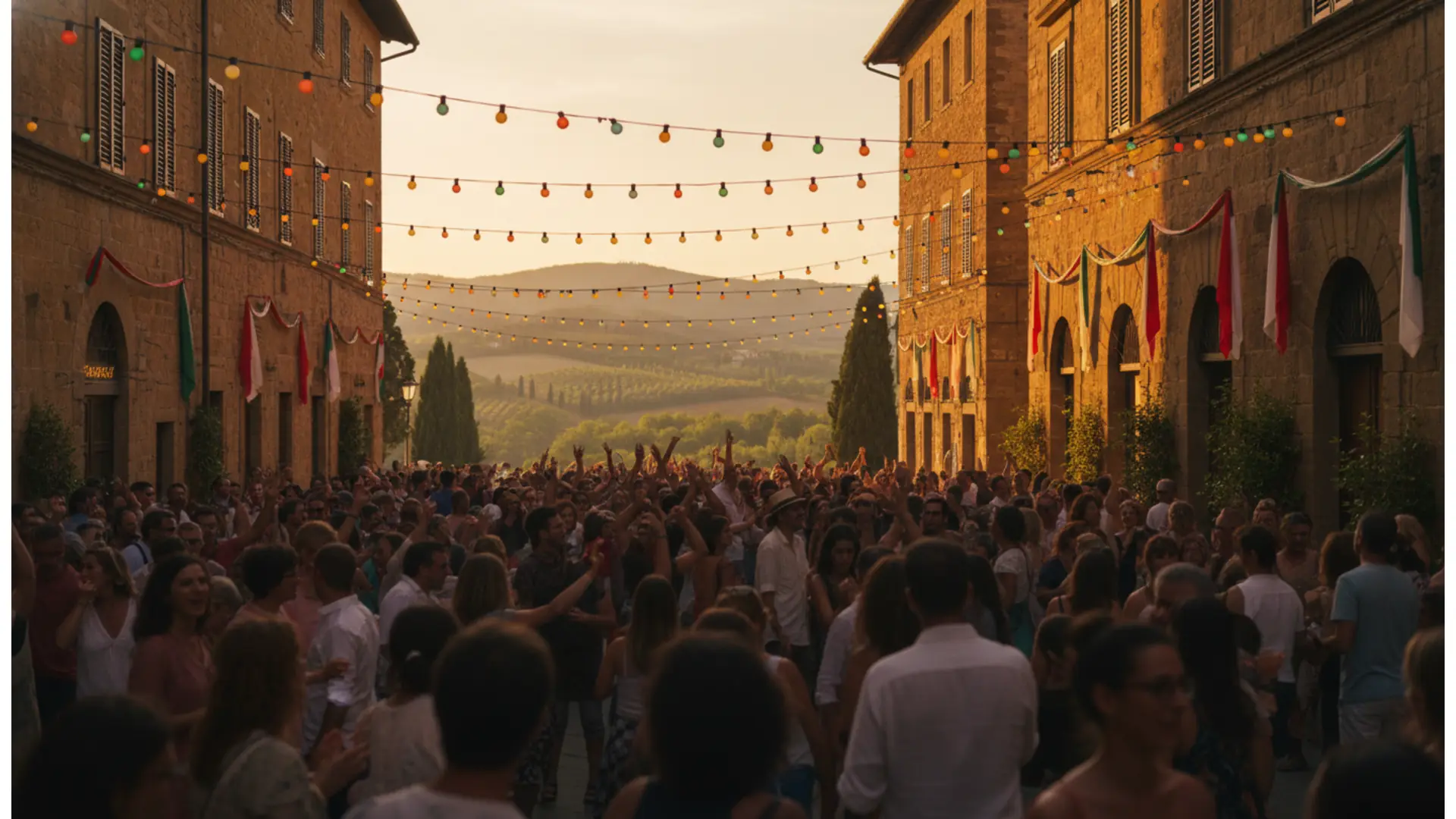
Salento Carnival – The Quadriglia and the Zeza
The Quadriglia danced in the square and the Zeza comedy in the heart of the Cilento
About Salento Carnival
The Salento Carnival, in the heart of the Cilento
In the Municipality of Salento, a village of just over 1,700 inhabitants nestled at an altitude of 420 meters in the province of Salerno, Carnival is not just a folkloric interlude but a defining identity event. Here, in the inland Cilento, the festival revolves around two popular rituals that Campania preserves with particular care: the Quadriglia danced in the square and the Zeza comedy, a form of sung and acted theater of Neapolitan origin. Two different languages—dance and drama—that tell the same story in the same village: a community's desire to recognize itself in its own traditions.
The Quadriglia: A French dance that became Cilentano
The Quadriglia of Salento began as a French group dance and has evolved over time into the symbol of the local Carnival. Its history also reflects the evolution of social customs: it was originally an exclusively male dance, with men dressing as women for the sake of modesty, before opening up to the participation of both sexes. Today, it is mainly young people, aged 16 to 30, who take to the square to dance in pairs, wearing traditional costumes under the gaze of the entire village.
- Up to 24 couples performing the dance figures
- Dancers in traditional attire, aged 16 to 30
- Performances on Carnival Sunday and Shrove Tuesday
- Banquets with local products accompanying the festivities
The sequence of figures, learned year after year by the younger generations, is a true oral tradition: you learn by watching, you repeat, and you pass it on. It is no coincidence that the Quadriglia of Salento is listed among the intangible heritage expressions of the Campania region.
The Zeza comedy
Alongside the Quadriglia, the Salento Carnival hosts the Zeza. The name is a diminutive of Lucrezia, the wife of Pulcinella in the Commedia dell'Arte: a sung and acted scene performed in the street, which originated in Naples, likely in the second half of the 17th century, and later spread throughout the provinces of the old Kingdom of Naples. The plot is always the same—Zeza, Pulcinella, their daughter Vastianella, and the suitor Don Nicola—but every village interprets it in its own way, with its own verses and music.
In February 2026, the local Cilento press noted that in Salento, along with Sacco, the Zeza comedy returned as one of the most authentic moments of the Salerno Carnival: a sign that this form of popular theater, which has disappeared elsewhere, still thrives in the inland villages.
A festival that also passes through the table
As throughout the Cilento, the Salento Carnival is also a gastronomic festival: banquets featuring traditional rustic products accompany the performances and turn the square into a place of conviviality. The village, after all, is known in the area for its confectionery tradition and for rustic dishes such as foglie e patane (wild greens with potatoes) or the struffolone, a glazed festive pastry. Here, dance and food intertwine in a single act of sharing.
When it takes place
The event follows the movable calendar of Carnival: the appointments fall on Carnival Sunday and Shrove Tuesday, meaning the dates change every year. In 2026, the two days were February 15 and 17; in 2025, with a later Easter, they fell on March 2 and 4. Those planning a trip should therefore check the liturgical calendar of the current year before booking.
An itinerary through the Cilentano Carnival
Salento is not an isolated case: the entire Cilento and Alburni area experiences a Carnival of rural roots, made of rituals rather than parades. Within a few kilometers, you can encounter the Quadriglia in the square of Gioi, the Maschkarata of San Mauro Cilento, the agrarian ritual of the twelve months in Aquara, the Carnuluvaro bonfire with traditional masks in Cosentini di Montecorice, the burning of the Vavo puppet in Trentinara, and the "poor man's carnival" of Olevano sul Tusciano. Visiting Salento during these days means entering a cultural system, not just attending a single show: it is the best way to get to know the Cilento out of season, when the villages still belong to those who live there.
Salento Carnival — edition 2026
Salento Carnival 2026: Two days of tradition
The 2026 Carnival in the Municipality of Salento, in the province of Salerno, focused as usual on the two symbolic days of the festival: Carnival Sunday, February 15, and Shrove Tuesday, February 17. Both dates were included in the calendar of Campanian Carnivals curated by the regional company Scabec, which listed the Quadriglia of Salento among the identity-defining events of Campania.
The Quadriglia in the square
The heart of the event remains the Quadriglia: couples, young people aged 16 to 30, perform in traditional costumes, executing the figures of this group dance of French origin, which has been rooted in Salento for generations. In recent editions, the square has seen up to 24 couples take the field, with children leading the way before the older dancers enter. Banquets featuring typical products of Cilentano rural cuisine accompanied both days.
The return of the Zeza
In 2026, the Zeza comedy was a highlight in Salento and the nearby village of Sacco: a sung and acted scene of Neapolitan tradition, featuring Zeza, Pulcinella, and their daughter Vastianella, which continues to be performed by the inhabitants themselves in the villages of the inland Cilento. In a year where bad weather forced several municipalities in the Salerno area to postpone or reorganize events, the Salento Carnival remained true to its rituals.
Programme Salento Carnival 2026
Sunday, February 15, 2026 — Carnival Sunday
- Quadriglia in the square: couples in traditional dress perform the dance figures
- Participation of children before the older dancers, according to local custom
- Banquets with typical products of the Cilentano rural tradition
Tuesday, February 17, 2026 — Shrove Tuesday
- New performance of the Quadriglia, with up to 24 couples participating
- Zeza comedy: the sung and acted scene of Campanian folk theater
- Closing of the Carnival with music and conviviality in the square
No single official program with detailed times was released: performances take place outdoors, in the square, in the center of the village.
Highlights Salento Carnival 2026
- The Quadriglia danced by up to 24 couples in traditional dress
- The Zeza comedy, popular theater of Neapolitan origin, performed in Salento and Sacco
- Banquets with typical products of Cilentano rural cuisine
- Involvement of the village's youth, aged 16 to 30, as guardians of the dance
- Two distinct days: Carnival Sunday and Shrove Tuesday
Prices Salento Carnival 2026
Practical information — Salento Carnival
How to get there
Salento is located in the inland Cilento, at an altitude of 420 meters, in the province of Salerno. By car, it can be reached from the A2 del Mediterraneo motorway, continuing along the roads that climb up the Cilento towards Vallo della Lucania. The reference railway station for the inland Cilento is Vallo della Lucania-Castelnuovo, on the Tyrrhenian line; from there, you can continue by car or local bus connections.
Admission and costs
The Quadriglia performances and the Zeza comedy take place in the square, outdoors, and are free to attend. There are no tickets or reservations required; any tastings at the food stalls are by donation or at an affordable price.
Information
Municipality of Salento, Piazza Europa 2 — tel. +39 0974 62018 — [email protected]. The exact dates, linked to the movable Carnival calendar, are announced by the Municipality and the local Cilento press in the weeks preceding the event.
Practical tips
In February, at this altitude, temperatures can be cold: warm clothing and comfortable shoes for the historic center are recommended. Parking spaces in the village are limited, so it is best to arrive well in advance. The area is perfect for a long weekend exploring the villages of the inland Cilento, with stops in Gioi, Stio, and Vallo della Lucania.
Festival-goer photos
No photos yet. Share yours!
Share your photos
5 photos max, 5 MB per photo (JPG, PNG, WebP)
Noticed an error or missing information?
Help us keep this listing up to date. Every proposal is verified by our team before publication.
Festival-goer reviews
No rating yet — be the first!
No comments yet. Be the first!
Were you there?
Share your experience with the community.
Published by Valentin Contard, festival listings writer. Reviewed, corrected and approved by Christophe Contard, editor-in-chief. .
Where does it take place — Salento Carnival
Piazze e vicoli del centro storico