Pagani Carnival
Allegorical floats, quadrilles, and music in the heart of Pagani, in the Agro Nocerino-Sarnese area
About Pagani Carnival
The Pagani Carnival, the great street festival of the Agro Nocerino-Sarnese
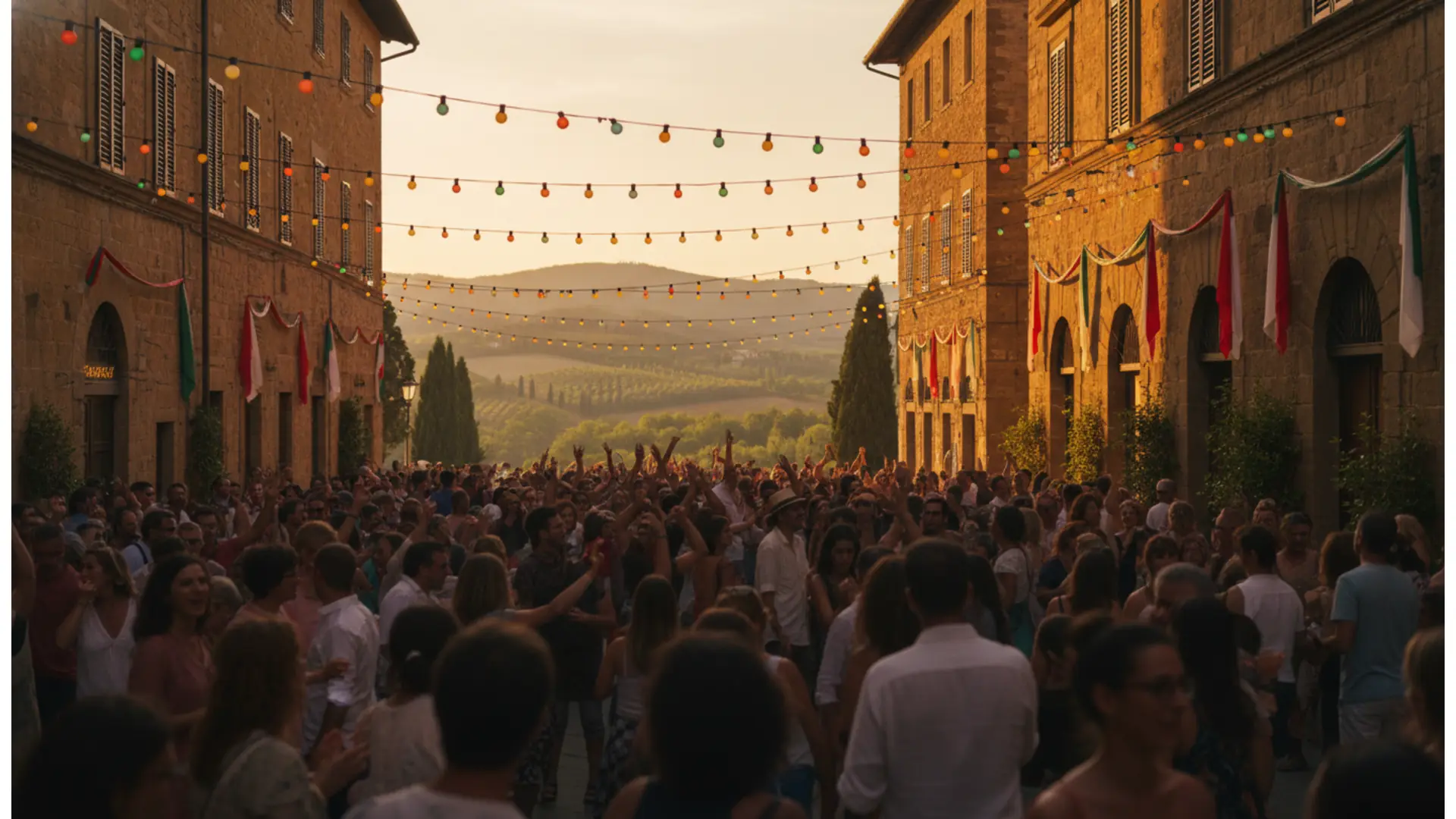
In Pagani, a town in the province of Salerno in Campania, Carnival is not just a fleeting moment but a full week of street life. The city center—Corso Ettore Padovano, Via Cesarano, Piazza Sant'Alfonso, and Piazza Auditorium—becomes an open-air stage where towering allegorical floats, costumed dance quadrilles, masked groups, and hundreds of children pass by. It is one of the most cherished events in the Agro Nocerino-Sarnese, the plain between Mount Vesuvius and the Lattari Mountains, where Carnival is a popular tradition shared by neighboring towns that exchange floats, music, and performers.
The allegorical floats: Carnevale Nocerino and Gran Carnevale di Orta Loreto
The heart of the event lies in the parades of floats built by local associations. The Carnevale Nocerino, chaired by Pasquale Gambardella Pasquale Gambardella, brings together neighborhood committees from Nocera Inferiore—Sant'Anna di Fiano, Fosso Imperatore, Cicalesi, San Mauro, Piedimonte—and brings its floats to Pagani along with the quadrilles that accompany them. Each float involves between one hundred and one hundred and fifty people: about thirty for construction and a hundred for choreography. Alongside them parades the Gran Carnevale di Orta Loreto, the other major carnival association of the Agro, which has brought up to six floats to the streets over the years.
The result is a community carnival: sketches are born in neighborhood warehouses during the autumn, families sew costumes, and young people rehearse choreography for months. In 2026, the Carnevale Nocerino reached its twentieth edition, with themes ranging from Greek mythology to flower power, from the Italian dream to the oriental imagination, involving a total of about three thousand people including organizers, builders, and performers.
The school procession
A chapter of its own is the parade of students from the I Circolo Didattico of Pagani, which brings together the Carducci, Manzoni, and Rodari schools. Every year, hundreds of masked children—over six hundred in 2026, with a procession dedicated to Disney characters—cross the main streets of the city to Piazza Sant'Alfonso, where they perform in front of their families. It is the most tender moment of the week and the one that best captures the participatory nature of this festival: costume preparation is a shared effort between school and parents.
Music, entertainment, and town square festivities
Surrounding the parades, the Municipality builds a program of widespread entertainment: musical stations along the main street, live concerts in Piazza Auditorium, and the "Carnival Party" in Piazza Sant'Alfonso with confetti, cotton candy, face painting, and entertainment for the little ones. In recent editions, carnival events have intertwined with Valentine's Day celebrations when the two dates fall close together, creating evenings of music in the historic center. Bars, pastry shops, and kiosks along the main street participate with traditional Carnival sweets—chiacchiere, sanguinaccio, migliaccio—and themed offers.
When it takes place
Dates follow the movable calendar of Lent: the Pagani Carnival is concentrated in the days leading up to Shrove Tuesday, usually between the second half of February and the first days of March. Float parades are held on Sunday and Tuesday, with hours covering the morning (10 am–1 pm) and late afternoon (4 pm–9 pm); the school procession opens the celebrations on the preceding weekdays.
Tips for your visit
- All events are free and outdoors: no reservations or tickets are required.
- During the parades, the center is closed to traffic: it is best to leave your car in the parking areas indicated by the Municipality and reach the main street on foot.
- The best position to view the floats is along Corso Ettore Padovano, but Piazza Sant'Alfonso remains the focal point for shows and entertainment.
- Those arriving for the day can combine their visit with the Sanctuary of the Madonna delle Galline and the Basilica of Sant'Alfonso Maria de' Liguori, both just a short walk from the route.
Pagani is easily reached from Naples and Salerno and is a good starting point for exploring the Agro Nocerino-Sarnese, the Amalfi Coast, and Pompeii: the Carnival is the ideal opportunity to discover a popular and authentic side of Campania, far from the most beaten tourist circuits.
Pagani Carnival — edition 2026
A week of Carnival in the center of Pagani
The 2026 Pagani Carnival opened on Thursday, February 12, with the procession of the I Circolo Didattico and closed on Tuesday, February 17, Shrove Tuesday, with the grand evening parade of the Carnevale Nocerino floats. In between, on Saturday, February 14, the municipal administration combined Carnival and Valentine's Day in the initiative "Carnevale in Love. Music in the center," with musical stations along Corso Ettore Padovano and a concert in Piazza Auditorium.
The twentieth-anniversary floats
2026 coincided with the twentieth edition of the Carnevale Nocerino: five allegorical floats created by the neighborhood committees of Nocera Inferiore, with themes inspired by Greek mythology, the Italian dream, the power of love, flower power, and the oriental imagination. Each float required between one hundred and one hundred and fifty people, including builders and quadrilles, for a total of about three thousand people involved. Alongside them, on Tuesday morning, the floats of the Gran Carnevale di Orta Loreto crossed the suburbs and the city center.
The children's procession
The opening moment was the procession of the I Circolo Didattico, with over six hundred students from the Carducci, Manzoni, and Rodari schools dressed as Disney characters: "101 Dalmatians," Pinocchio, Alice, and princesses paraded from 9 am from Piazza Corpo di Cristo to Piazza Sant'Alfonso, where they performed in front of their families.
Organization
The event was promoted by the Municipality of Pagani with the departments of Culture (Valentina Oliva) and Commerce and Municipal Police (Luana Giammetta), in collaboration with carnival associations, schools, local merchants, and volunteers. Mayor Raffaele Maria De Prisco emphasized the value of a city that comes together again to live in shared spaces.
Programme Pagani Carnival 2026
Thursday, February 12
- 9:00 am: Carnival procession of the I Circolo Didattico (Carducci, Manzoni, and Rodari schools) with over 600 children in Disney-themed masks. Departure from Piazza Corpo di Cristo, arrival around noon in Piazza Sant'Alfonso with final performances.
Saturday, February 14 — "Carnevale in Love. Music in the center"
- From 6:00 pm: Musical stations along the main street.
- Piazza Auditorium: Concert by the Groove Motion Live Band.
- Limited traffic zone active from 5:30 pm to 8:30 pm between Corso Ettore Padovano and Piazza Sant'Alfonso.
Sunday, February 15
- 10:00 am–1:00 pm: First parade of the Carnevale Nocerino association's allegorical floats.
- Piazza Sant'Alfonso: "Carnival Party" with confetti, cotton candy, photos, and entertainment for children.
Tuesday, February 17 (Shrove Tuesday)
- 10:00 am–1:00 pm: Parade of the Gran Carnevale di Orta Loreto floats through the suburbs and city center.
- From 10:30 am, Piazza Auditorium: "Carnival Party" with music, entertainment, and fun for all ages.
- 4:00 pm–9:00 pm: Grand finale with the Carnevale Nocerino floats in the city center.
The five Carnevale Nocerino 2026 floats (twentieth edition)
- Uniti per Fosso Imperatore — "Eternal myths of ancient Greece"
- Rural Fiano — "The Italian dream"
- Il Laghetto, in collaboration with Amici di Cicalesi — "Chaos and Love"
- Gruppo Fantastic — "Fantastic Flower Power"
- New Generation — "Under the skies of the Orient"
The typical mask of the Carnevale Nocerino is the Princess Nuceria; the association is chaired by Pasquale Gambardella, with Gennaro Della Mura as vice-president and Severino Molisse as secretary.
Highlights Pagani Carnival 2026
- The twentieth edition of the Carnevale Nocerino, with five allegorical floats and quadrilles of about one hundred performers each.
- The I Circolo Didattico procession with over 600 children dressed as Disney characters.
- "Carnevale in Love," the evening of February 14 that combined Carnival and Valentine's Day with music throughout the main street.
- The double Shrove Tuesday parade: Orta Loreto in the morning, Carnevale Nocerino from the afternoon until evening.
- The "Carnival Party" in the square, designed for families with small children.
Prices Pagani Carnival 2026
Practical information — Pagani Carnival
How to get there
Pagani is located in the Agro Nocerino-Sarnese, about 30 km from Salerno and 40 km from Naples. By train, the Pagani station is served by regional trains on the Naples-Salerno line. By car, take the Pagani exit from the A30 Caserta-Salerno motorway, or take the A3 Naples-Salerno motorway with the Nocera-Pagani exit. The nearest airport is Naples-Capodichino.
Where it takes place
The parades travel along Corso Ettore Padovano and Via Cesarano; shows and entertainment are concentrated in Piazza Sant'Alfonso and Piazza Auditorium, in the heart of the city center.
Tickets
Free admission to all parades and shows.
Practical tips
On parade days, traffic changes and a limited traffic zone are active in the center: it is better to arrive early. For families with small children, the final stretch of the route is recommended, where the floats slow down. Accommodation facilities can be found in Pagani and in the neighboring towns of Nocera Inferiore, Sant'Egidio del Monte Albino, and Angri.
Contacts
Municipality of Pagani, Piazza Bernardo D'Arezzo 33 — switchboard +39 081 3240111.
Festival-goer photos
No photos yet. Share yours!
Share your photos
5 photos max, 5 MB per photo (JPG, PNG, WebP)
Noticed an error or missing information?
Help us keep this listing up to date. Every proposal is verified by our team before publication.
Festival-goer reviews
No rating yet — be the first!
No comments yet. Be the first!
Were you there?
Share your experience with the community.
Published by Valentin Contard, festival listings writer. Reviewed, corrected and approved by Christophe Contard, editor-in-chief. .
Where does it take place — Pagani Carnival
Centro cittadino (Corso Ettore Padovano, via Cesarano, piazza Sant'Alfonso, piazza Auditorium)
Corso Ettore Padovano, 84016 Pagani