Festival of Saint Ulpia Candidia the Martyr
The patronal feast of Pozzaglia Sabina, featuring the opening of the urn and the procession of the silver icon
Edition 2026 not confirmed to date
This edition has not been confirmed by the organiser to date. We recommend checking before going.
About Festival of Saint Ulpia
A devotion spanning over two centuries
The Festival of Saint Ulpia Candidia the Martyr is the main religious event in Pozzaglia Sabina, a small village in the Province of Rieti, Lazio, perched on the slopes of the Lucretili Mountains on the border between the Sabina region and the Aniene Valley. For over two hundred years, the community has honored its patron saint with a celebration that has never turned into a tourist spectacle: it remains an intimate, deeply felt village feast where the entire community gathers around the parish church.
Who was Saint Ulpia Candidia
Very little is known about Saint Ulpia Candidia. Tradition holds that she was a martyr, killed around the age of thirty-five, likely during the reign of Diocletian, although her name does not appear in official martyrologies. Her body was exhumed from the Catacombs of Saint Agnes in Rome and donated to the village by Don Nicola Petrucci; solemnly transported to Pozzaglia during the pontificate of Clement XII, it has rested since 1758 under the high altar of the parish church of San Nicola di Bari. Since then, the people of Pozzaglia have invoked her with faith in times of need and gratefully acknowledge the blessings received through her intercession.
The opening of the urn
The most intense moment of the event is the ceremony during which the urn containing the saint's mortal remains is opened. It is a sober and moving ritual, accompanied by the singing of Marian litanies performed by the brass band and the faithful, in an atmosphere charged with emotion that touches even first-time observers. During those hours, the church fills well beyond its usual capacity as emigrant families, children, and grandchildren of Pozzaglia return from Rome and the rest of Italy.
The procession of the silver icon
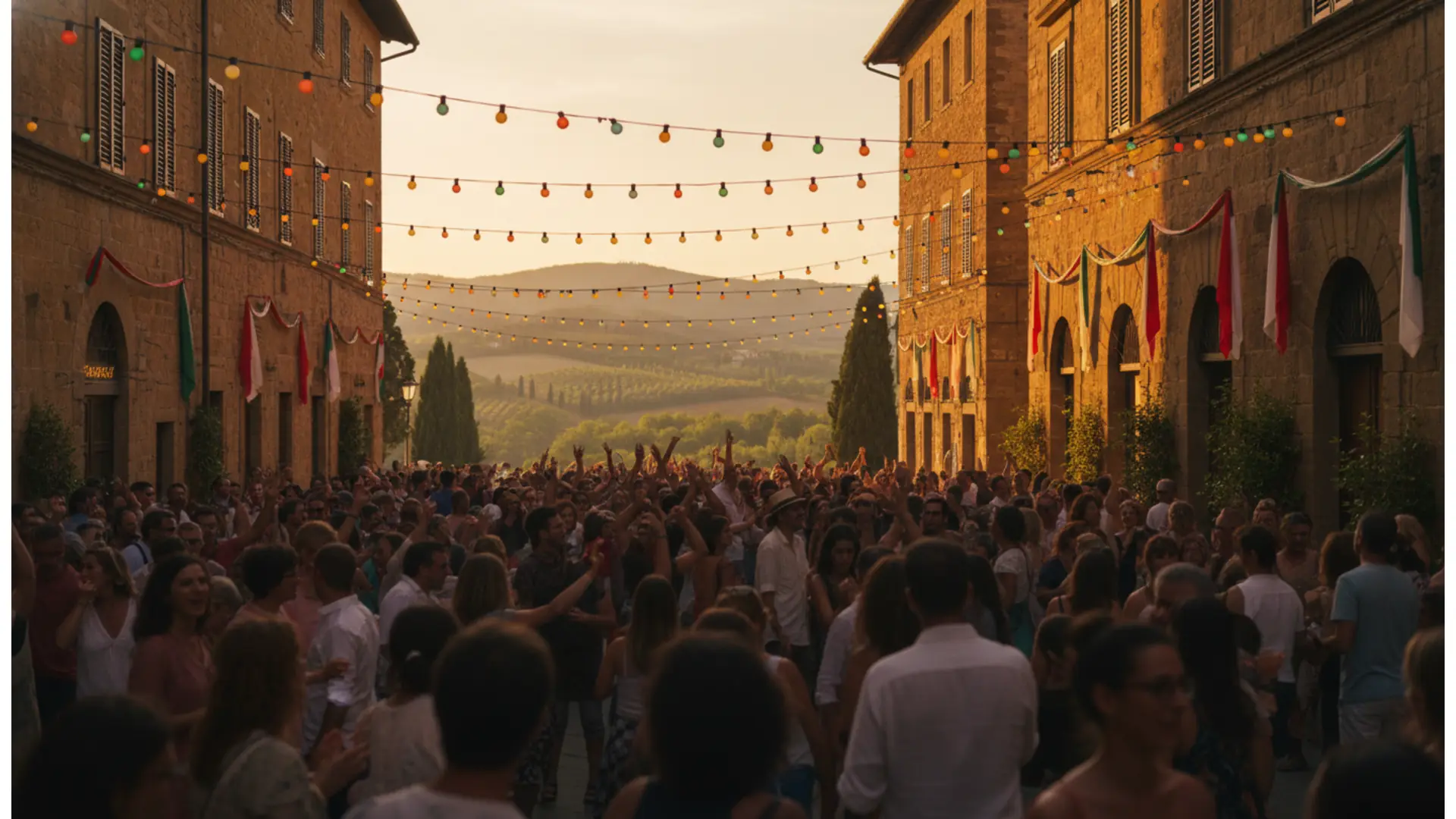
The main religious celebration takes place on Sunday, when the patron saint's image is carried through the streets of the village. The most distinctive feature of Pozzaglia lies right here: three women dressed in costumes resembling those of ancient Roman matrons, holding traditional candles, carry a beautiful silver icon depicting the martyr in procession. The pageant winds through the stone alleys of the historic center, accompanied by the band, amidst decorated houses and lanes that open onto views of the Sabina countryside.
A movable date linked to Pentecost
The event does not have a fixed date on the calendar: it follows the movable liturgical cycle of Pentecost, usually falling between late May and mid-June. The opening of the urn, celebrated in the days immediately following Pentecost, is followed by the Sunday of the main feast with a solemn mass and procession. Those wishing to attend should verify the exact dates for the current year with the Municipality of Pozzaglia Sabina or the parish, as they vary from year to year.
The village and its other saint
Pozzaglia Sabina has just over three hundred inhabitants and is also known for being the birthplace of Saint Agostina Pietrantoni, the Sister of Charity martyred in Rome in 1894 and canonized by John Paul II, who is celebrated in the village on the second Sunday of September. With the Grotto of Saint Michael the Archangel and the birthplace of Saint Agostina, the village is a small, quiet destination for religious tourism, immersed in the greenery of the Lucretili Mountains Park.
Why it is worth attending
Those seeking an authentic patronal feast, far from the beaten paths of Lazio, will find in Pozzaglia a celebration that has remained true to itself: no stages, no noisy fairs, but an ancient rite, the sound of the band echoing through stone houses, and the spontaneous hospitality of a small community. It is also an opportunity to discover a corner of the Rieti Sabina that few visitors know.
Festival of Saint Ulpia — edition 2026
The 2026 edition
In 2026, Pozzaglia Sabina once again renewed its appointment with its patron saint according to the movable liturgical calendar: Pentecost fell on May 24th, and the celebrations took place in the days immediately following, with the solemn opening of the urn in the parish church of San Nicola di Bari and the main feast on Sunday.
The ritual remained as it has been passed down for generations: Marian litanies sung by the brass band and the faithful, the solemn mass, and the procession in which three women in costumes inspired by ancient Roman matrons carried the martyr's silver icon through the historic center of the Rieti village.
Please note that the Municipality of Pozzaglia Sabina did not publish a detailed schedule for the 2026 edition online; information regarding the event remains as described in the institutional profile dedicated to the festival. Those wishing to participate are invited to contact the parish or municipal offices directly.
Programme Festival of Saint Ulpia 2026
Traditional conduct of the event
- In the days following Pentecost — solemn opening of the urn containing the remains of Saint Ulpia Candidia in the parish church of San Nicola di Bari, followed by mass
- During the service — singing of Marian litanies performed by the brass band together with the faithful
- Sunday — main religious feast with solemn mass and procession through the village streets
- In the procession — three women in costumes resembling those of ancient Roman matrons, carrying traditional candles, lead the silver icon bearing the martyr's effigy
Precise times for the services are communicated each year by the parish in the weeks leading up to the festival and were not released online for 2026.
Highlights Festival of Saint Ulpia 2026
- The opening of the urn containing the patron saint's relics, kept in the village since 1758
- Marian litanies sung by the brass band in an atmosphere of great intensity
- The procession of the silver icon carried by three women in Roman matron costumes
- The stone historic center of Pozzaglia Sabina, at the foot of the Lucretili Mountains
Prices Festival of Saint Ulpia 2026
Practical information — Festival of Saint Ulpia
How to get there
Pozzaglia Sabina can be reached by car from Rome in about an hour and fifteen minutes: take the A24 to Vicovaro-Mandela, then provincial roads towards Orvinio and Pozzaglia. From the Salaria road, arrive via Osteria Nuova and Poggio Moiano. The nearest train station is Mandela-Sambuci on the Rome-Avezzano line, from which you must continue by car.
Admission and hours
Religious celebrations and the procession are free to attend. Exact times for the services are announced each year by the parish of San Nicola di Bari and the Municipality in the weeks prior.
Tips
The historic center is hilly and paved with cobblestones: comfortable shoes are recommended. Parking in the village is limited; it is advisable to arrive early and leave your car along the access road. For lunch and overnight stays, it is best to look toward Orvinio, one of the most beautiful villages in Italy, just a few kilometers away.
Festival-goer photos
No photos yet. Share yours!
Share your photos
5 photos max, 5 MB per photo (JPG, PNG, WebP)
Noticed an error or missing information?
Help us keep this listing up to date. Every proposal is verified by our team before publication.
Festival-goer reviews
No rating yet — be the first!
No comments yet. Be the first!
Were you there?
Share your experience with the community.
Published by Valentin Contard, festival listings writer. Reviewed, corrected and approved by Christophe Contard, editor-in-chief. .
Where does it take place — Festival of Saint Ulpia
Chiesa parrocchiale di San Nicola di Bari