Festival of Maria SS. Avvocata del Popolo and San Leone IX
The patronal feast of Sessa Aurunca featuring the Translatio, the confraternity procession, and vibrant evenings in the square
About Patron Saint Festival
The most cherished festival in Sessa Aurunca
The Festival of Maria SS. Avvocata del Popolo and San Leone IX is the most anticipated event in the religious and civic calendar of the Municipality of Sessa Aurunca, located in the Province of Caserta, in the far north of Campania, just a few kilometers from the border with Lazio. It is not a fixed-date event: it follows the movable Easter calendar and culminates on Easter Monday, the day when the community, after the silence and sorrow of Holy Week rites, returns to fill the squares.
It is precisely this transition—from mourning to joy—that gives the festival its unique character: the same city that, just days earlier, witnessed hooded confraternities marching in the Good Friday procession of the Mysteries, finds itself on Easter Sunday and Monday surrounded by brass band music, market stalls, and fireworks.
Two Patrons, a centuries-old devotion
Sessa Aurunca has two co-patrons. Maria SS. Avvocata del Popolo is venerated in a 16th-century panel painting kept in the Basilica Cathedral of Saints Peter and Paul, attributed by scholars to the painter Marco Cardisco. The image was solemnly transferred to the Cathedral in the first quarter of the 17th century following events deemed miraculous by the faithful, and placed at the center of the apse, where a marble altar, tabernacle, and silver canopy were later added. The solemn coronation of the image took place in 1904 by decree of the Holy See: over five centuries of uninterrupted popular devotion.
Beside her is San Leone IX, the reforming pope of the 11th century, whose liturgical feast falls on April 19th. The two figures are inseparable in the minds of the locals: they are simply referred to as "the Patron Saints," and they emerge together during the Easter Monday procession.
The Translatio and the procession
The ritual heart of the festival consists of two moments. The first is the Translatio of the Patron Saints: on Easter Sunday evening, the images are moved from the Bishop's Palace to the Cathedral, followed by the faithful, with the Eucharistic celebration presided over by the Bishop. The second is the solemn procession on Easter Monday, which winds through the streets of the historic center in the morning with the participation of local confraternities and lay associations: it is the same network that animates the rites of Holy Week, and its unified presence ideally closes the Easter cycle.
Evenings in the square
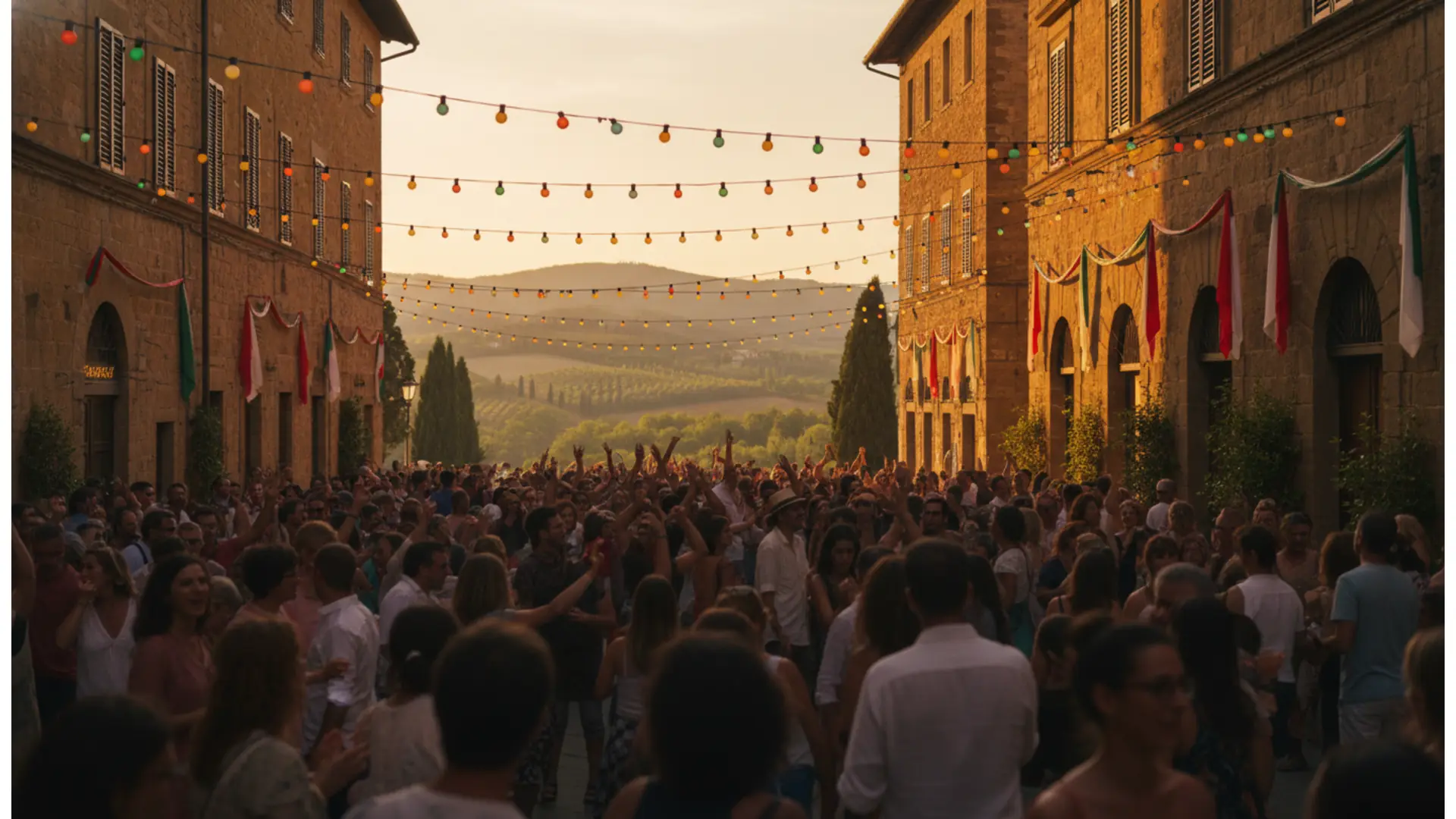
The religious aspect has always been accompanied by a robust civic program organized by the Festival Committee. Easter Day opens with the brass band parade: a wind orchestra travels through the city streets from morning until night, a typical tradition of Southern patronal festivals. On the following evenings, Piazza XX Settembre and Piazza Tiberio host concerts, children's entertainment, and the fireworks display, with the unmissable pyrotechnic show that concludes the festivities at midnight.
Over the years, names from the Italian music scene and traditional Campanian folk groups have taken the stage alongside local bands: the lineup changes every year, but the structure remains identical—three full days of faith, music, and conviviality.
A city worth a visit
Sessa Aurunca preserves a historic center of great interest, dominated by the medieval Cathedral and overlooking the slopes of the extinct Roccamonfina volcano, amidst olive groves and vineyards. Those arriving for the patronal festival will also find the perfect opportunity to visit the village, its confraternity churches, and the Aurunca countryside during a particularly favorable time of year—the beginning of spring.
How to experience the festival
- Free admission to all religious and civic events.
- Family-friendly and popular atmosphere: the festival is primarily experienced by locals and emigrants returning for the occasion.
- The most intense moment is the Easter Monday morning procession; the most spectacular is the fireworks display on the final evening.
- The historic center is largely pedestrianized during the festivities: it is advisable to leave your car in the external parking lots.
Patron Saint Festival — edition 2026
Three days between devotion and the square
The 2026 calendar followed the traditional structure of the festival: Easter Sunday dedicated to the brass band parade and the Translatio, Easter Monday to the solemnity of the Patron Saints with Mass and procession, and Tuesday to the grand musical and pyrotechnic finale.
The civic part featured a varied lineup: live music and a fire show on Easter evening, the Frezza concert in Piazza Tiberio on Monday, and Gemelli DiVersi in Piazza XX Settembre on Tuesday. All events were free of charge.
Programme Patron Saint Festival 2026
Sunday, April 5, 2026 — Easter Sunday
- 8:00 AM - 8:00 PM: Brass band parade through the city streets with the "Enrico Annoscia" Grand Wind Orchestra of Bari.
- 6:00 PM: Traditional Translatio of the Patron Saints from the Bishop's Palace to the Basilica Cathedral, followed by the Eucharistic celebration.
- 6:30 PM - 9:30 PM: Entertainment and shows for children in Piazza Tiberio.
- 9:45 PM: "Castle" fire show in Piazza XX Settembre by Ferraro Events.
- 10:00 PM: Live music with the Marshmallow Party Band, featuring Teodoro Delfino and Alberto Croce.
Monday, April 6, 2026 — Easter Monday, Solemnity of the Patron Saints
- 10:00 AM: Solemn Eucharistic celebration in the Cathedral presided over by the Bishop.
- 11:00 AM: Start of the solemn procession of Maria SS. Avvocata del Popolo and San Leone IX through the city streets, with confraternities and lay associations.
- 10:00 PM: Grand musical evening with Frezza in concert in Piazza Tiberio.
Tuesday, April 7, 2026 — Grand Finale
- 10:00 PM: Gemelli DiVersi in concert in Piazza XX Settembre.
- 12:00 AM: Fireworks display to close the festivities.
Highlights Patron Saint Festival 2026
- The Translatio of the Patron Saints from the Bishop's Palace to the Cathedral on Easter evening.
- The brass band parade by the "Enrico Annoscia" Wind Orchestra of Bari, from morning to evening on April 5.
- The Easter Monday procession with local confraternities.
- The Gemelli DiVersi concert in Piazza XX Settembre.
- The midnight fireworks that conclude the festival.
Prices Patron Saint Festival 2026
Practical information — Patron Saint Festival
Getting there
By train: the Sessa Aurunca-Roccamonfina station is on the Rome-Formia-Naples line, about 7 km from the historic center, connected by local buses. By car: from the A1 motorway, take the Cassino exit or travel along the SS 7 Appia and the SS 430 of the Garigliano Valley; from the Domitian coast, it takes only a few minutes to reach the hilltop center. By plane: the reference airport is Naples-Capodichino, about an hour and a half away by car.
Admission and costs
All events are free: celebrations, the procession, the brass band parade, concerts in the square, and the fireworks display. No reservations are required.
Tips
The squares fill up an hour before the evening concerts: arrive early if you want to be close to the stage. For the Easter Monday procession, it is best to position yourself along the streets of the historic center. April evenings can be cool: bring a jacket. Park in the areas outside the historic center, which is closed to traffic during the festivities.
Information
The detailed program is released each year in the weeks leading up to Easter by the Festival Committee and the Diocese of Sessa Aurunca.
Festival-goer photos
No photos yet. Share yours!
Share your photos
5 photos max, 5 MB per photo (JPG, PNG, WebP)
Noticed an error or missing information?
Help us keep this listing up to date. Every proposal is verified by our team before publication.
Festival-goer reviews
No rating yet — be the first!
No comments yet. Be the first!
Were you there?
Share your experience with the community.
Published by Valentin Contard, festival listings writer. Reviewed, corrected and approved by Christophe Contard, editor-in-chief. .
Where does it take place — Patron Saint Festival
Centro storico: Basilica Cattedrale dei Santi Pietro e Paolo, Piazza XX Settembre e Piazza Tiberio