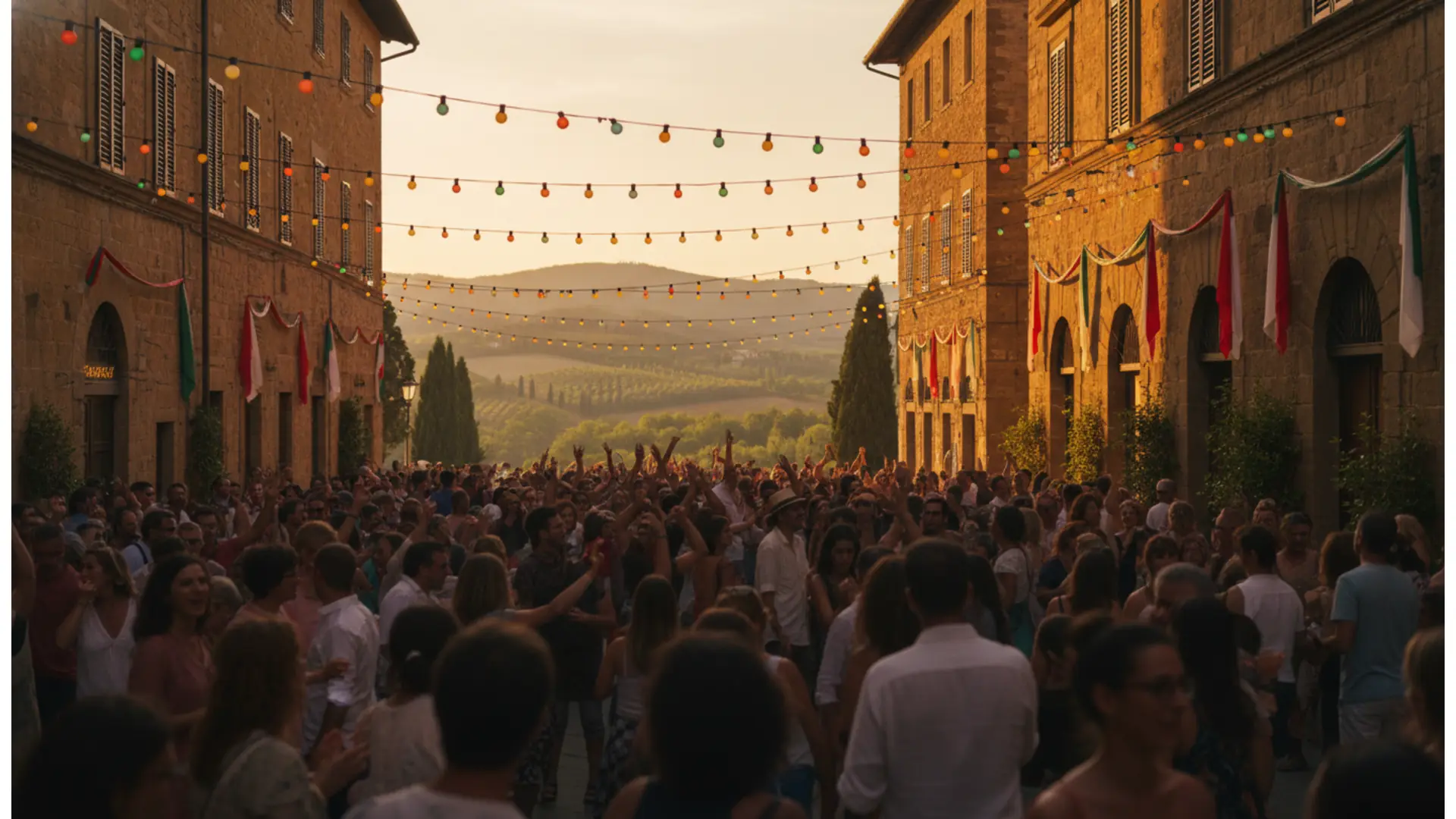
Feast of Santa Maria della Neve and the Toro Ossequioso (with the Interregional Canto a Braccio Festival)
The ancient rite of the bull kneeling before the Madonna, featuring the Manocchio, the ritual furrow, and improvised poetry
About Toro Ossequioso of Bacugno
A rite rooted in the Sabina prehistory
In Bacugno, a small village in the Municipality of Posta (province of Rieti, in the upper Velino Valley, Lazio), the first days of August bring to life a popular liturgy that scholars trace back over three millennia. The local cult of Madonna della Neve is believed to have been grafted onto ancient Sabina agrarian rites linked to the goddess Vacuna and the fertility of the fields: a slow process of Christianization that kept the gestures intact while changing only the name of the divinity to whom they are addressed. The result is a festival like no other, now recognized as one of the most precious ethno-anthropological heritages of the Central Apennines.
The Toro Ossequioso
The protagonist is a bull, patiently trained in the preceding weeks and adorned with drapes, ribbons, and ornaments. On August 5th, the day of the liturgical feast of Santa Maria della Neve, the animal is yoked in the Picciame area, joins the religious procession, and finally, upon reaching the churchyard, performs the triple genuflection before the statue of the Virgin. It is a moment charged with tension and silence, followed by hundreds of people who climb the valley every year to witness it.
The Manocchio and the furrow
Alongside the bull, two other agrarian rites of great symbolic power take place. The Manocchio is a massive wheat sheaf woven by hand, ear by ear, on the afternoon of August 3rd: it is then carried in a procession through the houses and presented to the church. At dawn on August 4th, meanwhile, local plowmen trace a ritual furrow that descends from Mount Boragine to the village, a propitiatory gesture for the fertility of the land. Those who arrive in Bacugno during these days witness a complete cycle: plowing, harvesting, offering, and blessing.
The Interregional Canto a Braccio Festival
Since 1987, on the evening of August 3rd, the churchyard has hosted the Interregional Canto a Braccio Festival, created by the poets themselves who wanted to honor the festival with their art. The poeti a braccio (improvised poets) challenge each other in improvised ottava rima on current events and daily life, accompanied by the ciaramella (folk oboe) and the accordion. The festival features singers from Lazio, Tuscany, and Abruzzo: in 2025, for the thirty-eighth edition, Alessio Runci, Paolo Santini, Pietro De Acutis, and Dante Valentini (for Lazio), Emilio Meliani and Niccolino Grassi (for Tuscany), and Marcello Patrizi and Berardino Perilli (for Abruzzo) took the stage.
The schedule for August 5th
- 9:00 AM — Yoking of the bull in the Picciame area
- 9:30 AM — Parade of the Manocchio through the hamlets
- 11:30 AM — Meeting of the religious procession with the bull and the Manocchio
- 12:30 PM — Arrival at the church, triple genuflection of the Toro Ossequioso, entry of the Manocchio into the churchyard, and the tossing of the traditional giant ring-shaped cake; tossing of smaller ring-shaped cookies by girls in traditional costumes
- 1:00 PM — Solemn commemoration of the fallen and wreath-laying
- 1:30 PM — Fireworks display
- 4:00 PM — Games and entertainment for children at the Steccato
- 8:00 PM — Opening of food stands featuring the Farrecillu festival
Flavors and atmosphere
The culinary aspect is not just a side event but a continuation of the rite: the Farrecillu, a spelt soup from the Rieti peasant tradition, is served at the Steccato along with typical dishes of the upper Velino Valley. The evenings conclude with folk music and, at midnight, with a fireworks show. It is a village festival where emigrant Bacugnesi return every year, and the welcome for visitors is genuine and warm.
Why it is worth the trip
Bacugno is reached by traveling up the Velino Valley, in a mountain landscape between Terminillo and the Laga Mountains, just a few kilometers from the border with Abruzzo and Umbria. Those looking for the Italy of authentic traditions—those not built for tourism but that have survived because the community never stopped practicing them—will find here one of the clearest examples in all of Central Italy.
Toro Ossequioso of Bacugno — edition 2026
The 2026 Edition
In Bacugno, a hamlet of the Municipality of Posta in the province of Rieti, the festival is celebrated as every year in the first days of August, culminating on August 5th, the day of Santa Maria della Neve. The ritual sequence is fixed and handed down: on the afternoon of August 3rd, the Manocchio is woven, and in the evening the churchyard hosts the Interregional Canto a Braccio Festival; at dawn on August 4th, plowmen trace the furrow that descends from Mount Boragine; on August 5th, the adorned bull meets the procession and performs the triple genuflection before the statue of the Virgin, followed by the tossing of traditional ring-shaped cakes.
At the time of writing, the Associazione Culturale Toro Ossequioso has not yet published the 2026 poster with times and names of participating poets. Updates will be released on the association's website in the weeks leading up to the festival.
Programme Toro Ossequioso of Bacugno 2026
Traditional festival structure
- August 3rd, afternoon — Weaving of the Manocchio, the huge wheat sheaf built ear by ear
- August 3rd, evening — Interregional Canto a Braccio Festival on the churchyard: poets from Lazio, Tuscany, and Abruzzo challenge each other in improvised ottava rima, accompanied by ciaramella and accordion
- August 4th, at dawn — Tracing of the ritual furrow from Mount Boragine to the church
- August 5th, 9:00 AM — Yoking of the bull in the Picciame area
- August 5th, 9:30 AM — Parade of the Manocchio through the hamlets
- August 5th, 11:30 AM — Meeting of the religious procession with the bull and the Manocchio at Picciame
- August 5th, 12:30 PM — Arrival at the church, triple genuflection of the Toro Ossequioso, entry of the Manocchio into the churchyard, tossing of ring-shaped cakes by girls in costume
- August 5th, 1:00 PM — Commemoration of the fallen and wreath-laying
- August 5th, 1:30 PM — Fireworks display
- August 5th, 4:00 PM — Games and entertainment for children at the Steccato
- August 5th, 8:00 PM — Food stands and Farrecillu festival at the Steccato; evening folk music and fireworks
The times indicated correspond to the usual festival schedule; the official 2026 program has not yet been published.
Highlights Toro Ossequioso of Bacugno 2026
- The triple genuflection of the Toro Ossequioso before the statue of Santa Maria della Neve
- The Manocchio, a hand-woven wheat sheaf carried in procession
- The ritual furrow traced at dawn from Mount Boragine
- The Interregional Canto a Braccio Festival, improvised poetry in ottava rima
- The tossing of traditional ring-shaped cakes by girls in traditional costumes
- The Farrecillu festival, a spelt soup from the Rieti tradition
Prices Toro Ossequioso of Bacugno 2026
Practical information — Toro Ossequioso of Bacugno
How to get there
By car: from the Salaria (SS4) road, reach Posta, then continue on the road to the village of Bacugno. From Rieti, it is about 40 km; from Rome, about 130 km. The nearest train station is in Rieti, which is connected by regional bus lines to the upper Velino Valley; to reach Bacugno, a car is effectively essential.
Admission and costs
Participation in the rites and the Canto a Braccio Festival is free. Food at the stands at the Steccato is for purchase, with typical village festival prices.
Tips
The moment of the triple genuflection, around 12:30 PM on August 5th, draws many people to the churchyard: it is advisable to arrive well in advance and park at the entrance to the village. You are in the mountains, over 800 meters high: the temperature drops in the evening, so a light jacket is recommended. For accommodation, you can stay in Posta, Amatrice, Leonessa, or Rieti.
Information
Associazione Culturale Toro Ossequioso, Via Steccato 2, Bacugno — 02019 Posta (RI). Updates on the website www.bacugno.it.
Festival-goer photos
No photos yet. Share yours!
Share your photos
5 photos max, 5 MB per photo (JPG, PNG, WebP)
Noticed an error or missing information?
Help us keep this listing up to date. Every proposal is verified by our team before publication.
Festival-goer reviews
No rating yet — be the first!
No comments yet. Be the first!
Were you there?
Share your experience with the community.
Published by Valentin Contard, festival listings writer. Reviewed, corrected and approved by Christophe Contard, editor-in-chief. .
Where does it take place — Toro Ossequioso of Bacugno
Bacugno, sagrato della chiesa di Santa Maria della Neve
Via Steccato, 2 - Bacugno, 02019 Posta