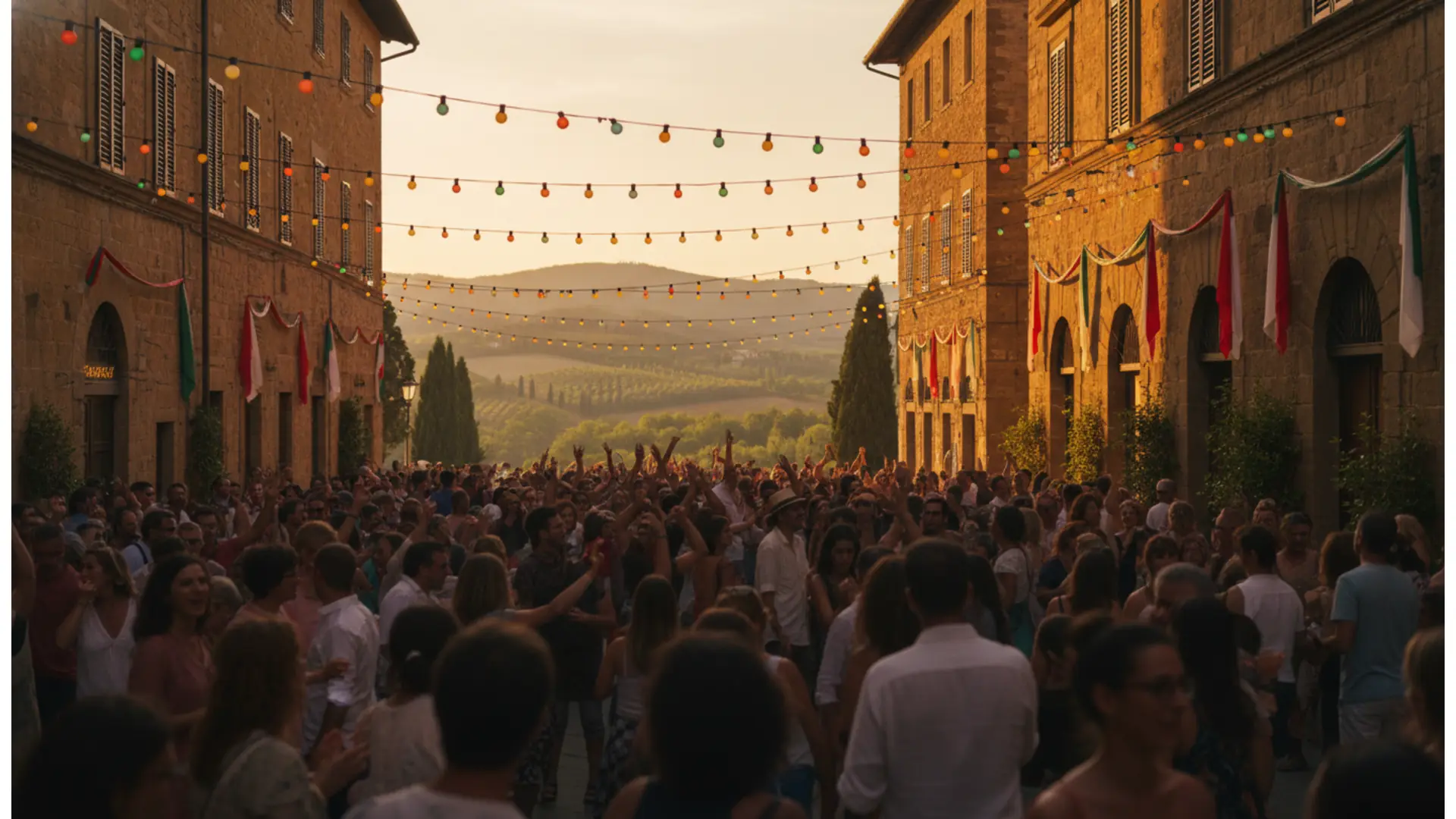
Corpus Domini Flower Festival in Fumone
The village alleys carpeted in petals for the Corpus Domini solemnity
About Fumone Flower Festival
A carpet of flowers on the Terrace of Ciociaria
Fumone is one of the most recognizable villages in southern Lazio: a rock cone at 793 meters above sea level, nestled between the Ernici and Lepini Mountains, dominating the entire valley. It is not by chance that it is called the Terrace of Ciociaria. Here, every year, the solemnity of Corpus Domini transforms the maze of alleys in the historic center into an open-air gallery: the stones disappear under a continuous floral carpet that follows the path of the Eucharistic procession.
The tradition of Ciociaria flower festivals
Fumone belongs to a network of towns in the province of Frosinone that set up their flower festivals on the same Sunday: Alatri, Ferentino, Sora, Cervaro, and the Abbey of Casamari. It is a collective tradition that unites the entire Ciociaria region, described by the provincial tourism portal with a striking image: for Corpus Domini, the streets and villages transform into flowering meadows, featuring scenes from the life of Jesus and the Madonna. In nearby Alatri, the floral carpet earned a Guinness World Record in 1999 as the longest uninterrupted one in the world, measuring nearly 1,476 meters.
How a floral masterpiece is born
The work is not improvised. Sketches are studied weeks in advance, flowers are gathered and selected in the preceding days, and petals are separated by color and kept in a cool place. The palette is the spontaneous one of the Ciociaria countryside: the yellow of broom, the blue of wildflowers, the red of carnations, and the green of boxwood and wild fennel. The laying takes place during the cooler hours, between late Saturday afternoon and Sunday morning, when families and groups of volunteers work side-by-side, kneeling on the cobblestones.
A work destined to last only a few hours
The most fascinating characteristic of the flower festival is its fragility. The carpet is completed just before the celebration and then traversed by the procession: the passage of the Blessed Sacrament and the faithful progressively undoes the designs. Those who arrive early in the morning see the work intact; those who arrive in the afternoon find only traces of it. This is precisely the religious meaning of the gesture—to offer the most beautiful thing one can create, knowing it will last only for the duration of a liturgy.
The village of Fumone as a backdrop
No two flower festivals are the same, and in Fumone, the context makes the difference. The route winds through arches, portals, and stairways of the medieval village, up to the vicinity of Castello Longhi De Paolis, the fortress that served as the prison for Pope Celestine V in 1295 and today houses some of the highest hanging gardens in Europe. For centuries, Fumone was the sentinel of the Papal States, capable of warning Rome with smoke signals by day and fires by night: hence the popular saying, "when Fumone smokes, the whole Campagna trembles."
What to expect as a visitor
- A fully pedestrian historic center, to be explored on foot at a leisurely pace
- Floral displays with sacred themes, made exclusively with plant materials
- The Corpus Domini procession that walks over the carpet
- Open panoramic views over the Sacco Valley and the Ernici Mountains
- Free and open access to the entire flower festival route
When to go
The date follows the liturgical calendar and changes every year: Corpus Domini falls on the Sunday following the solemnity of the Most Holy Trinity, therefore between late May and the second half of June. We recommend arriving early, when the colors are still vibrant and the morning light enhances the contrast between the petals and the gray stone of the alleys. A visit to Fumone can easily be combined with the other flower festivals of the Ciociaria, all held on the same day and within a short distance of each other.
Fumone Flower Festival — edition 2026
Corpus Domini 2026 in Fumone
In 2026, the solemnity of Corpus Domini fell on Sunday, June 7. Fumone renewed its flower festival alongside the other centers of Ciociaria that share this tradition — Alatri, Ferentino, Sora, Cervaro, and the Abbey of Casamari — as indicated by the tourism portal of the province of Frosinone.
As every year, the floral displays were composed directly on the cobblestones of the village alleys, using petals, broom, boxwood, and wild fennel, to then be traversed by the procession carrying the Blessed Sacrament. Access to the route was free and open to all.
Programme Fumone Flower Festival 2026
Highlights Fumone Flower Festival 2026
Prices Fumone Flower Festival 2026
Practical information — Fumone Flower Festival
How to get there
By car from the A1 Rome-Naples motorway, take the Anagni-Fiuggi exit, then follow the provincial road for about 15-20 minutes. From Rome, the total journey is just over an hour. By train, the reference station is Anagni-Fiuggi on the Rome-Cassino line, to be completed by bus or taxi.
Parking and access
The village is pedestrian-only: cars must be left in the parking lots at the foot of the town, and you must walk up. Comfortable shoes are recommended, as the route is uphill and on cobblestones.
Costs
Visiting the flower festival is free. The visit to the Castello Longhi De Paolis is paid and requires booking with a guide.
Tips
Arrive in the early morning to see the carpets while they are still intact. Do not step on the floral displays before the procession passes. At this altitude, the temperature is cooler than in the valley, even in June.
Festival-goer photos
No photos yet. Share yours!
Share your photos
5 photos max, 5 MB per photo (JPG, PNG, WebP)
Noticed an error or missing information?
Help us keep this listing up to date. Every proposal is verified by our team before publication.
Festival-goer reviews
No rating yet — be the first!
No comments yet. Be the first!
Were you there?
Share your experience with the community.
Published by Valentin Contard, festival listings writer. Reviewed, corrected and approved by Christophe Contard, editor-in-chief. .
Where does it take place — Fumone Flower Festival
Centro storico di Fumone