Corbara and the Corbarino
Two evenings of tammorra, tarantella, and cherry tomatoes in the village of the Lattari Mountains
About Corbarino Festival
Corbara and the Corbarino: the Lattari Mountains cherry tomato festival
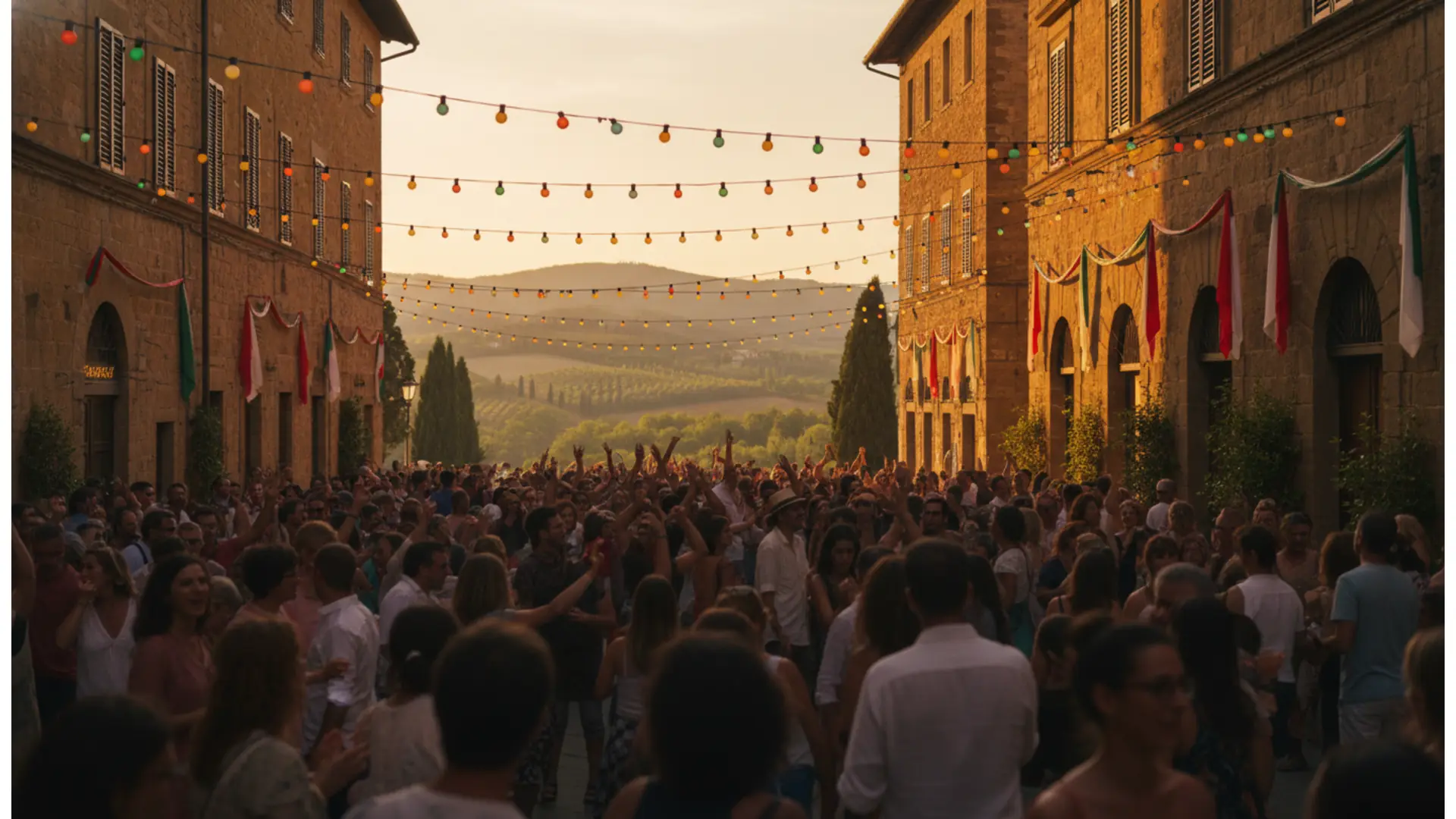
In mid-July, the small town of Corbara, in the province of Salerno, Campania, transforms for two evenings into a grand open-air dining room to celebrate the product that bears its name: the Corbarino cherry tomato. The Corbara and the Corbarino event, reaching its 18th edition in 2026, fills the alleys, courtyards, and gardens of the historic center with a local motto that has accompanied it for years: «Se magna, se balla e se beve o' vino… tammorra, tarantella e pomodorino» (You eat, you dance, and you drink wine… tammorra, tarantella, and cherry tomatoes). It is not just a simple village fair, but a moment where an agricultural community showcases its very identity.
A village suspended between the Agro and the Coast
Corbara is a hillside town perched on the northern slopes of the Lattari Mountains, in the territory that acts as a bridge between the Agro Nocerino Sarnese and the Amalfi Coast. On these terraced slopes, exposed to the sun and sea breezes, the Corbarino cherry tomato ripens: small, with a thick skin and a sweet yet tangy taste, it is one of the most recognizable products of Campanian cuisine and the ideal base for quick sauces and long-lasting preserves. The festival was born precisely to tell its story to visitors, explaining how it is grown, preserved, and prepared.
Borgo Sala, the stage of the festival
The heart of the event is Borgo Sala, the ancient core of the town around Via Gerardo Giordano. For two nights, the entire village becomes a continuous path: you walk through narrow streets, peek into courtyards opened for the occasion, and move from one tasting point to another without a set order. It is a formula that works because it does not separate the public from the residents: the houses, doorways, and private gardens are all part of the scenery.
At the table: what to eat
The food stalls offer traditional local peasant dishes, almost all built around the cherry tomato. Among the specialties returning every year:
- Spaghetti allo scarpariello, the festival's signature dish;
- Corbarino caponata, with stale bread, cherry tomatoes, and olive oil;
- Sausage and Corbarino sandwich, the most popular choice among the youth;
- Gluten-free options, provided to ensure everyone can participate;
- Traditional desserts accompanied by local wine.
Admission to the event is free: you only pay for what you consume at the stalls, with affordable prices designed for families.
Tammorra, tarantella, and folk song
The soundtrack of the festival is the folk music of Southern Italy. Tammorre and tarantellas mark the evenings and guide visitors from one corner of the village to the other; in the 2026 edition, musical entertainment was entrusted to the Compagnia Paganese, with a repertoire dedicated to southern folk songs. Dancing is not confined to the stage: it is common for impromptu circles to form in the small squares, with those who know the steps teaching others.
The Calata dell'Angelo
The festival intertwines with another deeply rooted tradition of Corbara, the Calata dell'Angelo, a sacred representation of ancient origin linked to the festivities in honor of Saint Erasmus, the town's co-patron. Anyone visiting Corbara at this time of year finds themselves faced with a dual narrative: the devotional and the gastronomic, which in the culture of Campanian villages are never truly separate.
Who organizes it
The event is promoted by the Pro Loco of Corbara with the support of the Municipality of Corbara, the Slow Food Convivium of the Agro Nocerino Sarnese, and UNPLI. The presence of Slow Food is no coincidence: the festival is also an opportunity for agricultural promotion, aiming to defend a niche production and the small farmers who carry it forward on the terraces of the Lattari Mountains.
Why it's worth a visit
Corbara and the Corbarino remains a human-scale festival, far from the large food and wine events built for mass tourism. You arrive as the sun sets, eat well for little money, listen to live music, and discover a village that in summer is just a few kilometers from the chaos of the Amalfi Coast but retains a rhythm all its own. For those visiting Campania in July, it is a stop that tells the story of the territory much better than any guidebook.
Corbarino Festival — edition 2026
Corbara and the Corbarino 2026: the 18th edition
The 2026 edition of the festival was held on Saturday, July 18th and Sunday, July 19th, opening at 8:30 PM in Borgo Sala, the ancient core of Corbara, in the province of Salerno. As per tradition, the route wound through the alleys, courtyards, and gardens of the village, with tasting points distributed along the entire path.
The taste
The menu revolved around the Corbarino cherry tomato: spaghetti allo scarpariello, Corbarino caponata, sausage and cherry tomato sandwiches, as well as gluten-free options and traditional desserts, accompanied by local wine.
The music
Musical entertainment was provided by the Compagnia Paganese, which offered a repertoire dedicated to Southern folk songs, including tammorre and tarantellas, helping to create the festive atmosphere that characterizes the event.
Organization
The event was organized by the Pro Loco of Corbara with the support of the Municipality of Corbara, the Slow Food Convivium of the Agro Nocerino Sarnese, and UNPLI. During the same period, the town also hosted the Calata dell'Angelo, the sacred representation linked to the festivities of Saint Erasmus.
Programme Corbarino Festival 2026
Saturday, July 18th, 2026
- 8:30 PM — Opening of food stalls in Borgo Sala: spaghetti allo scarpariello, Corbarino caponata, sausage and cherry tomato sandwiches, gluten-free options, traditional desserts, and local wine.
- From 8:30 PM — Free exploration of the alleys, courtyards, and gardens of the historic center.
- In the evening — Music and entertainment with the Compagnia Paganese, featuring a repertoire of Southern Italian folk songs, including tammorre and tarantellas.
Sunday, July 19th, 2026
- 8:30 PM — Second evening of tastings at the Borgo Sala stalls.
- In the evening — Continuation of folk music and dancing in the village.
During the same period, the Calata dell'Angelo took place, a traditional sacred representation linked to the celebrations in honor of Saint Erasmus, co-patron of Corbara.
Highlights Corbarino Festival 2026
- 18th edition of the festival dedicated to the Corbarino cherry tomato
- Borgo Sala open for two evenings: alleys, courtyards, and gardens of the historic center
- Spaghetti allo scarpariello and Corbarino caponata among the signature dishes
- Gluten-free options available at the stalls
- Southern Italian folk music with the Compagnia Paganese
- Coincided with the Calata dell'Angelo, a sacred representation for Saint Erasmus
- Free admission, with the support of Slow Food Agro Nocerino Sarnese and UNPLI
Prices Corbarino Festival 2026
Practical information — Corbarino Festival
When
Two evenings in mid-July, starting at 8:30 PM. In 2026, the 18th edition took place on Saturday, July 18th and Sunday, July 19th.
Where
Borgo Sala, historic center of Corbara (SA), around Via Gerardo Giordano. The route winds through alleys, courtyards, and gardens: comfortable shoes are recommended.
How to get there
- By car: A3 Naples-Salerno motorway, exit Nocera Inferiore or Angri, then provincial road towards Corbara. The historic center has restricted traffic during the festival: it is best to park in the designated areas at the edge of town and walk up.
- By train: Nocera Inferiore or Pagani stations on the Naples-Salerno line, then bus or taxi to Corbara.
- By plane: Naples Capodichino Airport, approximately 45 km away.
Prices
Admission is free. You only pay for tastings and purchases at the stalls, at popular prices.
Tips
Summer evenings in the hills can be cool after midnight: a light sweatshirt is useful. For those wishing to stay overnight, accommodation is available in Nocera Inferiore, Angri, and on the nearby Amalfi Coast.
Information
Pro Loco of Corbara and Municipality of Corbara, tel. +39 081 913801.
Festival-goer photos
No photos yet. Share yours!
Share your photos
5 photos max, 5 MB per photo (JPG, PNG, WebP)
Noticed an error or missing information?
Help us keep this listing up to date. Every proposal is verified by our team before publication.
Festival-goer reviews
No rating yet — be the first!
No comments yet. Be the first!
Were you there?
Share your experience with the community.
Published by Valentin Contard, festival listings writer. Reviewed, corrected and approved by Christophe Contard, editor-in-chief. .
Where does it take place — Corbarino Festival
Borgo Sala (centro storico di Corbara)
Via Gerardo Giordano, Borgo Sala, 84010 Corbara