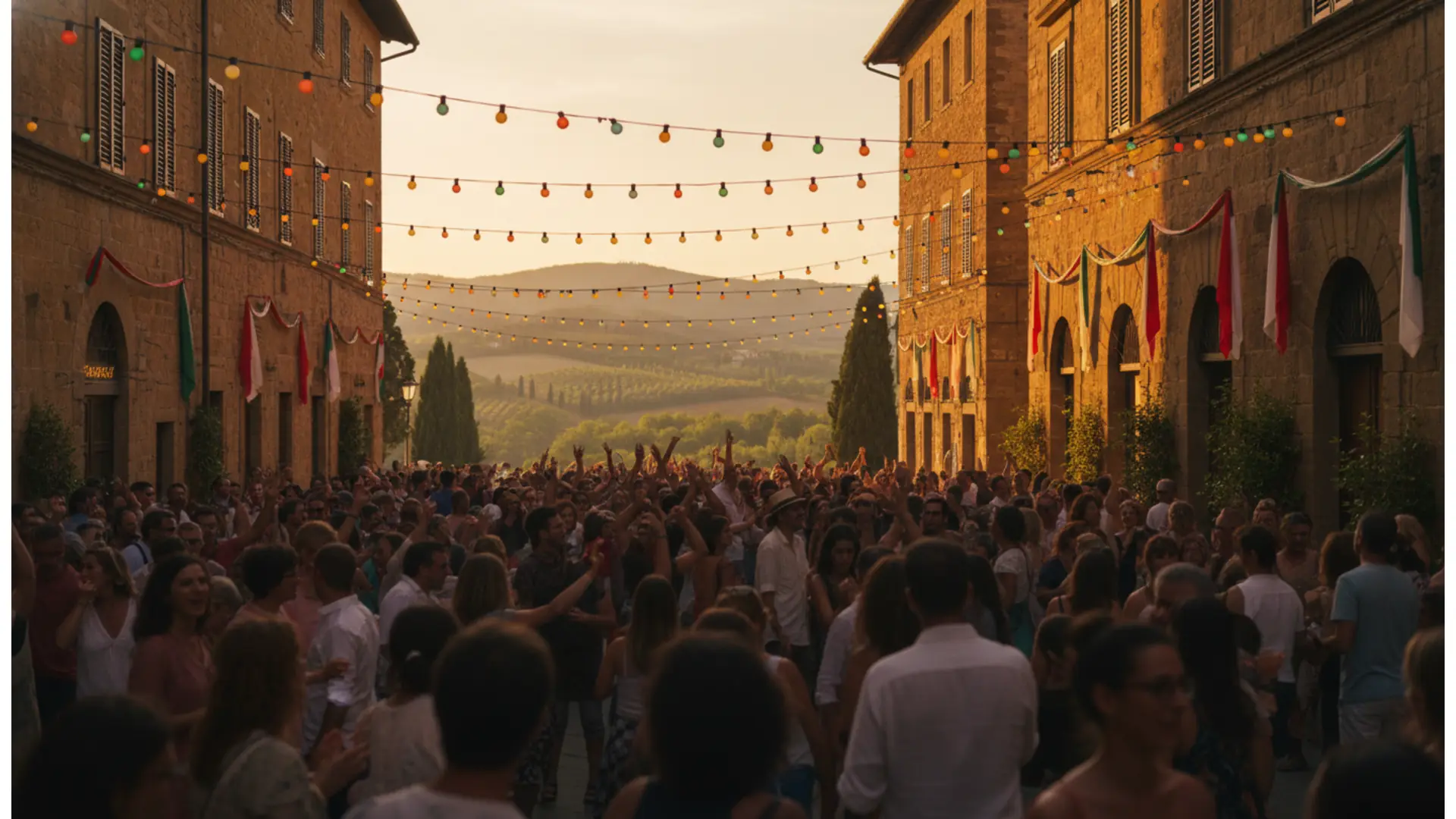
'A Màschkarata (San Mauro Carnival)
The ancient rural carnival of the Cilento region, featuring Prucinella, the Zite, and the burning of the Cannuluvàro
About 'A Màschkarata
A rural carnival born from peasant memory
In San Mauro Cilento, a small hillside town in the province of Salerno perched at an altitude of about 560 meters in the heart of the Cilento, Vallo di Diano and Alburni National Park, the carnival has nothing to do with allegorical floats. It is 'A Màschkarata, a traveling theatrical performance that takes place among the stone houses of the village and has been passed down by the community from generation to generation. In the local dialect, the festival is called masckaràta and those who wear the mask are the màsckaro: the vocabulary alone reveals how deeply rooted this tradition is in the identity of the town and, more broadly, of inland Campania.
Not a parade, but a popular commedia dell'arte
The San Mauro carnival consists of a series of scenes that intertwine along the route, following a script that is unwritten but fixed by tradition. The characters belong to a popular, stylized version of the commedia dell'arte: Prucinella, the Cilento-style Pulcinella, jealous and protective, who accompanies his daughters—the Zite to be married—along with the Turk, the Volante, the Devil, the Bishop, the Priest, the Doctor, the Barber, the Notary, the Cardalàna, Death, and the allegorical figures of Carnival and Lent. Standing out among them is the Double Person, a mannequin mounted on the back of an actor who walks hunched over: a woman carrying a man on her shoulders, a powerful image of the female role as the backbone of rural society in times past.
The sound of the tófa, the conch shell once used by farmers as a call, announces the beginning of the rite. From that moment on, spectators are no longer mere observers: in the famous hunter's game, a simple tap on the shoulder is enough to be targeted, and those who turn around are covered in bran amidst the laughter of the entire village.
The burning of the Cannuluvàro
The highlight of the day is the burning of the Cannuluvàro, the character who personifies the dietary excess of the carnival: having died from eating too many meatballs, he is carried in a procession on a ladder by four masked figures dressed in black and finally set on fire. It is the symbolic gesture that closes the time of disorder and opens Lent, a rite of passage common to many rural carnivals in Cilento—where the puppet is also known as Carnuluvàro—but which retains a rare dramatic power here.
The route: between Casal Sottano and Casal Soprano
The maschkarate depart in the early afternoon from the two historic districts, Casal Sottano and Casal Soprano, and move toward each other along the village streets; on the second day, the route is reversed. The procession passes through alleys, squares, and courtyards, stopping in front of houses to perform the scenes: the entire village becomes a stage, with residents participating just as much as the actors.
A recognized heritage
- Since 2023, 'A Màschkarata has been inscribed in the Inventory of Intangible Cultural Heritage of the Campania Region.
- In 2022, it was selected by the Ministry of Culture for a project dedicated to intangible ties in festive landscapes.
- The performance actions were documented by photographer Barbara Di Maio and exhibited at the Museo di Roma in Trastevere, representing the Campania Region.
- The Faculty of Architecture of the University of Naples Federico II has studied the San Mauro carnival alongside other historical festivals to build scientific documentation, with a view toward a possible UNESCO candidacy.
All initiatives related to the festival are coordinated by a local popular committee, now gathered in the 'A Maschkarata Carnevale Sanmaurese association, which operates at its own expense: a grassroots commitment that explains the quality of the costumes and the preservation of the tradition.
The Living Museum of the Carnival
The tradition does not live only during the festival days. In the Ratto district, in the historic center of San Mauro Cilento, an ancient 17th-century olive mill houses the Living Museum of the Carnival: handmade stage costumes, masks of the popular commedia dell'arte, reconstructions of the scenes, music, and materials that tell the story of the deep bond between the community and its festival. Visits are by appointment and are the best way to understand 'A Màschkarata even outside the carnival period.
Flavors and conviviality
Like every peasant carnival, the Màschkarata also ends at the table: sausage, bread and potato meatballs—a signature humble dish of San Mauro Cilento—and fried chiacchiere accompany the convivial moment that follows the procession, often enlivened by live music. Surrounding this is a territory that is a recognized home of the Mediterranean Diet and produces high-quality extra virgin olive oil, waiting to be discovered at local farms.
Why it's worth the trip
Those looking for the spectacular carnival of large parades will not find it here. 'A Màschkarata is something else: popular theater, satire, peasant memory, and collective participation in a village of a few hundred inhabitants. For an Italian or international visitor, it is one of the most authentic opportunities that Campania offers to understand how festivals were celebrated in Cilento villages before the carnival became an industry.
'A Màschkarata — edition 2026
'A Màschkarata 2026
In 2026, the ancient traveling performance of San Mauro Cilento was once again staged on the two canonical days of the Cilento carnival: the last Sunday before Ash Wednesday and Shrove Tuesday. Sunday, February 15, the maschkarate departed at 3:00 PM from the districts of Casal Sottano and Casal Soprano, moving toward each other along the village streets; Tuesday, February 17, the procession was repeated at the same time with the route reversed between the two districts.
The rite opened with the sound of the tófa and followed the traditional script: Prucinella with the Zite, the Turk, the Volante, the Double Person, the Cardalàna, the Doctor, the Barber, the Notary, the Devil, and Death, the hunter's game with bran thrown at the spectators, and, in closing, the burning of the Cannuluvàro carried in procession on a ladder by four masked figures dressed in black.
The musical show with tasting planned at the end of the festival was postponed to Sunday, February 22, at 5:30 PM, in the Piazza N. Petillo parking area, with samples of sausage, meatballs, and chiacchiere. The organization is by the 'A Maschkarata Carnevale Sanmaurese association, which manages the event together with the local popular committee in the Municipality of San Mauro Cilento (province of Salerno, Campania).
Programme 'A Màschkarata 2026
Sunday, February 15, 2026
- 3:00 PM — Departure of the maschkarate from Casal Sottano and Casal Soprano: traveling theatrical procession along the village streets with Prucinella, the Zite, the Turk, the Volante, the Double Person, the Cardalàna, and other traditional masks.
- During the afternoon: hunter's game with the public and, in closing, the burning of the Cannuluvàro.
Tuesday, February 17, 2026
- 3:00 PM — Second maschkarata, departing from the two districts with the route reversed compared to Sunday.
Sunday, February 22, 2026
- 5:30 PM — Musical show in the Piazza N. Petillo parking area (appointment postponed from the original dates of February 15 and 17).
- Followed by: tasting with sausage, meatballs, and chiacchiere.
Highlights 'A Màschkarata 2026
- The sound of the tófa announcing the start of the ancient rite.
- Prucinella and the Zite, the heart of the San Mauro popular commedia dell'arte.
- The Double Person, the mannequin carried hunched on the actor's back.
- The hunter's game, with bran thrown at distracted spectators.
- The burning of the Cannuluvàro, the symbolic epilogue of the carnival.
- The final tasting with sausage, meatballs, and chiacchiere.
Prices 'A Màschkarata 2026
Practical information — 'A Màschkarata
How to get there
San Mauro Cilento can be reached by car from the Cilentana highway, exiting toward Vallo della Lucania and continuing along the provincial hillside roads. The reference train station is Vallo della Lucania-Castelnuovo, on the Salerno-Reggio Calabria line, about twenty kilometers away; the nearest airports are Salerno-Costa d'Amalfi and Naples-Capodichino.
Parking and mobility
The village is small and very steep: it is best to leave the car in the parking spaces at the entrance to the districts—including the Piazza N. Petillo parking area—and continue on foot. Comfortable shoes are essential, as the procession moves along inclines and descents.
Tips
- The maschkarate depart in the early afternoon: it is best to arrive at least half an hour early.
- At an altitude of 560 meters, it can be cold in February: dress in layers.
- Watch out for the hunter's game: bran flies, so it is better to avoid delicate clothing.
- The Living Museum of the Carnival, in the Ratto district, can be visited by appointment.
- For accommodation, it is best to rely on local agritourisms or those on the coast between Pollica-Acciaroli and Montecorice, just a few kilometers away.
Contacts
Associazione 'A Maschkarata Carnevale Sanmaurese — e-mail: [email protected]. Updates and dates are published on the association's Facebook page and on local Cilento event portals.
Festival-goer photos
No photos yet. Share yours!
Share your photos
5 photos max, 5 MB per photo (JPG, PNG, WebP)
Noticed an error or missing information?
Help us keep this listing up to date. Every proposal is verified by our team before publication.
Festival-goer reviews
No rating yet — be the first!
No comments yet. Be the first!
Were you there?
Share your experience with the community.
Published by Valentin Contard, festival listings writer. Reviewed, corrected and approved by Christophe Contard, editor-in-chief. .
Where does it take place — 'A Màschkarata
Casal Sottano e Casal Soprano, centro storico