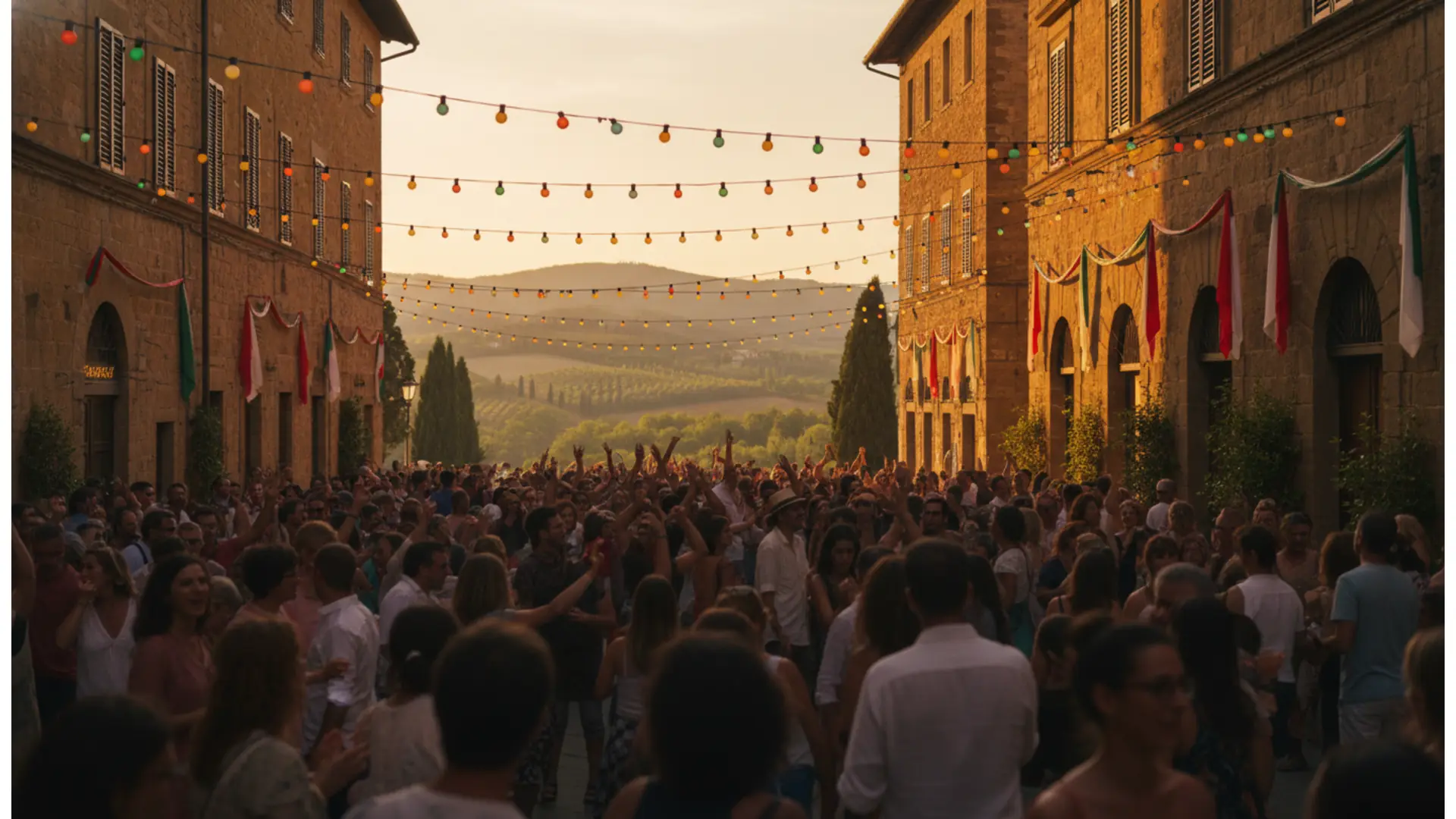
Saint Nicholas of Bari Festival in Perito
The patronal feast of Perito, between the votive Patronage in August and the solemnity of December 6th
Edition 2026 not confirmed to date
This edition has not been confirmed by the organiser to date. We recommend checking before going.
About Saint Nicholas of Bari
A cult that marks the year
In the Municipality of Perito, a small town in the heart of the Cilento region in Campania, devotion to Saint Nicholas of Bari is not limited to a single day. The patron saint is celebrated twice a year: with the votive Patronage festival, which local tradition sets for the first Sunday of August, and with the liturgical solemnity of December 6th, the date the Church dedicates to the Bishop of Myra throughout Italy. It is a dual recurrence that perfectly illustrates the relationship between the village and its saint: a winter festival, intimate and liturgical, and a summer festival, more choral and participatory.
Perito, a balcony over Cilento
Perito has just over seven hundred inhabitants and sits at an altitude of about 465 meters, with the hamlet of Ostigliano completing the municipal territory. The town's name is thought to derive from the Latin piretum, meaning pear orchard. The heart of civic life is Piazza della Vittoria, which acts as a natural balcony overlooking the valley, offering glimpses of the sea and the coast on clear days. Having become an autonomous municipality in 1850 after being a hamlet of Orria, the village still preserves a fabric of stone houses, narrow alleys, and small rural chapels.
The 16th-century Church of Saint Nicholas
The focal point of the festival is the parish church of Saint Nicholas of Bari, a building dating back to the 16th century, distinguished by its monumental bell tower, constructed from the remains of an ancient Angevin-era tower. Inside, the church houses various works of art and the statue of the saint, which is carried in procession through the village streets during the festivities. The oldest part of the town is arranged around the building, with the square serving as a natural meeting point for the community.
The Patronage of the first Sunday of August
Starting in the 18th century, various votive recurrences were established in Cilento, intended as acts of thanksgiving or requests for intercession, later transforming into patronage festivals in perpetual memory. In Perito, as in the nearby Valle Cilento, this recurrence falls on the first Sunday of August. The choice of date is not accidental: it is the time of year when the village repopulates thanks to the return of emigrants and families coming back for their holidays, making the festival an occasion for collective reunion as well as devotion. The heart of the day remains the solemn mass followed by the procession with the saint's statue through the center.
The solemnity of December 6th
On December 6th, the day the Church commemorates the death of Saint Nicholas, Perito celebrates the true liturgical solemnity. It is a more collected festival, experienced primarily by the parish community, and fits into a Cilento landscape rich in winter rites linked to the saint.
Saint Nicholas, the most beloved saint of Cilento
In Cilento, the parish title dedicated to Saint Nicholas is second only to that reserved for the Virgin Mary: dozens of churches and chapels bear his name, and many towns have chosen him as their patron. A dense web of popular traditions has developed around the recurrence, from the votive bonfires lit on the eve—such as the one in the Spio district of Vallo della Lucania, in front of the saint's chapel—to dates shifted by vow, as in Gioi, where the festival was set for December 16th after the earthquake that struck Lucania in 1857. Participating in the Perito festival therefore means coming into contact with a devotion that is a shared cultural heritage of the entire inner Cilento region.
What to expect
- Solemn mass and procession with the patron saint's statue through the historic center
- An authentic Cilento village, far from mass tourism circuits
- A community that gathers in full in August, including residents and emigrants
- The opportunity to visit the 16th-century church and its Angevin bell tower
2026 Program
At the time of writing, no official program for the 2026 Perito patronal festival has been published online. Available information confirms the votive recurrence on the first Sunday of August and the solemnity of December 6th, but not the details of times and events: it is therefore advisable to check with the parish or the Municipality of Perito before traveling.
Saint Nicholas of Bari — edition 2026
For the year 2026, no official program for the Saint Nicholas of Bari Festival in Perito, Cilento, has been published. Available sources confirm the custom of the votive Patronage festival on the first Sunday of August and the liturgical solemnity of December 6th, but do not report times, events, or civil initiatives for this year.
Those wishing to participate can contact the parish of Saint Nicholas of Bari or the offices of the Municipality of Perito, in the Province of Salerno, which normally release information in the weeks immediately preceding the event. As with most Cilento patronal festivals, the core of the celebrations remains the solemn mass followed by the procession with the patron's statue through the streets of the historic center.
Prices Saint Nicholas of Bari 2026
Practical information — Saint Nicholas of Bari
Location
Perito (SA), Postal Code 84060, Province of Salerno, Campania. The celebrations are concentrated in the parish church of Saint Nicholas of Bari and the streets of the historic center, with the main square serving as the meeting point.
How to get there
By car: Take the Battipaglia exit on the A2 del Mediterraneo motorway, then the SS18 to Vallo della Lucania and follow the provincial roads leading up to inner Cilento. By train: The reference stations are Vallo della Lucania-Castelnuovo and Agropoli-Castellabate on the Tyrrhenian line; from there, connections continue via local bus lines or taxis. By plane: Salerno-Costa d'Amalfi Airport or Naples-Capodichino Airport.
Admission and costs
Participation in religious celebrations and the procession is free of charge.
Tips
The village is small and parking in the center is limited: it is best to leave your car in the outer areas and continue on foot. For the exact date and times, it is always best to contact the parish of Saint Nicholas of Bari or the Municipality of Perito, as the calendar may vary from year to year. Those visiting Perito in August can combine the patronal festival with the village's other summer events.
Festival-goer photos
No photos yet. Share yours!
Share your photos
5 photos max, 5 MB per photo (JPG, PNG, WebP)
Noticed an error or missing information?
Help us keep this listing up to date. Every proposal is verified by our team before publication.
Festival-goer reviews
No rating yet — be the first!
No comments yet. Be the first!
Were you there?
Share your experience with the community.
Published by Valentin Contard, festival listings writer. Reviewed, corrected and approved by Christophe Contard, editor-in-chief. .
Where does it take place — Saint Nicholas of Bari
Chiesa di San Nicola di Bari e centro storico