Saint Faustinus Festival (Patronal Feast)
The patron saint of lonely hearts celebrated in Pietradefusi, between Irpinia and the Calore Valley
Edition 2026 not confirmed to date
This edition has not been confirmed by the organiser to date. We recommend checking before going.
About Saint Faustinus Festival
Saint Faustinus, a Roman martyr in the heart of Irpinia
The Saint Faustinus Festival is the most cherished event in Pietradefusi, a town of just over two thousand inhabitants in the province of Avellino, nestled in the hilly hinterland of Campania. The relics of the young Roman soldier, who converted to Christianity and died a martyr defending his faith, arrived here thanks to Cardinal Nicola Coscia (1682-1755), a native of the town and Secretary of State to Pope Benedict XIII. Obtained from a family in Benevento, they were authenticated and translated between September 6th and 8th, 1717, to the Church of San Gennaro, where they remained largely forgotten for about 120 years.
The miracle of 1835 and the birth of the cult
The turning point came in 1835: according to tradition reported by the Municipality, the saint appeared in a dream to the elderly paralyzed man Sabato Petrillo, who was healed. The collective emotion was so profound that Saint Faustinus was proclaimed the main patron of Pietradefusi, replacing Saint Lucidus, and from the following year, the name Faustino became extremely popular among newborns in the town. Since then, the statue of the martyr, depicting him in a gentle slumber wearing military attire and sporting long, thick hair, has been the most venerated by local faithful and is kept in the Collegiate Church of Maria Santissima Annunziata, a Greek-cross church with three naves built in 1728 by Cardinal Coscia himself.
Two appointments every year
In Pietradefusi, the patron saint is solemnly celebrated twice a year, with two very different spirits:
- February 15th — the liturgical anniversary: schools remain closed and churches open, with celebrations dedicated to the martyr on the day the calendar reserves for the saint.
- Second Sunday of August — the actual civil festival, which draws emigrants, families, and visitors from neighboring towns, enlivening the town center for an entire day and evening.
The religious program
The devotional aspect has always defined the festivities: the novena of preparation, the solemn masses in the Collegiate Church of the Annunziata, and above all the procession with the statue of the saint along the streets of the village, accompanied by the faithful and the local brass band. It is the moment when the Pietradefusi community gathers in full, blending ancient devotion with a strong sense of belonging.
The civil festival in Piazza Marconi
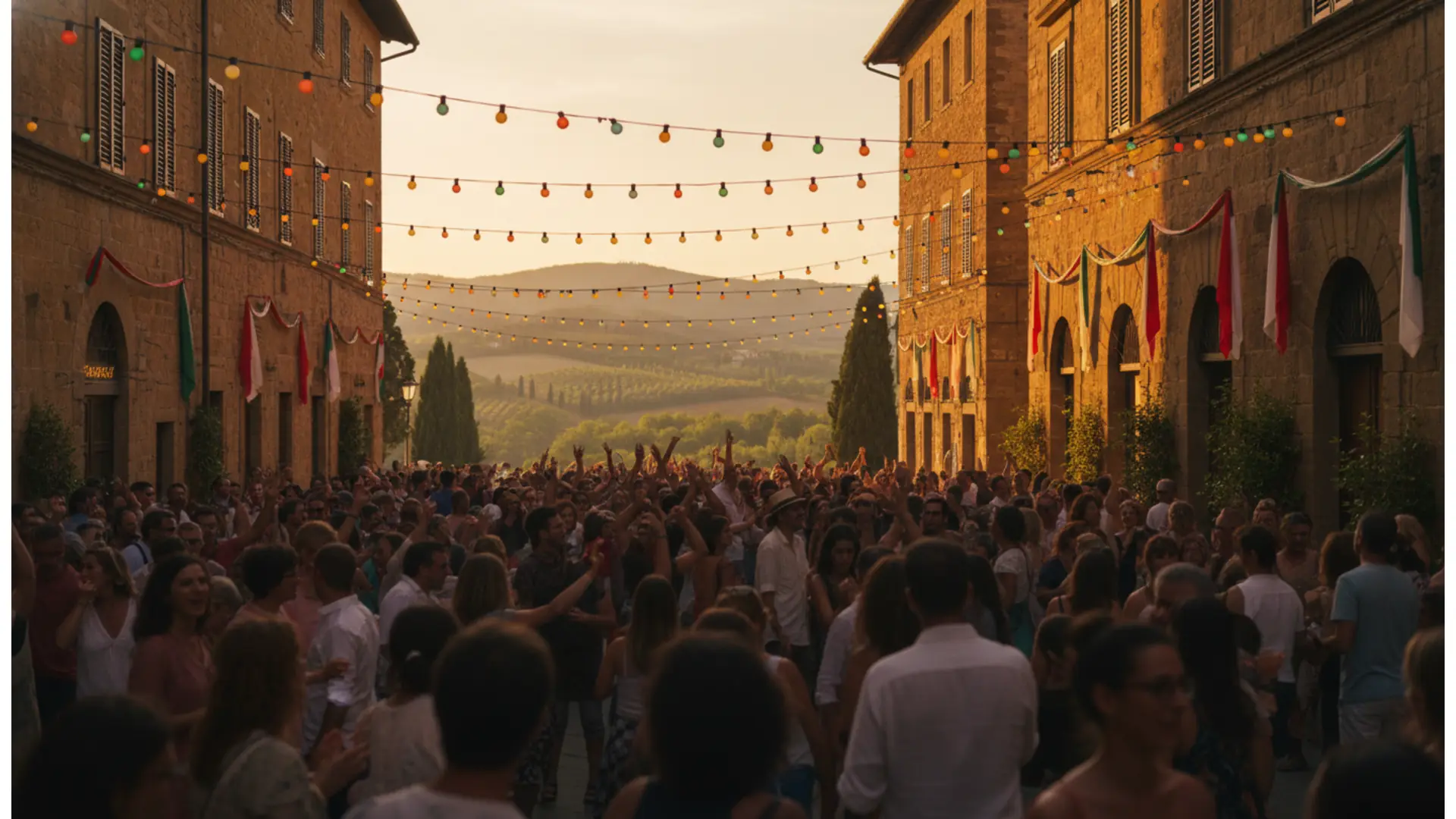
As evening falls, the focus shifts to Piazza Guglielmo Marconi, the heart of the town's summer events. The central streets are decorated with illuminations, and the civil program alternates between group dances, tastings of local products, brass band concerts, and light music evenings, culminating in the traditional fireworks display that closes the festivities. The atmosphere is that of a genuine Irpinian patronal feast.
The patron saint of singles
In recent decades, Saint Faustinus has gained a curious notoriety: proclaimed by popular belief as the protector of singles—those who do not celebrate Valentine's Day—he attracts young and old alike to Pietradefusi in search of their soulmate, entrusting themselves to the graces of the sleeping saint. The town also maintains a Christian twinning with Brescia, the other Italian city under the protection of Saint Faustinus.
The village, the tower, and the flavors
The festival is also the best opportunity to discover Pietradefusi, on the border between the provinces of Avellino and Benevento. In the historic center, the base of the Aragonese Tower remains, built in 1431 by the feudal lord Giacomo de Tocco as a gathering point for the population in case of invasions. The hamlet of Dentecane is famous throughout Italy for the artisanal production of torrone (nougat) and pantorrone, while the territory offers Taurasi and Aglianico wine, Camponica hazelnuts, and acacia honey. In the days immediately preceding the patronal feast, Piazza Marconi itself hosts the Fusillo and Pietrafusana Braciola Festival, one of the longest-running food festivals in Irpinia: those arriving for the patron saint will therefore find an entire weekend of tradition and gastronomy.
The 2026 edition
At the time of writing, the official dates for the 2026 civil festivities have not yet been published by the Municipality or the parish. Custom, confirmed by all local sources, places the festival on the second Sunday of August, while the liturgical anniversary remains fixed on February 15th. It is advisable to check the final program on the Municipality and parish channels in the weeks leading up to the event.
Saint Faustinus Festival — edition 2026
What is known about the 2026 edition
As of the date of this entry, the Municipality of Pietradefusi and the Maria Santissima Annunziata Parish have not yet released the calendar of civil festivities in honor of Saint Faustinus the Martyr for 2026. For this reason, the date indicated is provisional and should be considered purely indicative.
The usual structure of the festival
According to local sources, the patronal festival of Pietradefusi is organized every year into a religious program—novena, holy masses, and a procession along the streets of the center—and an evening civil program in Piazza Guglielmo Marconi, featuring illuminations, group dances, tastings of local products, brass band concerts, and light music, before the customary closing fireworks display.
How to check the dates
Those planning a visit to Irpinia in August 2026 can monitor the notices from the Municipality of Pietradefusi and the parish, as well as the local press of the province of Avellino, which announces the patronal festival and the nearby Fusillo and Pietrafusana Braciola Festival together every year. This entry will be updated as soon as the official program is made public.
Prices Saint Faustinus Festival 2026
Practical information — Saint Faustinus Festival
How to get there
Pietradefusi is located in the middle Calore Valley, on the border between the provinces of Avellino and Benevento; the municipal territory is crossed by the state road 90 delle Puglie, which connects the town and the hamlet of Dentecane to nearby centers. Traveling by car is the most convenient way to reach the village; the reference railway stations and connections are those of Avellino and Benevento, from where you can continue with local bus lines or taxis.
Where it takes place
Religious celebrations are held in the Collegiate Church of Maria Santissima Annunziata and along the streets of the center during the procession; civil events, concerts, and fireworks are concentrated in Piazza Guglielmo Marconi.
Admission and costs
Participation in celebrations and square performances is free. Only potential tastings at food stands are paid, with popular prices typical of Irpinian festivals.
Tips
August evenings in the hills can be cool: it is advisable to bring a light sweater. The historic center is easily explored on foot, but the ground is partly uphill and paved with stone: comfortable shoes are recommended. For accommodation, you can rely on farmhouses and facilities in the Calore Valley and the Taurasi area.
Festival-goer photos
No photos yet. Share yours!
Share your photos
5 photos max, 5 MB per photo (JPG, PNG, WebP)
Noticed an error or missing information?
Help us keep this listing up to date. Every proposal is verified by our team before publication.
Festival-goer reviews
No rating yet — be the first!
No comments yet. Be the first!
Were you there?
Share your experience with the community.
Published by Valentin Contard, festival listings writer. Reviewed, corrected and approved by Christophe Contard, editor-in-chief. .
Where does it take place — Saint Faustinus Festival
Piazza Guglielmo Marconi e Collegiata di Maria Santissima Annunziata