Montemarano Carnival
The Montemarano tarantella, the Caporabballo, and the 'Dead Carnival' ritual in the Irpinian village
About Montemarano Carnival
The Montemarano Carnival, the beating heart of Irpinia
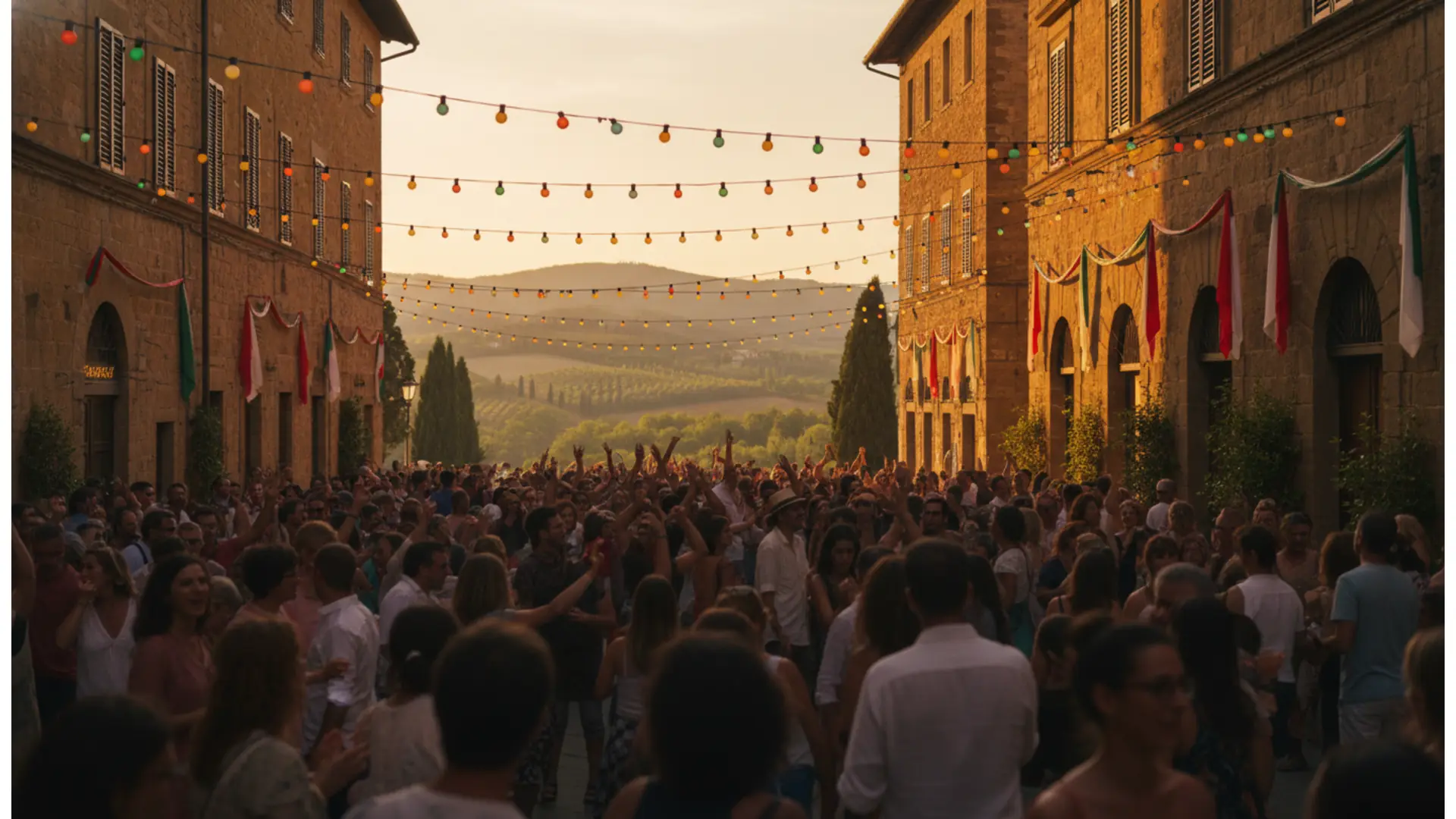
Perched among the Aglianico vineyards and the forests of the Alta Valle del Calore, the town of Montemarano, in the province of Avellino, preserves one of the most authentic folk carnivals in Campania and the entire South. Here, the festival is not a show to be watched from behind a barrier: it is a collective ritual where anyone arriving in town eventually ends up joining the procession dancing through the streets. There are no massive floats or monumental stages, just live music, local masks, and an entire community that finds its identity in its own traditions.
The Montemarano tarantella and the Caporabballo
The hallmark of the event is the Montemarano tarantella, a processional dance that winds through the main streets of the village to the rhythm of clarinets, accordions, drums, and castanets. Leading it is the Caporabballo, a figure dressed in white and red who sets the pace, calls out the figures, and pulls dancers and the public into an increasingly frenetic crescendo. This is not a fixed choreography: improvisation is the rule, and the line between spectator and participant dissolves in minutes.
The Montemarano Tarantella School has played a decisive role in passing on this intangible heritage. Its workshops, open to everyone, attract groups of enthusiasts every year from all over Italy, including northern cities like Bologna, Ferrara, and Milan—a phenomenon that has made the Carnival a rare example of a living tradition in an inland area marked by depopulation.
Masks, processions, and the reversal of roles
As in every peasant carnival, in Montemarano the world turns upside down. Behind the mask, the people mock the powerful, and social hierarchies are suspended for a few days. The recurring elements are always the same:
- Masked processions, which parade both by day and by night, accompanied by local bands of musicians.
- The Pacchiana, the traditional female costume, and the Caporabballo's outfit, both preserved in the local civic museum.
- Pulcinella, a mask that embodies the spirit of reversal upon which the entire festival is based.
- Cross-dressing and role-swapping, with men dressed as women and women as men, an ancient satire of social conventions.
The 'Dead Carnival' ritual
The closing is the most evocative and beloved moment: the Dead Carnival. A grotesque funeral procession crosses the town mourning the end of the festivities, until it reaches the reading of the will, a satirical text in which the deceased Carnival lists the debts, vices, and misdeeds accumulated during the festival, targeting local characters and events of the past year. The reading is followed by the breaking of the pignata, the pot that releases sweets and biscuits, and the final big party in the square before Lent.
Piazza del Gusto and Irpinian flavors
Throughout the event, the Piazza del Gusto remains active, with food and wine stands set up in Piazza Mercato where you can taste the typical products of the Avellino area. We are in the land of Aglianico and Taurasi DOCG, just a few kilometers from the Irpinian wine villages: dining is an integral part of the experience, featuring mountain cheeses, cured meats, homemade pasta, and Carnival sweets.
The Civic Ethnomusical Museum
Those who want to truly understand the roots of the festival can visit the Celestino Coscia and Antonio Bocchino Civic Ethnomusical Museum, dedicated to the instruments and historical performers of the local tarantella: double-reed flutes, accordions, organettos, tambourines, traditional costumes, and a collection of texts on Irpinian ethnomusicology.
Who organizes the Carnival
The event is promoted by the Municipality of Montemarano in collaboration with the A. Di Meo Comprehensive Institute, the Montemarano Tarantella School, the Pro Montemarano Association, the Pro Loco Montemarano, the Fratres Group, the Misericordia of Montemarano, and other local associations. All events are free to attend.
Why it's worth the trip
In a landscape of increasingly spectacularized carnivals, the Montemarano one remains a community ritual linked to agricultural cycles and the transition from winter to spring. Those who arrive here do not watch a parade: they enter a dance that lasts for hours, amidst maskers who know every alleyway. This is one of the reasons why the festival is considered an intangible cultural heritage to be protected and one of the strongest identity-defining events in all of Irpinia.
Montemarano Carnival — edition 2026
The 2026 edition
The 2026 Montemarano Carnival took place over two weekends in February, from the 9th to the 22nd, with the peak days between Friday, February 13, and Tuesday, February 17, and the closing on Sunday, February 22. The Municipality of Montemarano, in the province of Avellino, built the program around three pillars: masked parades, Montemarano tarantella workshops open to everyone, and moments of cultural reflection on the value of the Carnival as intangible heritage.
The opening was entrusted to the Carnival of Cultures, followed the next day by a conference dedicated to the cultural heritage of the Carnival, with a tribute to maestro Roberto De Simone and the presentation of the Silver Caporabballo award. The first parade was the night-time one on Saturday, February 14, which started at 10:00 PM through the village streets.
On Sunday, February 15, Monday, February 16, and Tuesday, February 17, the main parades, collective dances in the square, school initiatives, and evening concerts took place. On Sunday, February 22, from 4:00 PM, the Dead Carnival procession crossed the village with the reading of the will, before the final party in Piazza Mercato from 9:30 PM with live music by Musica Solare.
Despite bad weather in Campania that forced several events to postpone their parades for the weekend of February 21-22, the final day in Montemarano was confirmed and took place as scheduled.
Programme Montemarano Carnival 2026
Friday, February 13, 2026
- Opening of the event with the Carnival of Cultures show.
Saturday, February 14, 2026
- Conference dedicated to the Montemarano Carnival as intangible cultural heritage, with a tribute to maestro Roberto De Simone.
- Presentation of the Silver Caporabballo award.
- From 10:00 PM: first night-time parade of masked processions through the village streets.
Sunday, February 15, Monday, February 16, and Tuesday, February 17, 2026
- Montemarano tarantella workshops organized by the Montemarano Tarantella School, open to beginners and enthusiasts.
- Parades of masked groups at various times of the day, with the Caporabballo leading the processional dance.
- Involvement of children and students from local schools.
- Collective dances and evening folk music concerts in the square.
Sunday, February 22, 2026
- From 4:00 PM, through the village streets: Dead Carnival, symbolic funeral procession and reading of the will.
- From 9:30 PM, in Piazza Mercato: closing of the festivities with a concert by Musica Solare.
Throughout the event
- Piazza del Gusto in Piazza Mercato, with food and wine stands dedicated to typical products of the Avellino area.
- Visits to the Celestino Coscia and Antonio Bocchino Civic Ethnomusical Museum.
- Equipped camper area available for visitors.
Highlights Montemarano Carnival 2026
- The night-time parade on Saturday, February 14, starting at 10:00 PM through the village alleys.
- The processional dance of the Montemarano tarantella led by the Caporabballo, between Sunday, February 15, and Tuesday, February 17.
- Free tarantella workshops by the Montemarano Tarantella School, with participants arriving from as far as Bologna, Ferrara, and Milan.
- The conference on the Carnival as intangible heritage and the Silver Caporabballo award.
- The Dead Carnival procession on February 22 with the satirical reading of the will.
- The final party in Piazza Mercato with Musica Solare from 9:30 PM.
- The Piazza del Gusto with the flavors of Irpinia, active throughout the event.
Prices Montemarano Carnival 2026
Practical information — Montemarano Carnival
How to get there
Montemarano is located in the Alta Valle del Calore, about twenty kilometers from Avellino. By car, take the A16 Naples-Canosa motorway, exit at Avellino Est, then continue inland along the roads towards Alta Irpinia. The reference railway stations are those of Avellino and Benevento, connected to the town by regional bus lines; the nearest airport is Naples-Capodichino.
Parking and campers
During the parades, the historic center is closed to traffic: it is best to leave your car in the parking lots at the entrance to the town and continue on foot. A equipped camper area is available and is widely used by groups of dancers arriving from outside the region.
Costs
Parades, tarantella workshops, concerts, and closing rituals are free of charge. You only pay for what you consume at the Piazza del Gusto stands.
Tips
The village is at a high altitude and it is cold in February, especially during the night parades: comfortable shoes and warm clothing are essential. Those who want to dance can participate in the free Montemarano tarantella workshops, designed even for beginners. For last-minute updates, it is advisable to follow the official Facebook page of the Montemarano Carnival.
Contacts
Municipality of Montemarano, Piazza del Popolo 1, 83040 Montemarano (AV) — phone 0827 63012, email [email protected].
Festival-goer photos
No photos yet. Share yours!
Share your photos
5 photos max, 5 MB per photo (JPG, PNG, WebP)
Noticed an error or missing information?
Help us keep this listing up to date. Every proposal is verified by our team before publication.
Festival-goer reviews
No rating yet — be the first!
No comments yet. Be the first!
Were you there?
Share your experience with the community.
Published by Valentin Contard, festival listings writer. Reviewed, corrected and approved by Christophe Contard, editor-in-chief. .
Where does it take place — Montemarano Carnival
Centro storico e Piazza Mercato
Piazza Del Popolo, 1, 83040 Montemarano