Majo di San Michele
The fire ritual and the climb to the hermitage, in the heart of Sannio
About Majo di San Michele
A fire ritual among the oldest in Sannio
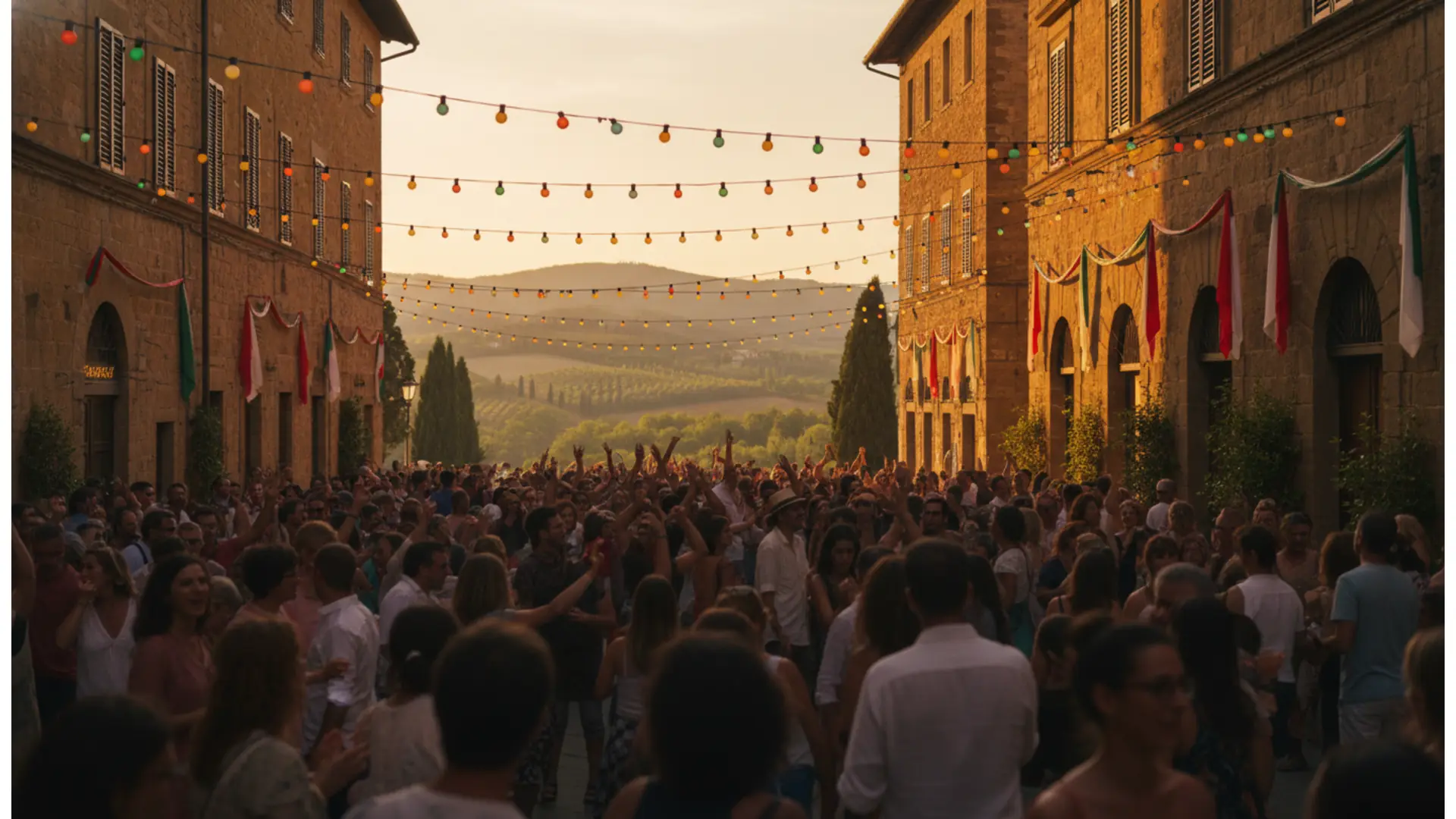
In the Municipality of Frasso Telesino, in the Province of Benevento (Campania), the Majo di San Michele is much more than a patronal feast: it is a propitiatory fire ritual that returns every year in early May, when spring is in full bloom and ancient pastoral communities celebrated the regeneration of nature. The village, overlooking the Telesina valley and nestled in the Taburno-Camposauro Regional Park, literally lights up district by district, in a night that belongs to all its inhabitants.
The «metalo», the Maji, and the Moifà chant
In the days leading up to May 7th, the young people of each district choose a tree with a thick canopy in the surrounding woods, strip it of its side branches, and plant it in the center of the square: this is the metalo, a word of Greek origin meaning «at the center». Around the pole, wood collected over weeks is stacked in a cone shape, while the top is adorned with broom flowers gathered in the Prata plain. At dusk, after the Christian blessing, torches lit from a common fire reach every Majo: the pyres rise into the night and the community intones the Moifà, a polyphonic chant passed down orally and unique to Frasso Telesino. People dance, sing, and eat until dawn while the bonfires continue to burn.
The climb to the hermitage of Monte Sant'Angelo
The second part of the festival is the procession: the statue of the Archangel leaves the church of Santa Giuliana, in the historic center, and is carried on shoulders along the path that climbs to the hermitage of San Michele, in the Camposcuro area, on the summit of Monte Sant'Angelo. Here, next to the sacred cave and the large basins that collected rainwater for the mountain pasture animals, open-air mass is celebrated and a communal lunch is enjoyed on the grass. The statue does not return to the village immediately: it remains at the hermitage throughout the summer and only returns to the parish on September 29th, the day of the liturgical feast of Saint Michael the Archangel.
Lombard roots and rural memory
Local studies place the Majo in early medieval Christianity, as a Lombard reinterpretation of older cults linked to fire, the fertility of the fields, and the protection of travelers and shepherds: we are in a territory that belonged to the Samnites and then the Romans, a short distance from Benevento, capital of the Longobardia Minor, from where the Michaelic cult spread starting from the Gargano cave. The first written evidence of devotion to Saint Michael in this corner of Sannio dates back to 1361. In agro-pastoral practice, the smoke from the Maji also had a purification function: flocks would pass through it before transhumance. The religious dimension is also accompanied by that of incubatio, the ancient custom of sleeping in the sacred cave to obtain a grace.
What to expect as a visitor
- An authentic, non-touristy event: you enter the districts, spend time with families, and taste what the neighbors offer.
- The Moifà, which alone is worth the trip: a popular polyphony that you won't hear in any other town in Italy.
- The view from the hermitage over the Telesina valley and the Taburno massif, for those who tackle the climb on foot.
- Trekking shoes, water, and a light jacket: the mountain, even in May, remains a mountain.
Frasso Telesino, a village of wine and traditions
Also known as the village of wine, Frasso Telesino preserves a medieval layout of alleys and arches, and in the local calendar, the Majo coexists with other deeply felt devotions, such as the Feast of the Crucifix of Brancone. Those who arrive for the Majo will find a Sannio village that tells its story through its language, songs, and products, within a protected natural area just over an hour from Naples.
Majo di San Michele — edition 2026
Majo di San Michele 2026: faith, fire, and community
The Municipality of Frasso Telesino presented the 2026 edition as «an appointment that unites faith, history, and the warmth of our community around the traditional MAJI». The chosen dates were May 7th to 10th, with the heart of the ritual set — as per tradition — on the eve of the Archangel's apparition at Gargano.
Thursday, May 7th, the church of Santa Giuliana opened the festival with evening mass; this was followed by the blessing of the fire in Piazza IV Novembre and, immediately after, the lighting of the Maji in the various districts, where young people had already erected the metalo and stacked the wood collected in the Taburno-Camposauro woods. Around the pyres, the Moifà was sung, the oral polyphony typical of Frasso.
Sunday, May 10th, the morning mass at Santa Giuliana preceded the procession with the statue of Saint Michael towards the mountain; at noon, the celebration was held at the hermitage of Monte Sant'Angelo, in the Camposcuro area, for the faithful who had tackled the climb. From that moment on, the statue remained at the hermitage, as every year, awaiting its return to the village on September 29th.
Programme Majo di San Michele 2026
Thursday, May 7th, 2026
- 19:00 — Holy Mass in the church of Santa Giuliana
- 20:00 — Blessing of the fire in Piazza IV Novembre
- 20:30 — Lighting of the Maji in the various districts of the town, with Moifà singing, dancing, and communal tables
Sunday, May 10th, 2026
- 10:00 — Holy Mass in the church of Santa Giuliana, followed by the procession with the statue of Saint Michael the Archangel
- 12:00 — Holy Mass at the hermitage of Monte Sant'Angelo, Camposcuro area, for the faithful present
On May 7th and 8th, the Municipality implemented traffic closure and security measures in the areas affected by the Maji and the procession.
Highlights Majo di San Michele 2026
- The blessing of the fire in Piazza IV Novembre and the torch run towards the districts
- The simultaneous lighting of the Maji around the metalo, the trunk planted in the center of the pyre
- The polyphonic Moifà chant, passed down orally and unique to Frasso Telesino
- The procession of the statue of Saint Michael from the church of Santa Giuliana to the mountain hermitage
- The noon mass at the hermitage of Monte Sant'Angelo, in the Camposcuro area
Prices Majo di San Michele 2026
Practical information — Majo di San Michele
How to get there
By car: A1 motorway, Caserta Nord exit or A16, Benevento exit, then SS 372 Telesina, Frasso Telesino - Dugenta exit. From Naples, about 1 hour and 15 minutes.
By train: Caserta-Benevento line, Frasso Telesino - Dugenta station (in the valley floor), then local connection or taxi to the town center.
Times and locations
The fire ritual takes place in the evening, after sunset, in the town's districts; the procession departs from the church of Santa Giuliana, on Via Piano dei Santi. The mass at the hermitage is celebrated at altitude, in the Camposcuro area, and is reached on foot along the mountain path.
Costs
Free participation in all religious moments and the lighting of the Maji in the districts.
Tips
- Park outside the historic center: traffic closures are planned during the events.
- For the climb to the hermitage, suitable footwear, water, and sun protection are required.
- Respect safety distances from the bonfires and follow the instructions of the Municipal Police.
Contacts
Municipality of Frasso Telesino, tel. +39 0824 973024.
Festival-goer photos
No photos yet. Share yours!
Share your photos
5 photos max, 5 MB per photo (JPG, PNG, WebP)
Noticed an error or missing information?
Help us keep this listing up to date. Every proposal is verified by our team before publication.
Festival-goer reviews
No rating yet — be the first!
No comments yet. Be the first!
Were you there?
Share your experience with the community.
Published by Valentin Contard, festival listings writer. Reviewed, corrected and approved by Christophe Contard, editor-in-chief. .
Where does it take place — Majo di San Michele
Chiesa di Santa Giuliana, rioni del paese ed Eremo di San Michele a Monte Sant'Angelo
Via Piano dei Santi, 82030 Frasso Telesino