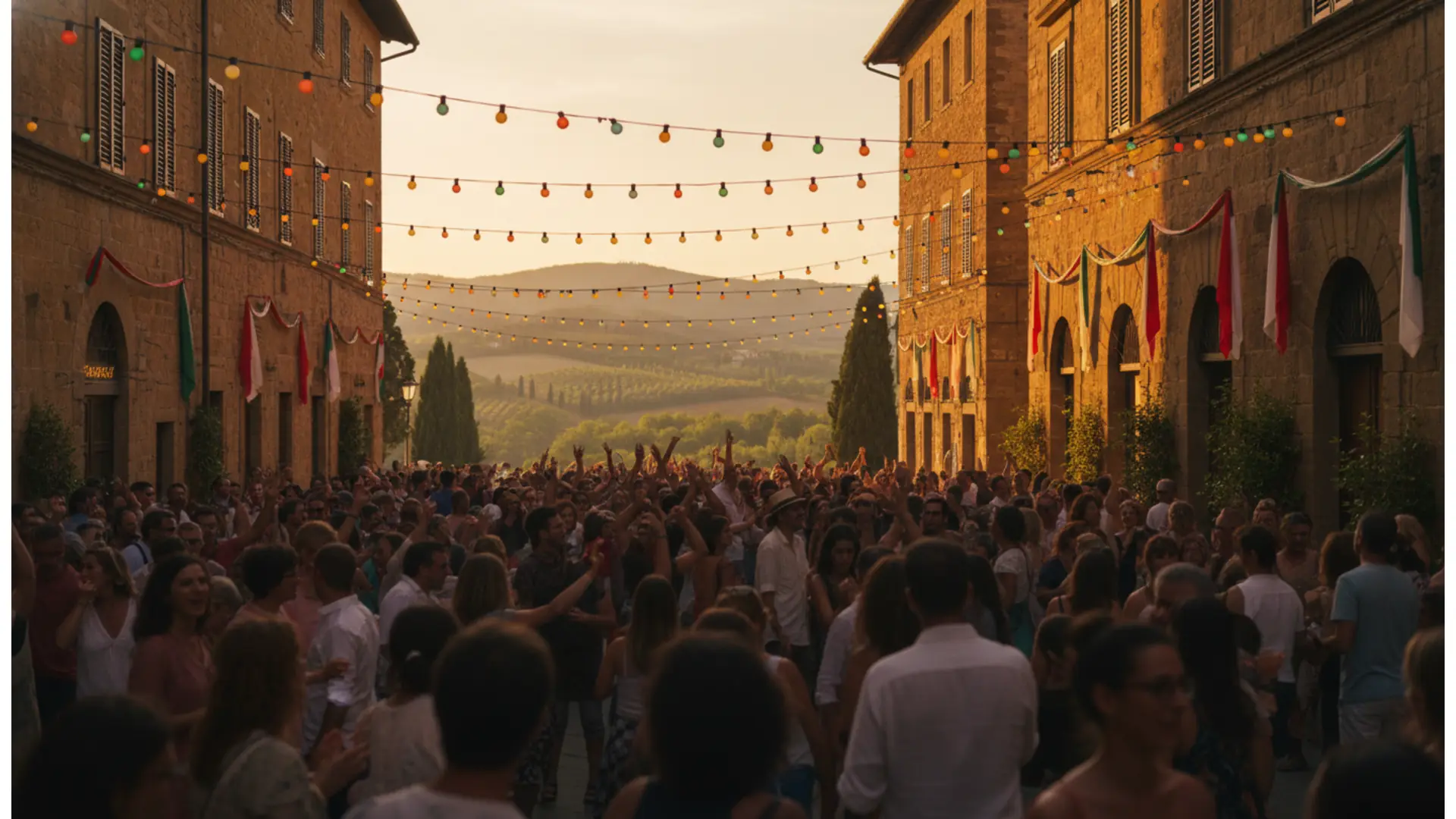
Gigli Festival of Nola (San Paolino Feast)
Eight wood and papier-mâché obelisks and the Boat of San Paolino dance on the shoulders of the cullatori in the historic center of Nola
About Gigli Festival
A tradition recognized by UNESCO
The Gigli Festival is not just the patronal feast of the town of Nola, in the province of Naples, Campania: it is the defining event for an entire city, the moment when the historic center transforms into a massive open-air stage. The festival is part of the Network of Major Shoulder-Borne Processional Structures, inscribed by UNESCO on the Representative List of the Intangible Cultural Heritage of Humanity alongside the Macchina di Santa Rosa in Viterbo, the Varia di Palmi, and the Candelieri of Sassari. This recognition is proudly celebrated by the locals every year and has made the event one of the most famous folk traditions in Southern Italy.
The legend of Saint Paolino and the white lilies
The festival's roots go back to the 5th century. According to tradition, Bishop Paolino offered himself as a slave to the barbarians to ransom the young people of Nola deported during the incursions linked to Alaric. Upon his return to the city in 431, the population welcomed him by waving white lilies as a sign of gratitude. From that floral tribute, the obelisks that still traverse the medieval streets of Nola were born over the centuries: no longer flowers, but true ephemeral architectures of wood and papier-mâché.
Eight Lilies and a Boat
The absolute stars are the eight Gigli, standing about twenty-five meters tall, and the Boat of San Paolino, which commemorates the saint's return from captivity. Each structure is entrusted to a historic guild of arts and crafts of the city:
- Greengrocer, Salumeria, Tavern-keeper, Baker
- Butcher, Cobbler, Blacksmith, Tailor
- the Boat of San Paolino, carried by the Orgoglio Nolano team
Each structure is lifted and made to dance by a paranza of about 120 bearers (cullatori), who move in time to the brass bands stationed at the base of the machine. The movements, spins, and stops are studied in minute detail: lifting twenty-five meters of wood and papier-mâché on one's shoulders requires months of preparation, rehearsals, and a collective discipline passed down from father to son.
The Giugno Nolano: a month of events
The Gigli Festival does not end in a single day. The calendar, which the locals call Giugno Nolano, spans weeks and leads the city toward the main day with religious, civil, and cultural appointments:
- the Novena of San Paolino in the Cathedral of Santa Maria Assunta in Cielo;
- the Historical Pageant of the Orsini, a costume re-enactment dedicated to the lordship that ruled Nola in the Middle Ages;
- the Franciscan Festival of Saint Anthony and neighborhood celebrations;
- concerts, theatrical performances, and papier-mâché exhibitions spread across squares, churches, and courtyards;
- the transport of the gigli spogliati (stripped lilies), the technical stability test of the machines still without their decorations;
- the procession of the silver bust of Saint Paolino, on June 22, followed by a pyromusical show in Piazza Duomo;
- the Saturday of the Committees, with a parade, music, and awards on the eve of the Ballata.
The Ballata dei Gigli
The heart of the festival is the Ballata (The Dance), held on the Sunday following June 22, the date of the saint's death. The day begins at dawn with the Bearers' Mass and continues without pause: solemn blessing, afternoon procession, and the parade of the machines along the urban circuit between Piazza Duomo, Corso Tommaso Vitale, and Piazza Giordano Bruno. The return of the Gigli to the square late at night is the most emotional moment, with thousands of people accompanying the final lifts.
Atmosphere and tips for your visit
During the central week, the historic center fills with stalls, street food, and markets, while the Gigli Museum opens with extended hours to tell the story of the machines and the teams. All main events are free to enter. First-time visitors should arrive in the morning, move on foot, and expect very large crowds: the Ballata is a participatory ritual, not a show for grandstands, and is best experienced by letting yourself be carried away by the rhythm of the bands and the chants of the teams.
Gigli Festival — edition 2026
A month of celebration in the historic center
The 2026 Gigli Festival animated Nola for an entire month, from May 31 to June 30, with the Giugno Nolano calendar spread across Piazza Duomo, the historic center, Piazza Matteotti, and other city venues. Alongside the devotional moments dedicated to Saint Paolino, there were theatrical performances, concerts, and exhibitions on papier-mâché, including the Ricartapesitamo project hosted at the Historical Archaeological Museum.
Key days
On June 22, the anniversary of the saint's death, the Cathedral of Santa Maria Assunta in Cielo hosted the Pontifical Mass, followed in the evening by the procession of the silver bust and the pyromusical show in Piazza Duomo. June 27 was the day of the Saturday of the Committees, with a parade and awards. On Sunday, June 28, the Ballata dei Gigli traveled the urban circuit from 12:00 PM to midnight, with the blessing given by the bishop and the afternoon procession. The calendar closed on Tuesday, June 30, with the final concert.
Programme Gigli Festival 2026
Prologue and central weeks
- May 31: Official opening of the Giugno Nolano calendar.
- June 13: Franciscan Festival of Saint Anthony; start of the Novena of San Paolino in the Cathedral.
- June 13-14: Historical Pageant of the Orsini, edition titled Nuptiae.
- June 15-27: Theatrical performances and concerts spread across Piazza Duomo, the historic center, Piazza Matteotti, and other city venues.
- June 20-21: Transport of the stripped lilies, the traditional stability test of the machines.
Monday, June 22 - San Paolino
- 11:30 AM: Pontifical Mass in the Cathedral of Santa Maria Assunta in Cielo.
- 7:00 PM: Procession of the silver bust of San Paolino.
- Followed by: Pyromusical show in Piazza Duomo.
From Wednesday, June 24 to Monday, June 29
- Gigli Museum with extended hours: 10:00 AM - 1:00 PM and 5:00 PM - 8:00 PM.
- June 27 and 28: Street food and markets in the center, from 10:00 AM to 12:00 AM.
Saturday, June 27 - Saturday of the Committees
- Parade of the guild committees, music, and awards.
Sunday, June 28 - Ballata dei Gigli
- 8:00 AM: Bearers' Mass.
- 8:30 AM: First Ballata in Piazza Duomo.
- 12:00 PM to 12:00 AM: Ballata dei Gigli along the urban circuit between Piazza Duomo, Corso Tommaso Vitale, and Piazza Giordano Bruno.
- 4:00 PM: Solemn blessing and procession.
- 6:00 PM to 10:00 PM: Exit of the Boat of San Paolino.
Tuesday, June 30
- 9:00 PM: Final concert, closing of the Giugno Nolano.
Highlights Gigli Festival 2026
- Eight wood and papier-mâché Gigli about 25 meters tall plus the Boat of San Paolino, carried on shoulders by teams of about 120 bearers.
- The Ballata on Sunday, June 28, from the Bearers' Mass at dawn to the return of the machines late at night.
- The UNESCO seal of the Network of Major Shoulder-Borne Processional Structures, shared with Viterbo, Palmi, and Sassari.
- The procession of the saint's silver bust on June 22 and the pyromusical show in Piazza Duomo.
- The Historical Pageant of the Orsini and the costume re-enactments on June 13 and 14.
- The Gigli Museum with extraordinary openings during the festival week.
Prices Gigli Festival 2026
Practical information — Gigli Festival
Getting there
By train: Nola is connected to Naples by the regional line; from the station, the historic center can be reached on foot or by local connections. By car: Take the Nola exit from the A16 Naples-Canosa motorway, then follow signs for the center. On the day of the Ballata, the historic center is closed to traffic.
Parking and shuttles
On peak days, the Municipality of Nola activates six dedicated parking areas (P1 to P6) with a shuttle service every ten minutes from Vulcano Buono and the Sporting Club to the city center.
Admission and prices
All events of the Gigli Festival are free: processions, the Ballata, concerts, and parades take place in public spaces. Only purchases at stalls, street food vendors, and commercial establishments are paid.
Tips
- Arrive early in the morning on the day of the Ballata to find a spot along the route.
- Wear comfortable shoes: you will be moving on foot and standing for many hours.
- Bring water and protect yourself from the sun; temperatures in late June are high.
- The Gigli Museum has extended hours during the festival week.
Festival-goer photos
No photos yet. Share yours!
Share your photos
5 photos max, 5 MB per photo (JPG, PNG, WebP)
Noticed an error or missing information?
Help us keep this listing up to date. Every proposal is verified by our team before publication.
Festival-goer reviews
No rating yet — be the first!
No comments yet. Be the first!
Were you there?
Share your experience with the community.
Published by Valentin Contard, festival listings writer. Reviewed, corrected and approved by Christophe Contard, editor-in-chief. .
Where does it take place — Gigli Festival
Centro storico di Nola (Piazza Duomo, Corso Tommaso Vitale, Piazza Giordano Bruno)
Piazza Duomo, 80035 Nola