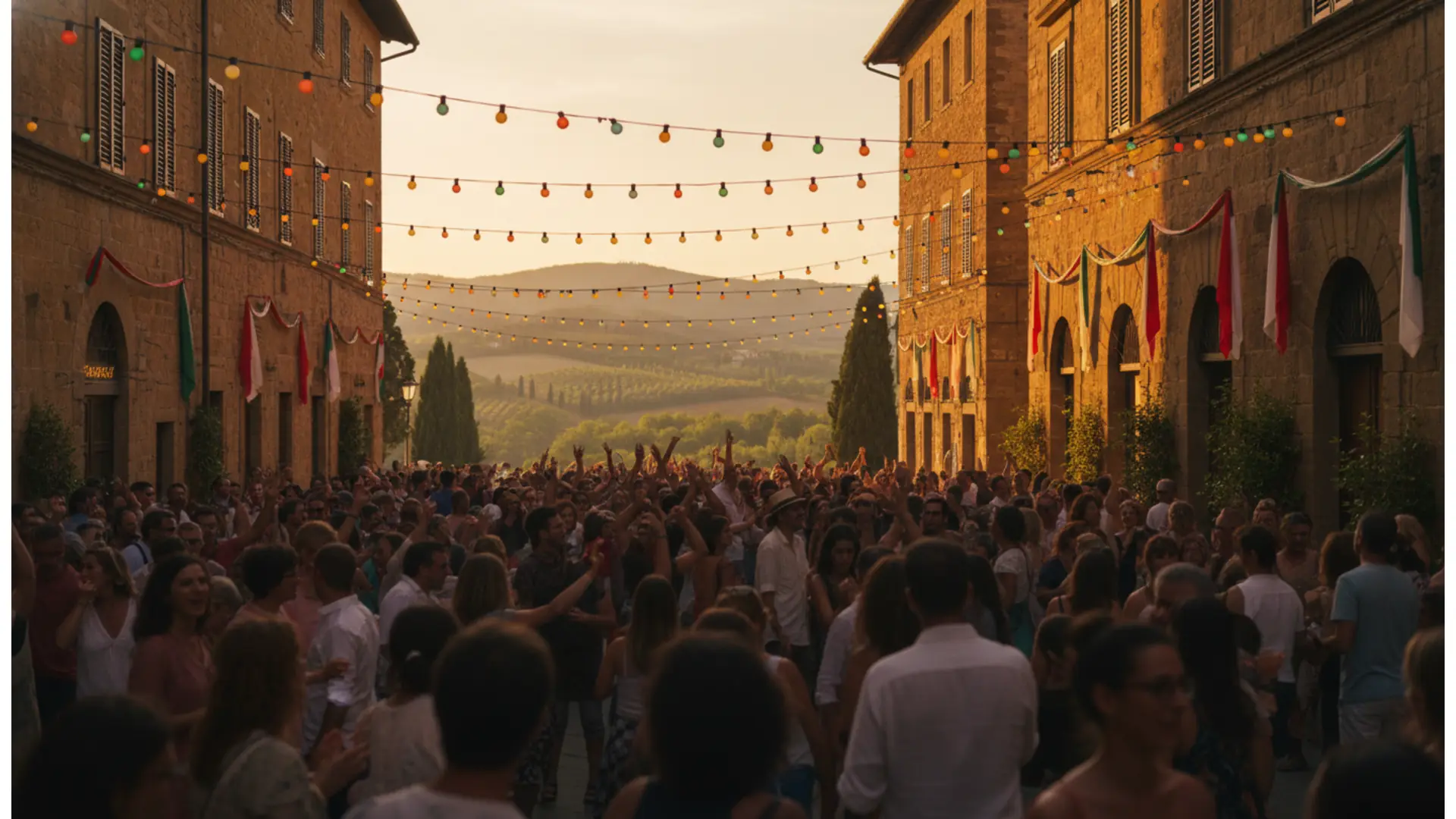
Festival of Saint Calogero the Hermit – Patronal Feast of Naro
The patronal feast of Naro: the 'straula' pulled by rope, blessed bread, and the fair along Viale Umberto
About Saint Calogero Festival
The Patronal Feast of Naro
In the heart of the Agrigento province, the medieval and baroque town of Naro — known as the Fulgentissima — dedicates one of Sicily's most intense and well-attended religious festivals to its patron, Saint Calogero the Hermit. For nearly a week, usually in mid-June, the town of Naro experiences a series of liturgical celebrations, processions, musical entertainment, and moments of deep popular devotion that involve the entire community and the many emigrants who return home for the occasion.
The Origins: The Plague of 1626
The cult of Saint Calogero in Naro is rooted in the terrible plague that struck Sicily between 1624 and 1626. According to tradition, the Franciscan tertiary Sister Serafina Maria Pulcella had a vision in which the Saint promised, through his intercession, to end the contagion. When the epidemic ceased, the city chose Saint Calogero as its patron and protector, replacing the previous patron, Saint Catherine of Alexandria. In 1693, the Saint was invoked again for protecting Naro from the devastating earthquake that hit the Val di Noto; for this reason, the Saint is also commemorated on January 11th. The venerated statue, the Black Saint with his long dark beard, staff, and medicine box symbolizing healing, was carved by sculptor Francesco Frazzotta in 1566 and is kept in the sanctuary's crypt.
The 'Straula' and the Rope
The most spectacular and identity-defining ritual is the procession of the 'straula': the cart carrying the statue of the Saint is placed on a heavy votive sled and dragged through the town streets by two lines of faithful clinging to sturdy ropes, the so-called corda, which can be up to 150-200 meters long and is donated as a vow in gratitude for graces received. During the procession, devotees climb onto the 'straula' to symbolically wipe the sweat from the statue with white handkerchiefs, which are then kept as protective relics, while the crowd shouts 'Viva Diu e San Calò'. A hallmark of the festival is the blessing of the votive bread, shaped like various parts of the human body and distributed to the faithful as a sign of healing.
The Festival Program
The festival days blend religious and secular moments. Mornings are marked by masses in the Sanctuary, while the eve and the evening of the main festival offer brass band parades, entertainment in the town squares (Piazza Roma, Piazza Cavour, Piazza Garibaldi), firework displays, and concerts of pop and Sicilian music. Along Viale Umberto, the large street fair takes place, a traditional event that attracts visitors from all over the Agrigento area. The main day, June 18th, culminates with a solemn mass celebrated by the Archbishop and the solemn procession of the Saint.
Naro, City of Art
The festival is also an opportunity to discover Naro, rich in churches, noble palaces, the Chiaramontano Castle, and the Cathedral, set in the typical hilly landscape of the Sicilian hinterland. Between faith, tradition, and conviviality, the Saint Calogero Festival represents one of the most authentic events in the Sicily Region.
Saint Calogero Festival — edition 2026
2026 Edition
The festivities in honor of Saint Calogero opened on Tuesday, June 16 with masses at the Sanctuary and, in the evening, a concert by 'Morena e Federico' in Piazza Roma. On Wednesday, June 17, the eve of the festival, the town was animated by the parade of the 'Petiliana' brass band from Delia, conducted by maestro Angelo Galiano, entertainment in Piazza Cavour, and a grand firework display late in the evening.
The highlight occurred on Thursday, June 18, with a solemn mass presided over by Archbishop Alessandro Damiano and the solemn procession of the 'straula', pulled by rope along Viale Umberto, the Mother Church, and Corso Vittorio Emanuele to Piazza Garibaldi. Subsequent evenings featured Sicilian music (June 19), the 'Refugee Festival' (June 20), and, on Sunday, June 21 for the octave, the final concert by Los Locos, with their 90s dance and pop repertoire, in Piazza Garibaldi.
Programme Saint Calogero Festival 2026
2026 Program
- Tuesday, June 16 – 7:15 AM and 7:00 PM masses in the Sanctuary; 9:30 PM 'Morena e Federico' concert in Piazza Roma
- Wednesday, June 17 (Eve) – 5:30 PM 'Petiliana' band parade from Delia; 7:00 PM mass; 9:30 PM entertainment in Piazza Cavour; 11:00 PM band parade and grand firework display
- Thursday, June 18 (Main Festival) – 10:00 AM solemn mass with Archbishop Alessandro Damiano; 11:00 AM 'straula' procession with the rope
- Friday, June 19 – 9:30 PM Sicilian music evening in Piazza Garibaldi
- Saturday, June 20 – 9:00 PM 'Refugee Festival' with DJ set
- Sunday, June 21 (Octave) – 9:30 PM Los Locos concert in Piazza Garibaldi
Highlights Saint Calogero Festival 2026
Prices Saint Calogero Festival 2026
Practical information — Saint Calogero Festival
Getting There
Naro is located in the hinterland of the Agrigento province. By car, it can be reached from Agrigento (about 30 km) or from Canicattì along the SS122. The most convenient train station is Canicattì, from where you can continue by bus or taxi; the nearest airport is Comiso, while Palermo and Catania are about a 2-hour drive away.
Practical Tips
Religious celebrations and the fair are free and take place in the historic center. During the festival days, and especially on June 18th, the central streets are closed to traffic: it is advisable to park on the outskirts and reach the squares on foot. We recommend arriving early to witness the 'straula' procession.
Festival-goer photos
No photos yet. Share yours!
Share your photos
5 photos max, 5 MB per photo (JPG, PNG, WebP)
Noticed an error or missing information?
Help us keep this listing up to date. Every proposal is verified by our team before publication.
Festival-goer reviews
No rating yet — be the first!
No comments yet. Be the first!
Were you there?
Share your experience with the community.
Published by Valentin Contard, festival listings writer. Reviewed, corrected and approved by Christophe Contard, editor-in-chief. .
Where does it take place — Saint Calogero Festival
Santuario di San Calogero e centro storico di Naro