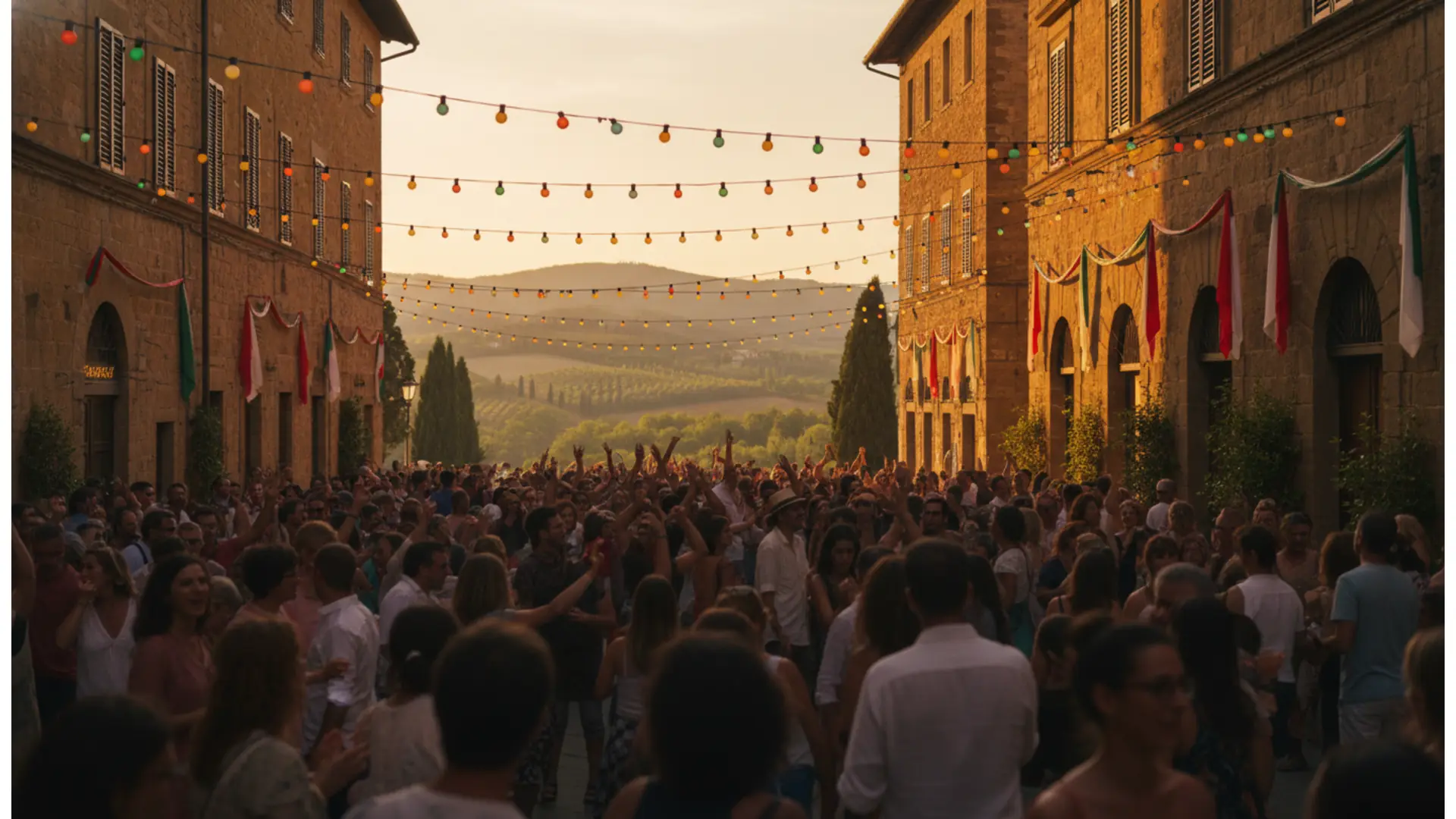
Feast of Saint Vitus the Martyr (Patron Saint of Felitto)
On June 15th, the eight-kilometer procession and the patron saint's taralli in the heart of the Cilento hinterland
Edition 2026 not confirmed to date
This edition has not been confirmed by the organiser to date. We recommend checking before going.
About Feast of Saint Vitus in Felitto
An ancient devotion in the heart of Cilento
In the municipality of Felitto, in the province of Salerno, the feast of Saint Vitus the Martyr falls on June 15th and has been the most cherished event of the year for centuries. The village, perched about 270 meters above sea level overlooking the Calore Gorges, gathers around its patron saint in a celebration that weaves together liturgy, pilgrimage, and ritual gastronomy. The cult of Saint Vitus is widespread throughout the Cilento area—from Capaccio to Pisciotta, from Sanza to Stio—but in Felitto, it takes on a unique form, tied to the site that local tradition identifies as the scene of the young saint's martyrdom.
The eight-kilometer procession
The element that makes the Felitto festival unique is the long pilgrimage on foot. The Church of the Assumption, the village's mother church, houses a bust of the saint; meanwhile, the rural chapel near the Pietra stream, which marks the border between the territories of Felitto and Bellosguardo, preserves a full-length statue. Approximately eight kilometers separate the two sites, a distance covered in procession: the statue is taken to the chapel, and on the morning of the feast, the faithful set out early to bring it back to the village.
The journey begins when the air is still cool, often at dawn, because the route is long and the mid-June heat can be intense. The path crosses countryside, olive groves, and hillside trails, and the shared effort is an integral part of the vow: carrying the saint, taking turns on their shoulders, is considered an honor passed down from generation to generation.
The taralli of Saint Vitus
Along the return route, Felitto families wait for the procession to offer the bearers and pilgrims the taralli of Saint Vitus and a glass of wine. These are ritual breads made from very simple ingredients—flour, water, salt, extra virgin olive oil, and natural yeast—boiled in water, cooled, and then baked, according to the traditional technique of the Cilento tarallo. They are prepared in the days leading up to the feast in a domestic ritual that involves the whole family.
- The legend: It is said that Saint Vitus interceded with God so that the harvest would not be destroyed, asking to leave at least a little 'for my dogs.' The grain was saved, and the tarallo serves as a memory of this: food spared from ruin.
- The ring shape: Practical for transport; the taralli were threaded onto broom branches and carried like a crown tied to the waist. The more taralli one received, the greater the honor.
- Preservation: Dry and durable, they were the ideal food for such a long procession.
Saint Vitus, martyr and protector
Saint Vitus, who lived between the 3rd century and 303 AD, was a young Christian martyred during the persecutions. Popular devotion venerates him as the protector of dancers and invokes him against nervous diseases, so much so that his name remains linked to the so-called 'Saint Vitus dance.' In Cilento, his cult has been documented for centuries: in the Sele Plain, a church dedicated to him is attested as early as 1042, while in Pisciotta, an ampoule containing the saint's blood is preserved.
The village and the Campania region
Felitto is one of the most evocative villages in the Cilento hinterland, in Campania: with just over a thousand inhabitants, a medieval historic center, the famous arched bridge over the Calore River, and the gorges carved into the rock, it is a summer destination for hikers and canoeists. The village is also known for its fusillo felittese, the handmade fresh pasta that has made its August festival famous. The feast of Saint Vitus, however, represents the most intimate and religious side of the community, the one the village reserves for itself and for the Felitto natives who return for the occasion.
How to experience the festival
The procession is accompanied by the novena in the nine days leading up to the feast, Eucharistic celebrations at the rural chapel and in the village, and moments of secular celebration in the evening. It is a free event, open to all: visitors are asked, above all, to respect the devotional nature of the pilgrimage. Those who wish to follow the entire journey should plan for several hours of walking, suitable footwear, and sufficient water.
Feast of Saint Vitus in Felitto — edition 2026
2026 Edition: Information being updated
The patronal feast of Saint Vitus the Martyr in Felitto, in the province of Salerno, traditionally falls on June 15th, the day of the saint's liturgical solemnity. For the year 2026, an official program of the festivities has not yet been found online: this entry will be updated as soon as the parish or the Municipality releases the schedule and calendar of celebrations.
In the meantime, the traditions remain, repeated almost unchanged for generations: the novena in the nine days preceding, the transport of the statue from the Church of the Assumption to the rural chapel by the Pietra stream, on the border with Bellosguardo, and the return pilgrimage of about eight kilometers, during which the faithful offer the bearers the taralli of Saint Vitus and wine. Those wishing to participate can contact the Municipality of Felitto directly to verify dates and times.
Highlights Feast of Saint Vitus in Felitto 2026
- Solemnity of Saint Vitus the Martyr, traditionally celebrated on June 15th.
- Walking procession of about 8 km between the Church of the Assumption and the Chapel of Saint Vitus by the Pietra stream.
- Distribution of the traditional taralli of Saint Vitus along the route.
- Novena in the days leading up to the feast.
- Detailed 2026 program not yet published: information to be confirmed.
Prices Feast of Saint Vitus in Felitto 2026
Practical information — Feast of Saint Vitus in Felitto
How to get there
Felitto is located in the Calore Valley, in the Cilento hinterland, and can be easily reached by car via the provincial roads that climb the valley from the Sele Plain. The reference train stations are those on the Tyrrhenian line (Vallo della Lucania and Agropoli area), from which you can continue by car. The nearest airport is Salerno-Costa d'Amalfi.
Parking
The historic center is compact and partially pedestrianized: it is best to leave your car in the spaces on the outskirts of the village and continue on foot.
Costs
Free participation in all celebrations and the procession.
Tips
- The procession to the Pietra stream chapel covers about 8 km: hiking shoes, a hat, and water are essential.
- The group leaves very early in the morning, when the temperature is still bearable.
- For those who do not wish to walk, the celebrations in the village and the arrival of the procession remain the most moving moments.
Information
Municipality of Felitto, Piazza Mercato 1, 84055 Felitto (SA) — tel. +39 0828 945028 — www.comune.felitto.sa.it
Festival-goer photos
No photos yet. Share yours!
Share your photos
5 photos max, 5 MB per photo (JPG, PNG, WebP)
Noticed an error or missing information?
Help us keep this listing up to date. Every proposal is verified by our team before publication.
Festival-goer reviews
No rating yet — be the first!
No comments yet. Be the first!
Were you there?
Share your experience with the community.
Published by Valentin Contard, festival listings writer. Reviewed, corrected and approved by Christophe Contard, editor-in-chief. .
Where does it take place — Feast of Saint Vitus in Felitto
Chiesa dell'Assunta e Cappella di San Vito (torrente Pietra)