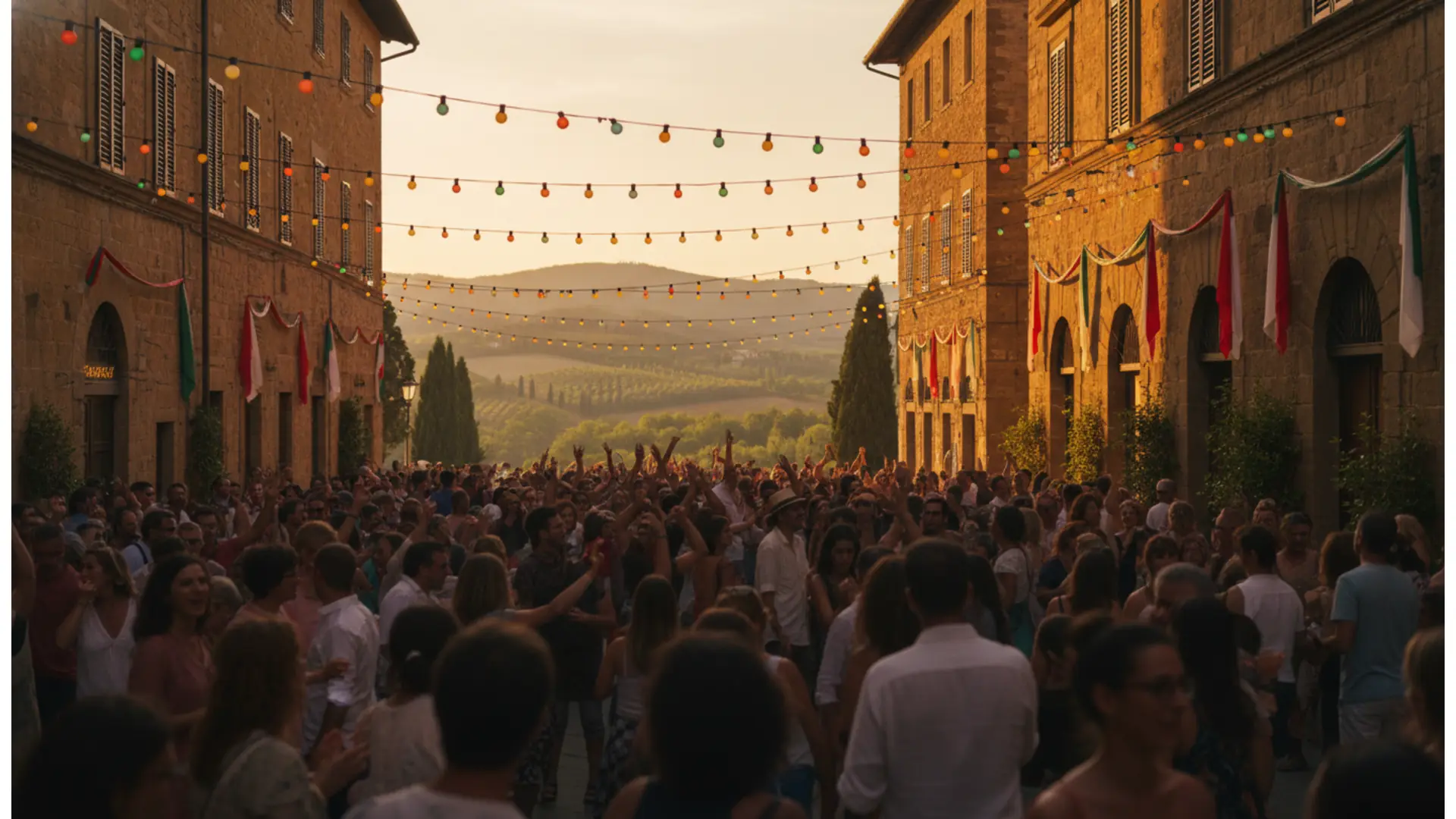
Feast of Saint Sabinus the Bishop and Saint Romulus the Deacon (Focaroni and Santa Manna)
In Atripalda, the night of the Focaroni and the ritual of the Santa Manna, February 8th and 9th
About Feast of Saint Sabinus
A festival that warms the Irpinian winter
In Atripalda, in the province of Avellino, the heart of winter is never a silent season. On February 8th and 9th, this Irpinian town in the Sabato Valley pauses for its most cherished celebration, dedicated to Saint Sabinus the Bishop and Saint Romulus the Deacon: two days where religious devotion and popular festivities intertwine to become one. It is the event that the people of Atripalda look forward to all year, drawing visitors from Avellino and across the inland Campania region.
The Focaroni: the night of the bonfires
The signal to begin comes with the darkness on February 8th, when the Focaroni are lit across the city: large piles of wood and brushwood that burn in the open air, blessed by the parish priests. The main bonfire, the most impressive of them all, is lit in Piazza Umberto I, but it is not the only one: dozens of smaller fires are ignited at the same time in the districts and neighborhoods, from the small square of San Sabino at Capo La Torre to the streets of Contrada Santissima, Contrada Ischia, Contrada Alvanite, and the San Pasquale ramp.
The result is a map of light that redraws the city: each neighborhood guards its own bonfire, neighbors gather around the embers, and the evening flows with conversation, songs, and shared glasses of wine. The Municipality and the Pro Loco provide the braziers and wood, but it is the residents who play the most important role, just as they have for generations.
February 9th: solemn mass, procession, and Santa Manna
On February 9th, the day commemorating the patron saint's death, the tone of the festival shifts. The Church of Saint Hippolytus the Martyr, the mother church of Atripalda, opens early in the morning with a series of celebrations to welcome the faithful. The central moment is the solemn mass in the late morning, followed by the procession that winds through the town streets with the statues of Saint Sabinus and Saint Romulus carried on the shoulders of the faithful.
In the late afternoon, the most iconic ritual of the day takes place: the distribution of the Santa Manna. Priests trace a sign of the cross on the foreheads of the faithful using a feather dipped in a liquid called Santa Manna, mixed with holy water, which tradition says once seeped from the saint's tomb. It is a simple gesture, repeated for hours over long lines of people, experienced as a sign of protection for the year ahead.
Saint Sabinus and Saint Romulus, the two patrons
- Saint Sabinus was the bishop of ancient Abellinum, the Roman city that stood where Atripalda is today and from which Avellino descends.
- His burial site is linked to the Specus Martyrum, one of the most important Christian archaeological monuments in Irpinia, preserved right beneath the Church of Saint Hippolytus.
- Atripalda celebrates its patron saint twice a year: on February 9th, the anniversary of his death, and in September.
- Saint Romulus the Deacon is venerated alongside him, and his statue accompanies that of Saint Sabinus during the procession.
Flavors and conviviality around the fire
Around the Focaroni, the festival is also a gastronomic experience: you can taste typical Irpinian food and wine products, from cured meats to cheeses, accompanied by local wines in a land that is home to some of the most renowned denominations in the South. The fire, hot food, and folk music do the rest, in an evening that is both a propitiatory rite and a great neighborhood party.
Atripalda and the Sabato Valley
Atripalda is located a few kilometers from Avellino, along the Sabato River, and is one of the oldest historical centers in Irpinia. Visitors arriving for the festival will find a compact town that is easy to explore on foot, with the historic center, the mother church, and the upper village naturally becoming the perimeter of the festivities. A visit to the Focaroni is also an opportunity to discover an Irpinia in winter that is authentic and far from the usual tourist paths.
Organizers
The festivities are managed by the Pro Loco Atripaldese in collaboration with the Municipality of Atripalda and the Parish of Saint Hippolytus the Martyr, supported by the Festival Committee for the processional aspects. In recent years, the administration has complemented the festival with moments of public reflection on the value of the Focaroni tradition and its transmission to new generations.
Feast of Saint Sabinus — edition 2026
Atripalda, February 8-9, 2026
The 2026 edition of the patronal festivities in Atripalda followed the traditional two-day format. Sunday, February 8th, as darkness fell, the Focaroni were ignited: the main bonfire in Piazza Umberto I, blessed by the parish priests, and a series of smaller fires distributed at strategic points in the city, from the small square of San Sabino at Capo La Torre to the districts and streets of the neighborhoods. Residents and visitors gathered around the embers, enjoying typical Irpinian products, wine, and music.
Monday, February 9th, the day commemorating the patron saint's death, the festival moved to the mother church of Saint Hippolytus the Martyr: a solemn mass in the late morning, presided over by the Bishop of Avellino, Arturo Aiello, followed by the procession with the statues of Saint Sabinus the Bishop and Saint Romulus the Deacon carried on the shoulders of the faithful through the city streets. In the afternoon, the ritual of the Santa Manna was renewed, with the sign of the cross traced on the foreheads of the faithful as a symbol of protection.
Conference on the Focaroni
As a prelude to the festival, on Friday, February 6, 2026, at 10:30 AM, the Conference Hall of the "L. Cassese" Municipal Library hosted the meeting "Between Tradition and Future: The Focaroni of Saint Sabinus", promoted by the Municipality to enhance the historical, social, and cultural significance of the bonfires and to discuss the protection of traditions, the involvement of new generations, and the promotion of the territory. Speakers included Mayor Paolo Spagnuolo, City Council President Raffaele Barbarisi, Councilor Raffaele Labate, UNPLI Campania Regional President Luigi Barbati, Pro Loco of Atripalda President Maria Assunta Galluccio, Father Ranieri Picone, and Father Luca Monti, with concluding remarks by Regional Councilor Enzo Maraio.
Programme Feast of Saint Sabinus 2026
Friday, February 6, 2026
- 10:30 AM — Conference "Between Tradition and Future: The Focaroni of Saint Sabinus", Conference Hall of the "L. Cassese" Municipal Library
Sunday, February 8, 2026 — The night of the Focaroni
- After sunset: Lighting of the main focarone in Piazza Umberto I, with the blessing of the parish priests
- Simultaneously: Lighting of the smaller focaroni in the districts and neighborhoods (San Sabino square at Capo La Torre, Contrada Santissima, Contrada Ischia, Contrada Alvanite, San Pasquale ramp, and other city streets)
- Throughout the evening: Tastings of typical Irpinian products, wine, and folk music around the bonfires
Monday, February 9, 2026 — Saint Sabinus the Bishop and Saint Romulus the Deacon
- From early morning: Holy masses at the Church of Saint Hippolytus the Martyr
- Morning — Solemn mass presided over by Monsignor Arturo Aiello, Bishop of Avellino
- Following — Procession through the city streets with the statues of Saint Sabinus and Saint Romulus
- Afternoon — Distribution of the Santa Manna to the faithful at the Church of Saint Hippolytus the Martyr
Exact times for the celebrations are announced each year by the Parish of Saint Hippolytus the Martyr and the Festival Committee in the days immediately preceding the event.
Highlights Feast of Saint Sabinus 2026
- The lighting of the main focarone in Piazza Umberto I, the most anticipated moment of the eve
- The map of fires lit in the districts: dozens of bonfires illuminating the entire city simultaneously
- The solemn mass on February 9th with the Bishop of Avellino, Arturo Aiello
- The procession with the statues of Saint Sabinus the Bishop and Saint Romulus the Deacon carried on shoulders
- The ritual of the Santa Manna, the sign of the cross traced on the foreheads of the faithful
- The conference "Between Tradition and Future: The Focaroni of Saint Sabinus" on February 6th
- Tastings of typical Irpinian products around the embers
Prices Feast of Saint Sabinus 2026
Practical information — Feast of Saint Sabinus
How to get there
By car: Take the Atripalda exit from the Avellino-Salerno highway connector, or the A16 Naples-Canosa motorway, Avellino Est exit. By train: the reference station is Avellino, a few kilometers away, connected by urban and suburban buses. By plane: Naples-Capodichino airport, about an hour's drive away.
Times and locations
On the evening of February 8th, the Focaroni are lit after sunset, with the main bonfire in Piazza Umberto I and other fires in the districts. On February 9th, the celebrations take place at the Church of Saint Hippolytus the Martyr (Piazza Tempio Maggiore 1), with the solemn mass in the late morning, the procession following, and the distribution of the Santa Manna in the afternoon.
Costs
Participation in the Focaroni, the procession, and the religious rites is free and held outdoors. Any tastings are offered as a donation or at popular prices according to the initiatives of individual neighborhoods.
Tips
Dress very warmly: February in Irpinia is cold, and you will be outdoors for hours. Keep a safe distance from the braziers and follow the volunteers' instructions. Park outside the historic center and reach the squares on foot: on the evening of the 8th, many streets are closed to traffic. For the Santa Manna, it is advisable to arrive early, as the lines can be long.
Contacts
Pro Loco Atripaldese: +39 0825 756412. Municipality of Atripalda: +39 0825 615300. Parish of Saint Hippolytus the Martyr: +39 0825 626116.
Festival-goer photos
No photos yet. Share yours!
Share your photos
5 photos max, 5 MB per photo (JPG, PNG, WebP)
Noticed an error or missing information?
Help us keep this listing up to date. Every proposal is verified by our team before publication.
Festival-goer reviews
No rating yet — be the first!
No comments yet. Be the first!
Were you there?
Share your experience with the community.
Published by Valentin Contard, festival listings writer. Reviewed, corrected and approved by Christophe Contard, editor-in-chief. .
Where does it take place — Feast of Saint Sabinus
Piazza Umberto I e chiesa di Sant'Ippolisto Martire
Piazza Umberto I, 83042 Atripalda