Corpus Domini Flower Festival of Rocca Santo Stefano
Floral carpets and popular devotion in the Aniene Valley village
Edition 2026 not confirmed to date
This edition has not been confirmed by the organiser to date. We recommend checking before going.
About Rocca Santo Stefano Flower Festival
A village turned into a canvas
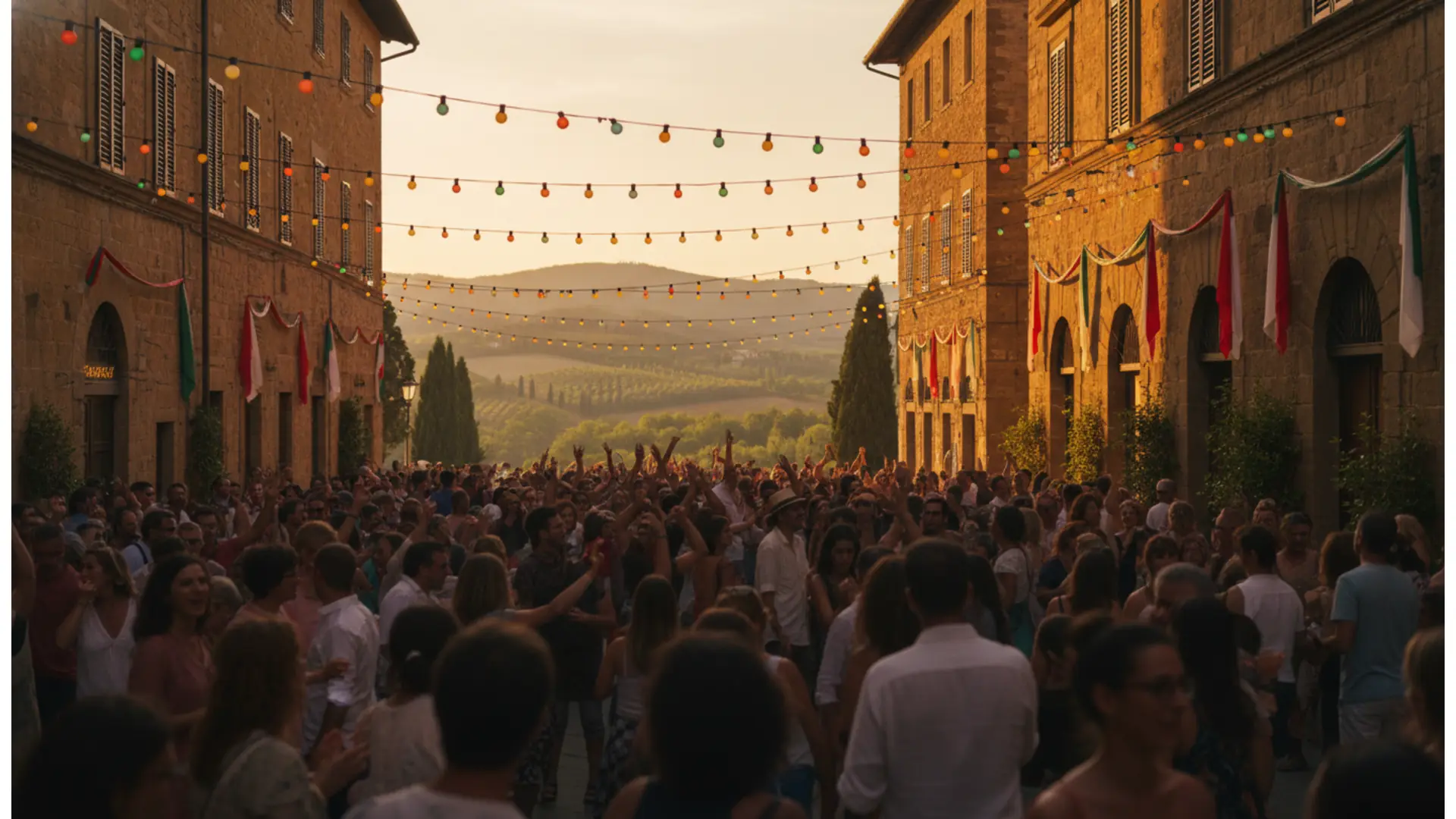
In Rocca Santo Stefano, a small town in the Metropolitan City of Rome nestled between the Ruffi and Affilani mountains in the upper Aniene Valley, just a few kilometers from Subiaco, the Corpus Domini festival is celebrated not only in church but on the streets, through color. On the night before the solemnity, the entire village works to lay out a series of large, ephemeral floral compositions along Via Padre Pellegrino Ernetti, destined to last only a few hours before being crossed by the procession.
Four centuries of tradition
Archival sources trace the first documented flower festival in Rocca Santo Stefano back over four centuries, making it one of the oldest in the Lazio region, alongside those of Genzano and the Roman countryside. The oral memory of the elders confirms a ritual that has never truly been interrupted. In the 1980s, the practice was structured around the Associazione Maestri Infioratori di Rocca, created to carry on the legacy of Monsignor Tancredi Ciancarella, the historical promoter of the event in its current form. As Mayor Sandro Runieri noted, it is a “centuries-old tradition, passed down from generation to generation,” which has preserved many of its original characteristics.
How a floral masterpiece is born
Work begins days in advance. Sketches are drawn, transferred to paper on the ground, and then filled with strictly vegetable materials: carnation petals peeled one by one, broom, wild fennel, leaves, and colored earth. The gathering and peeling of the flowers is a collective nocturnal ritual involving entire families, including children: some editions have required over fifty thousand carnations and involved about three hundred people. The twelve panels alternate between sacred subjects—the Eucharist, the Virgin Mary, Christ—and civil or current themes: peace, historical anniversaries, and tributes to artists like Perugino, Picasso, or Puccini during editions dedicated to their milestones.
Corpus Domini Sunday
By Saturday, the carpet is already visible, and the village fills with visitors walking the street in silence, photographing the works before dusk. The climax arrives on Sunday morning: the solemn procession, led by the parish priest with the Blessed Sacrament under the canopy, crosses the panels, which are thus consumed step by step. This is the profound meaning of the flower festival—beauty offered and intentionally destined to dissolve—and the moment when floral art becomes an expression of faith and community belonging.
Around the festival
- Opening of the medieval historic center, with stone houses, narrow alleys, and the remains of the ancient fortress
- Visit to the church of Santa Maria Assunta, the heart of the liturgical celebration
- Refreshment points and community dinner with a screening of images of the completed panels
- Walks in the Antera Woods, to the San Francesco Retreat, and the Grotta dell'Arco
Why it's worth the trip
Compared to more famous and crowded flower festivals, the one in Rocca Santo Stefano retains an authentically local dimension: there are no ticket offices or stages, just an entire village that stays awake for a night. For those visiting Lazio in June, it is an opportunity to discover a lesser-known corner of the region, between the Aniene Valley and the mountains rising toward Subiaco, and to witness a form of folk art that survives only thanks to family transmission.
Rocca Santo Stefano Flower Festival — edition 2026
The 2026 edition
The flower festival of Rocca Santo Stefano is tied to the liturgical calendar: it takes place on the weekend of the Corpus Domini solemnity, which in 2026 fell on Sunday, June 7. The Municipality, in the Metropolitan City of Rome, and the Associazione Maestri Infioratori confirm the event's structure year after year: collective flower peeling on Saturday, nocturnal setup of the panels along Via Padre Pellegrino Ernetti, and public opening followed by the Sunday procession.
Note: for this edition, we have not found an official announcement with specific dates and times. The information provided reconstructs the usual pattern of the festival and should be verified with the Municipality or the Associazione Maestri Infioratori before planning your visit.
Programme Rocca Santo Stefano Flower Festival 2026
Highlights Rocca Santo Stefano Flower Festival 2026
- Twelve large floral panels along Via Padre Pellegrino Ernetti
- Nocturnal flower peeling with the participation of the entire village
- Corpus Domini procession on the flower carpet, Sunday morning
- Medieval village in the Aniene Valley, a few kilometers from Subiaco
Prices Rocca Santo Stefano Flower Festival 2026
Practical information — Rocca Santo Stefano Flower Festival
Getting there
By car from Rome: A24 motorway to Vicovaro-Mandela, then SS5 Sublacense towards Subiaco and the provincial road to Rocca Santo Stefano (approx. 70 km, 1h15). From Fiuggi and the Sacco Valley, drive via Bellegra. The village is small: it is recommended to park in the areas outside the historic center and continue on foot, as Via Padre Pellegrino Ernetti is closed to traffic during the setup.
Public transport
Cotral bus lines from Rome Ponte Mammolo towards Subiaco and Bellegra; please check holiday schedules, which are reduced on Sundays.
Admission and hours
Access to the floral panels is free. The carpets are visible from Saturday afternoon/evening until the passage of the procession on Sunday morning. After the procession, the compositions are no longer legible.
Tips
Bring comfortable shoes (the village is hilly and cobbled), arrive on Saturday evening to see the masters at work, and never step on the compositions. For overnight stays, visitors generally look to Subiaco, Bellegra, or Olevano Romano.
Contacts
Municipality of Rocca Santo Stefano, Via Padre Pellegrino Ernetti 9 — tel. +39 06 9567304.
Festival-goer photos
No photos yet. Share yours!
Share your photos
5 photos max, 5 MB per photo (JPG, PNG, WebP)
Noticed an error or missing information?
Help us keep this listing up to date. Every proposal is verified by our team before publication.
Festival-goer reviews
No rating yet — be the first!
No comments yet. Be the first!
Were you there?
Share your experience with the community.
Published by Valentin Contard, festival listings writer. Reviewed, corrected and approved by Christophe Contard, editor-in-chief. .
Where does it take place — Rocca Santo Stefano Flower Festival
Centro storico — Via Padre Pellegrino Ernetti
Via Padre Pellegrino Ernetti, 9, 00030 Rocca Santo Stefano