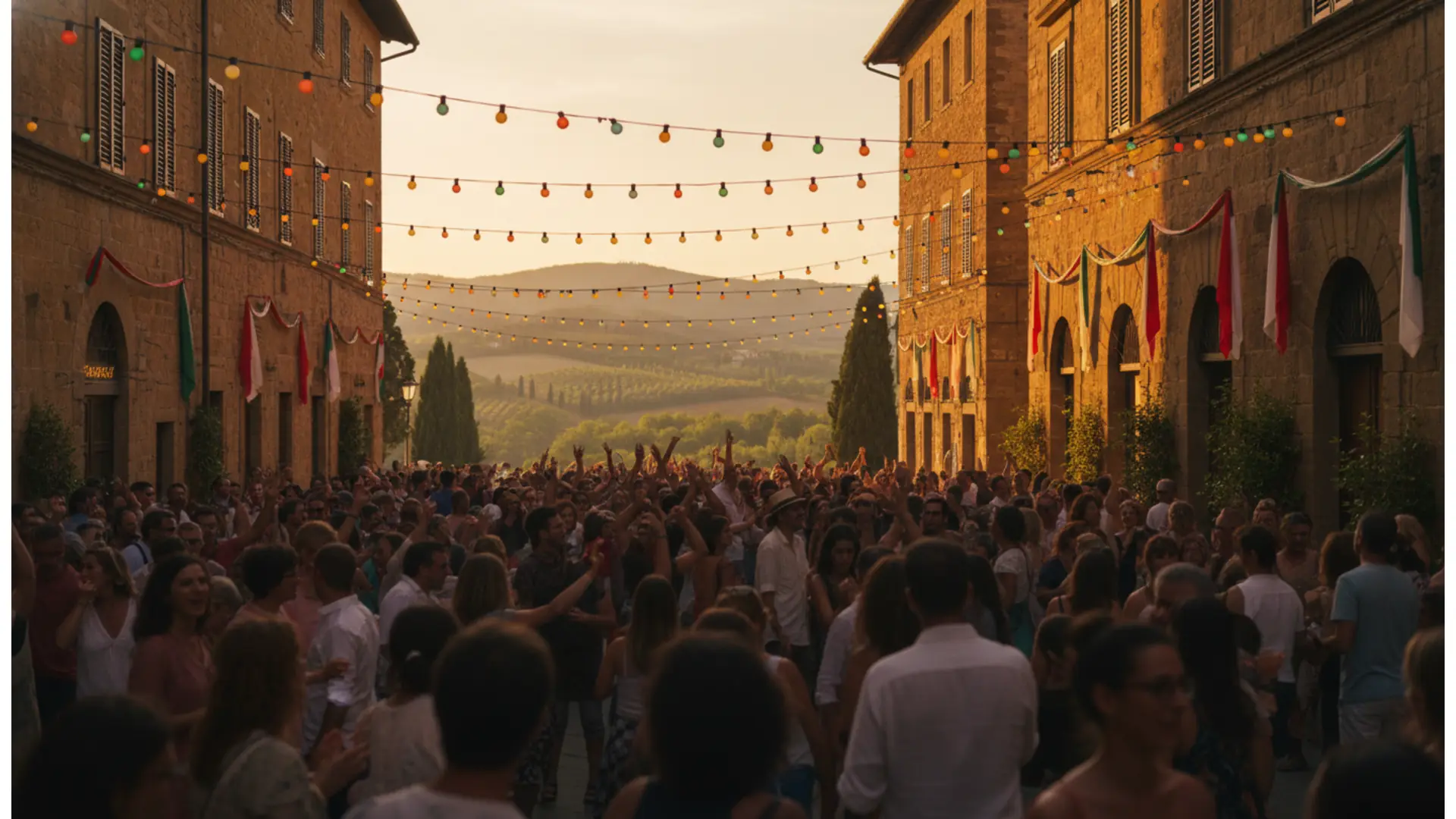
Tirata del Giglio of Villanova del Battista
The 28-meter-tall straw obelisk pulled by hand for Saint John the Baptist in the Ufita Valley
Edition 2026 not confirmed to date
This edition has not been confirmed by the organiser to date. We recommend checking before going.
About Tirata del Giglio
The Giglio of Villanova del Battista
In the heart of the Ufita Valley, on the eastern borders of the Province of Avellino, the town of Villanova del Battista preserves one of the most impressive grain rituals in Campania. Every year on August 27th, a pyramidal wooden obelisk up to 28 meters tall is pulled by hand through the village streets as a votive offering to Saint John the Baptist, the community's patron saint. This is the Tirata del Giglio: not a folk parade staged for tourists, but a celebration the village holds for itself, where visitors are simply welcomed as guests.
A 19th-century votive tradition
The tradition dates back to the early 19th century: according to local memory, the first giglio was a small two-meter votive offering by Costantino Ciccone. Over time, the votive structure grew into two obelisks—one about 25 meters tall made entirely of oats, and a smaller one of soft wheat. The earthquake of July 23, 1930, which destroyed the village, interrupted the ritual; for decades, the locals participated in the giglio of nearby Flumeri. Only in 1986, thanks to the initiative of then-mayor Ottaviano Silano—to whom the square where the pull begins is now dedicated—did the Giglio return to Villanova, and the tradition has continued unbroken ever since.
The 'Alzata': raising the Giglio
The festival does not begin on August 27th, but on the preceding Sunday with the alzata (raising): the obelisk, assembled on the ground, is slowly moved from a horizontal to a vertical position in Piazza Ottaviano Silano. It is a moment of great technical tension and immense popular participation, accompanied by live music and stalls selling local products. As the locals say, when the Giglio is standing, the festival can truly begin.
The August 27th 'Tirata'
On the afternoon of August 27th, usually around 5 PM, the Giglio departs from Piazza Ottaviano Silano. Twelve ropes connect it to trees, railings, balconies, and lampposts; the capifune (rope leaders) coordinate the pullers—often children and teenagers—and pace the collective effort. The route winds through the historic center, following the ancient path and tackling daunting technical sections, such as the steep, sharp turn at the Rampa Fontana del Signore. It arrives in Piazza Aldo Moro, in front of the Santa Maria Assunta church, where the obelisk remains on display for weeks before being dismantled.
Straw, oats, and young hands
The most striking part of the Giglio is its 'skin.' The structure is divided into five overlapping tiers, topped by a spire, and entirely covered in panels of woven straw and wild oats. Work begins in early July with the harvesting of the oats and the hand-reaping of the wheat, necessary to obtain long, intact stalks. After soaking in water, the stems become flexible and are used in traditional techniques—trucinielli, specchietti, braids, and strips of split straw—passed down orally from generation to generation. These are crafted primarily by the village's young people, often minors: a detail that speaks volumes about how this community transmits its knowledge.
Fish Festival and folk music
Once the Giglio reaches the square, the exertion gives way to celebration. In the evening, Piazza Aldo Moro hosts the Fish Festival, with fried fish and dishes served at the stalls, and a folk music concert that closes the day; in recent years, groups from the Irpinian and Campanian folk scenes have performed. The Tirata is also the most anticipated moment of the Villanova August, the town's summer calendar filled with dance evenings, village festivals, and tastings of Ufita Valley specialties.
The grain rituals of Irpinia
Villanova del Battista is part of the Grain Festivals network, which brings together Irpinian and Southern Italian towns tied to straw votive structures: Flumeri, Fontanarosa, Mirabella Eclano, and other centers build gigli, obelisks, and grain wagons every summer. Seeing one means quickly understanding the relationship between these communities, the land, and the harvest cycle: an intangible peasant heritage that is still alive and practiced in Irpinia, not merely preserved in a museum.
When to go
The key date is always August 27th, regardless of the day of the week; the raising falls on the preceding Sunday. If you only have one day, choose the 27th: there is the pull in the afternoon, the Fish Festival in the evening, and the village celebrates until late at night.
Tirata del Giglio — edition 2026
For 2026, the Municipality of Villanova del Battista has not yet made public the program for the Villanova August, the collection of summer events that culminates in the Tirata del Giglio. This is not unusual: announcements are typically made in the final weeks of August, just before the patronal feast of Saint John the Baptist.
What the established tradition leads us to expect is the usual sequence: the alzata (raising) of the Giglio in Piazza Ottaviano Silano on the Sunday preceding August 27th, when the straw and oat obelisk is brought to a vertical position, and then the tirata (pull) on August 27th, in the afternoon, with the twelve-rope tow through the historic center to Piazza Aldo Moro. In the evening, in the square, the Fish Festival and a folk music concert.
Until the official publication, it is advisable to check dates and times with the Municipality (tel. +39 0825 826015) or on the social media pages dedicated to the Giglio. The date indicated here is provisional and serves only to place the event in the reference month.
Highlights Tirata del Giglio 2026
Prices Tirata del Giglio 2026
Practical information — Tirata del Giglio
How to get there
Villanova del Battista is located at an altitude of 742 meters in the Ufita Valley, about 50 km from Avellino. By car: A16 Naples-Canosa motorway, exit at Grottaminarda, then take the SS90 road towards Ariano Irpino and provincial roads to Villanova (about 20-25 minutes). There is no train station in the village: the nearest stations are Benevento and Foggia, with local bus connections from Grottaminarda and Ariano Irpino.
Where to watch the ritual
The departure is in Piazza Ottaviano Silano, and the arrival is in Piazza Aldo Moro in front of the Santa Maria Assunta church. During the pull, the historic center is closed to traffic: it is best to leave your car in the parking lots at the entrance to the village and continue on foot.
Tips
Arrive at least an hour early to find a good spot along the route, which includes both uphill and downhill sections: comfortable shoes are essential. In August, the Irpinian afternoon can be very hot, so bring water and a hat. If you cannot be there on the 27th, you can still see the Giglio: it remains on display in Piazza Aldo Moro for the following weeks.
Information
Municipality of Villanova del Battista, tel. +39 0825 826015. Final dates and programs are released each year on the social media pages of the Municipality and the Giglio, usually a few weeks before August.
Festival-goer photos
No photos yet. Share yours!
Share your photos
5 photos max, 5 MB per photo (JPG, PNG, WebP)
Noticed an error or missing information?
Help us keep this listing up to date. Every proposal is verified by our team before publication.
Festival-goer reviews
No rating yet — be the first!
No comments yet. Be the first!
Were you there?
Share your experience with the community.
Published by Valentin Contard, festival listings writer. Reviewed, corrected and approved by Christophe Contard, editor-in-chief. .
Where does it take place — Tirata del Giglio
Piazza Ottaviano Silano - Piazza Aldo Moro
Piazza Ottaviano Silano, 83030 Villanova del Battista