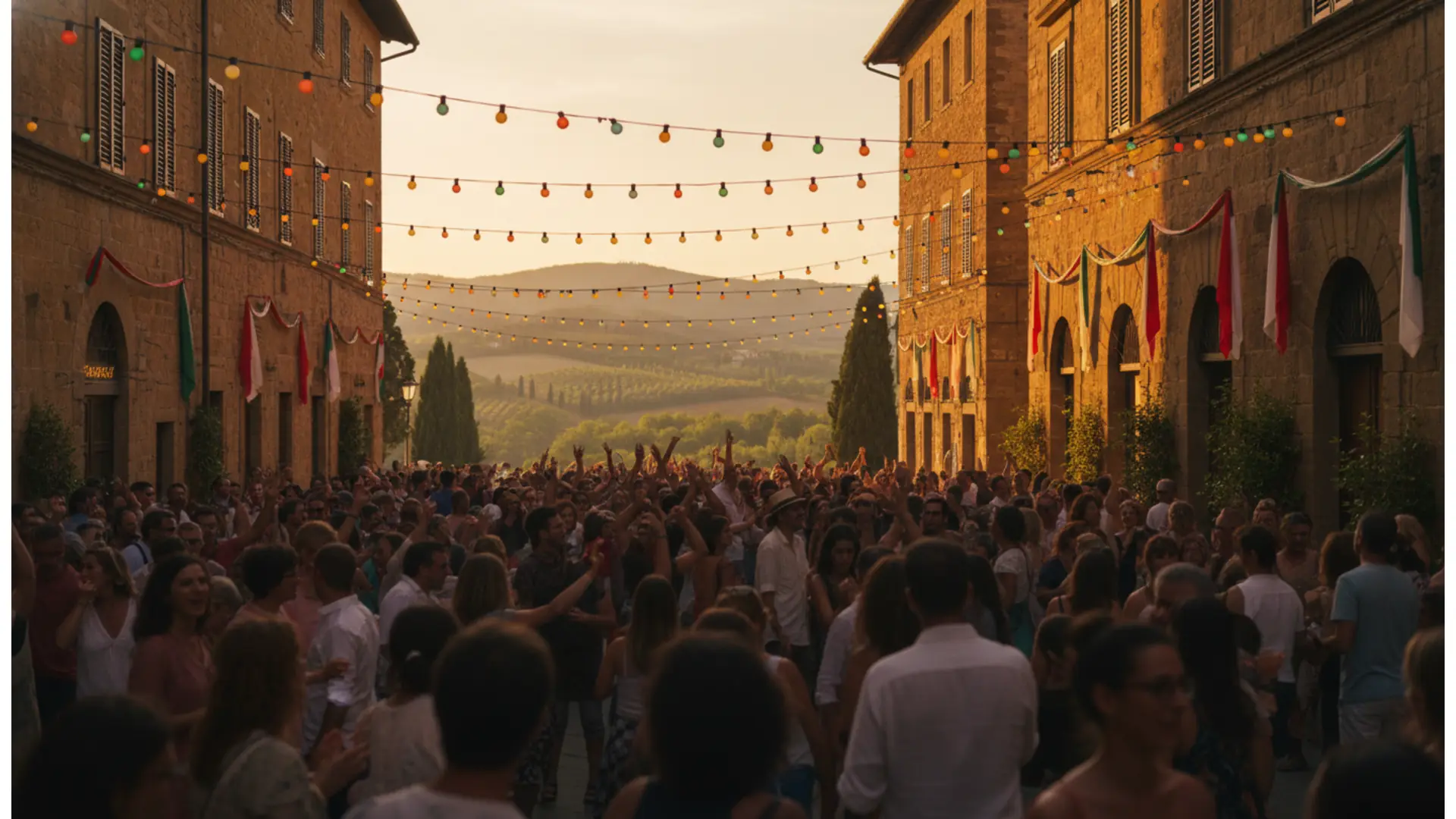
The Raganelle of Pozzaglia Sabina
The Good Friday re-enactment in the Sabina village, where bells fall silent and wood speaks
About The Raganelle
A wooden sound instead of bells
There is one evening each year when Pozzaglia Sabina does not listen to its bells. It is Good Friday: according to an ancient custom, during the Paschal Triduum—from Holy Thursday to the Easter Vigil—church bells were symbolically "tied," forbidden from ringing as a sign of mourning for the death of Jesus Christ. In their place, the raganelle took the stage—handcrafted wooden instruments that, when rotated, emit a dry, rhythmic sound similar to a frog's croak, hence the name.
In Pozzaglia Sabina, a small town in the province of Rieti in Lazio, this tradition has not remained a mere footnote in local history books. The Associazione Fedeli di Santa Agostina APS has brought it back to the village streets with a re-enactment open to all, starting at 7:00 PM and moving through the narrow alleys of the historic center, accompanied by the constant clatter of the raganelle.
Who played them, who plays them today
Since the mid-19th century, it was the young altar boys who would roam the village with the raganelle, announcing religious services in place of the bronze bells. Today, the gesture has become a collective one: on the evening of the re-enactment, the raganelle pass into the hands of everyone—young and old, children and the elderly—in an informal procession that is both an act of faith and a community gathering.
There is no stage, no spectacle: just a village walking together in the dark, with a sound unlike any other. Visitors from outside are struck by exactly this—the total absence of artifice and the power of a rite that relies solely on participation.
Abruzzese roots in Sabina soil
Local scholars trace the use of the raganelle back to Abruzzese folk traditions, from which Pozzaglia—nestled in the Lucretili Mountains on the border between Sabina and Abruzzo—has absorbed customs, dialects, and rites over the centuries. This is key to understanding this corner of the Rieti province: a cultural crossroads where the inland Lazio region blends with the mountains of the Central Apennines.
The village of Saint Agostina
Pozzaglia Sabina is the birthplace of Saint Agostina Pietrantoni, a Sister of Charity of Saint Jeanne-Antide Thouret, who was killed in 1894 at the Santo Spirito Hospital in Rome and proclaimed the patron saint of nurses in Italy. The association that promotes the raganelle bears her name and works year-round to enhance the historical, cultural, and religious heritage of the area with concerts, volunteer initiatives, and the grand Saint Agostina Festival on September 14th.
What to expect
- When: Good Friday, a movable date linked to Easter (April 3rd in 2026).
- Meeting point: 7:00 PM, in the historic center of the village.
- Route: The narrow streets and alleys of Pozzaglia, on foot.
- Participation: Free and open to all residents and visitors.
- The raganelle: Handcrafted wooden instruments, distributed and played along the way.
A village to discover around the rite
Pozzaglia Sabina has a few hundred inhabitants and preserves the medieval layout typical of the Lucretili Mountains villages: stone houses huddled together, stairways, and views over the valley. Good Friday evening is perhaps the best time of year to visit, as the village comes alive without losing its sense of contemplation. Those with more time can combine the visit with a tour of the Rieti Sabina, a land of ancient olive groves and DOP extra virgin olive oil, between Orvinio, Poggio Moiano, and the trails of the Lucretili Mountains Regional Natural Park.
The return of the raganelle, after many years of silence, tells a story of what is happening today in many small towns in inland Lazio: a community choosing not to let its rites die, bringing them back to the streets with few resources but great conviction.
The Raganelle — edition 2026
Good Friday 2026 in Pozzaglia Sabina
The 2026 edition took place on Friday, April 3rd, the day of Good Friday, with a meeting at 7:00 PM in the historic center of Pozzaglia Sabina, in the province of Rieti. The re-enactment, promoted by the Associazione Fedeli di Santa Agostina APS, brought the sound of the raganelle back to the village streets after many years of silence.
The procession walked through the narrow streets and alleys of the village: the raganelle, handcrafted wooden instruments, were distributed to participants—no longer just to altar boys as was the case from the mid-19th century, but to "young and old alike," according to the organizers' invitation. Participation was free and open to all.
The initiative was part of the Holy Week celebrations in the Rieti area, with a distinctly identity-focused approach: recovering a rite of the Paschal Triduum linked to the moment when church bells fall silent in memory of Christ's death.
Programme The Raganelle 2026
Friday, April 3, 2026
- 7:00 PM — Meeting in the historic center of Pozzaglia Sabina and distribution of the raganelle.
- Following — Procession on foot through the village alleys accompanied by the continuous sound of the raganelle, open to residents and visitors of all ages.
Event with free participation, no reservation required. The detailed program does not include shows or performances: it is a participatory popular rite linked to the Good Friday liturgy.
Highlights The Raganelle 2026
- The sound of the raganelle, handcrafted wooden instruments that mimic the croaking of a frog.
- The evening procession through the stone alleys of the Lucretili Mountains village at 7:00 PM.
- The return of a tradition documented since the mid-19th century, resumed after years of interruption.
- The bond with Saint Agostina Pietrantoni, born in Pozzaglia and patron saint of nurses in Italy.
Prices The Raganelle 2026
Practical information — The Raganelle
How to get there
Pozzaglia Sabina can be reached by car from the A24 Rome-L'Aquila motorway (take the Vicovaro-Mandela exit, then the SP road towards Orvinio and Pozzaglia) or from the Via Salaria SS4, turning off at Osteria Nuova. From Rome, the journey takes about an hour and a half; from Rieti, about an hour. There is no train station in the town: the closest ones are on the Rome-Pescara line in the Aniene Valley.
Parking
The historic center is pedestrian-only and very narrow: it is best to leave your car in the parking areas at the entrance to the village and continue on foot.
Costs
Participation in the re-enactment is free and open to all.
Tips
The evening event is outdoors, and in the mountains, April can be cold after sunset: wear warm clothing and comfortable shoes for the stone alleys and stairways. As this is a religious Good Friday rite, respectful and sober behavior is requested.
Information
Associazione Fedeli di Santa Agostina APS, Piazza Umberto I 30, 02030 Pozzaglia Sabina (RI) — www.fedelidisantaagostina.it
Festival-goer photos
No photos yet. Share yours!
Share your photos
5 photos max, 5 MB per photo (JPG, PNG, WebP)
Noticed an error or missing information?
Help us keep this listing up to date. Every proposal is verified by our team before publication.
Festival-goer reviews
No rating yet — be the first!
No comments yet. Be the first!
Were you there?
Share your experience with the community.
Published by Valentin Contard, festival listings writer. Reviewed, corrected and approved by Christophe Contard, editor-in-chief. .
Where does it take place — The Raganelle
Centro storico di Pozzaglia Sabina
Piazza Umberto I, 30, 02030 Pozzaglia Sabina