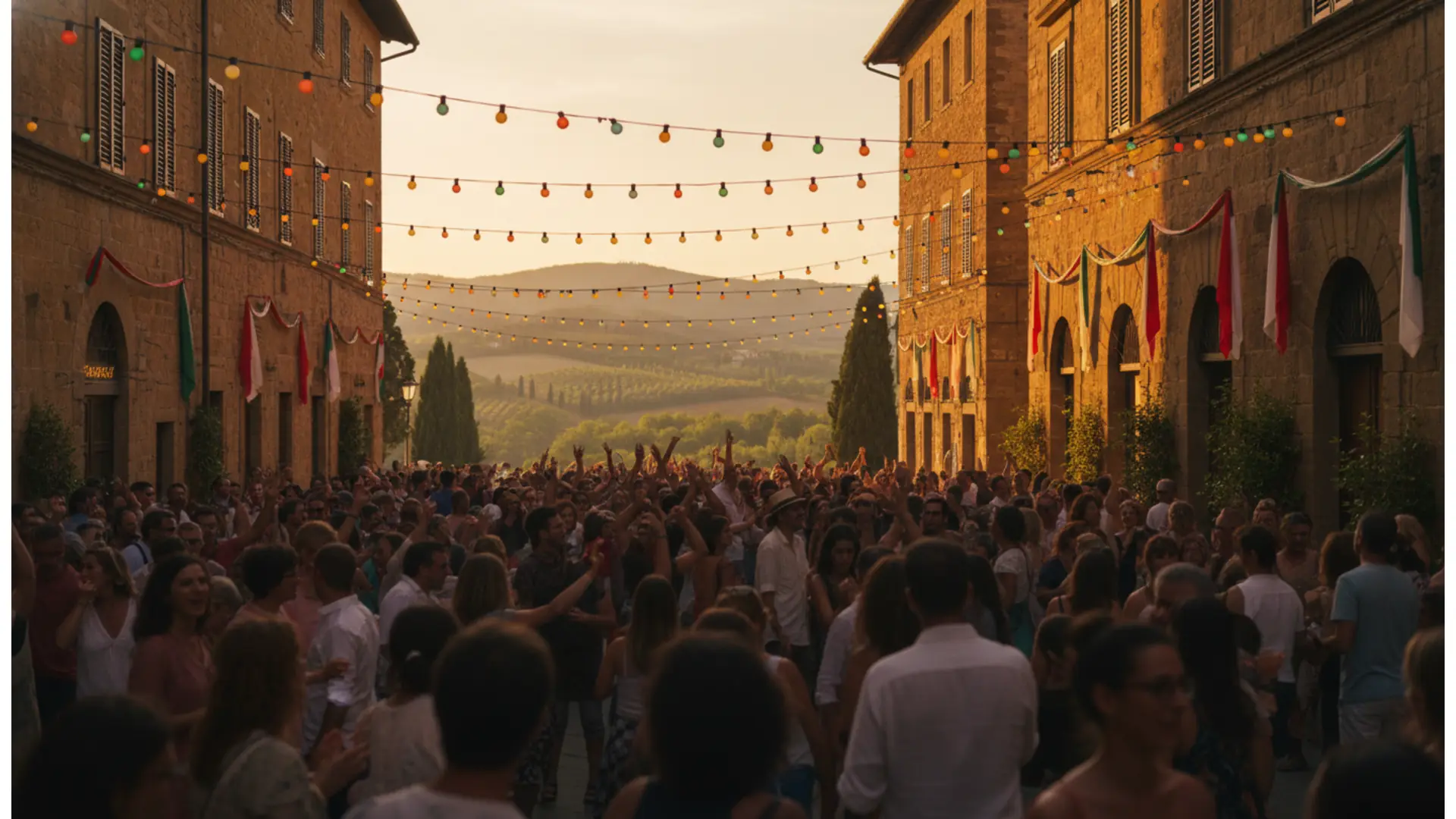
Santissimo Salvatore Festival
The ox-drawn cart procession in the heart of medieval Viterbo
About SS. Salvatore Viterbo
A devotion dating back to 1283
The Santissimo Salvatore Festival has its roots in a miraculous event recorded in Viterbo's chronicles. In 1283, two farmers were plowing a field near the Bagni area when their oxen suddenly stopped and knelt: the plow had struck a buried stone chest. Inside, they discovered a triptych depicting the Most Holy Savior, which was brought into the city and joyfully welcomed by the population at the church of Santa Maria Nuova, then the seat of the Guild of Plowmen, one of the most important corporations in medieval Viterbo.
The Savior's Triptych
The icon, dating back to the early 13th century, is crafted from leather on a wooden panel, in a style that blends the Roman school with Byzantine tradition. Scholars believe it is likely a copy of the Savior's image kept at the Lateran. For over seven centuries, the triptych has been housed in the church of Santa Maria Nuova, the beating heart of the festival and one of the oldest churches in the City of Popes.
From the 1344 statutes to the modern revival
The city statutes of 1344 already strictly regulated the celebration, which took place on the evening of August 14th with the participation of authorities, clergy, and the Guilds with their respective banners and torches. During the 19th century, however, the festival lost its prominence due to the growing popularity of the cult of Saint Rose and her spectacular processional machines, and the procession was suspended at the end of the century. Resumed in 1918 in a reduced form, the celebration has been progressively relaunched to regain its former glory: in 2025, 742 years after its discovery, the icon returned to parade on an ox-drawn cart, as per the original tradition.
The ox-drawn cart procession
The culminating ritual takes place on the Saturday preceding the second Sunday of May. A copy of the triptych is placed on a traditional agricultural cart decorated with wildflowers and pulled by a powerful pair of Maremma oxen, slowly traversing the streets of the city's ancient quarter. The procession is led by a historical pageant re-enacting the ancient Viterbo Guilds, with participants in medieval costumes starting from the church of San Pellegrino. Upon returning to Piazza Santa Maria Nuova, the triptych is welcomed by the Bishop of Viterbo for a solemn blessing.
The medieval village in celebration
A rich program of re-enactments unfolds around the procession: the San Pellegrino district, one of the best-preserved medieval villages in Italy, hosts a medieval trade market with educational stalls, historical fencing demonstrations, flag-wavers, musicians, and even a suggestive torture corner. A medieval dinner is served in the stables of the Papal Palace, where the first and longest conclave in history was held, while conferences and cultural meetings delve into the history of Papal Viterbo.
A festival in the heart of Tuscia
Organized by the Santa Maria Nuova – San Lorenzo parish together with the Santissimo Salvatore Historical Re-enactment Association, with the support of the Municipality of Viterbo, the festival is now a celebration for the entire city rather than just the parish. For the capital of Tuscia, in northern Lazio, it represents a precious opportunity to rediscover the medieval identity that made it the preferred seat of the pontiffs for decades, and to experience the historic center in an atmosphere of bygone days, amidst faith, history, and traditional flavors.
SS. Salvatore Viterbo — edition 2026
The 2026 edition, dedicated by the Bishop to the theme of peace, confirms the formula that relaunched the festival: a week of religious celebrations and historical re-enactments in the medieval heart of Viterbo. The most intense moment is the solemn procession on Saturday, May 9th, with the Savior's triptych transported on a cart adorned with flowers and pulled by Maremma oxen, preceded by the pageant of the ancient Guilds in costume starting from the church of San Pellegrino.
On Sunday, May 10th, Piazza Santa Maria Nuova and Piazza Don Mario Gargiuli host the medieval trade market all day, with demonstrations of historical fencing, flag-wavers, musicians, and the torture corner, along with solemn mass in the church of Santa Maria Nuova. The week closes on Wednesday the 13th with the conference «Viterbo between Popes, Antipopes, and the first conclave» with Tg1 journalist Mario Prignano. On the day of the procession, the historic center is closed to traffic from the morning.
Programme SS. Salvatore Viterbo 2026
Wednesday, May 6 – Friday, May 8
- Preparatory triduum with prayer moments and Eucharistic celebrations in the church of Santa Maria Nuova
Saturday, May 9
- 6:00 PM – Eucharistic celebration in the church of Santa Maria Nuova
- 6:15 PM – Departure of the historical pageant towards the church of San Pellegrino
- 6:30 PM – Historical re-enactment of the ancient Viterbo Guilds
- 6:40 PM – Solemn procession of the Santissimo Salvatore from Piazza Santa Maria Nuova, with the triptych transported on the ox-drawn cart
- 7:30 PM – Return of the procession to Piazza Santa Maria Nuova and welcoming of the triptych by Bishop Orazio Francesco Piazza
- 8:30 PM – Medieval dinner in the Papal Palace stables
Sunday, May 10
- All day – Medieval market in Piazza Santa Maria Nuova and Piazza Don Mario Gargiuli, with historical fencing demonstrations, flag-wavers, musicians, and the torture corner
- Solemn mass in the church of Santa Maria Nuova
Wednesday, May 13
- Conference «Viterbo between Popes, Antipopes, and the first conclave» with Mario Prignano, central editor-in-chief of Tg1, and Antonio Tempesta
Highlights SS. Salvatore Viterbo 2026
- Solemn procession with the 1283 triptych on a cart pulled by Maremma oxen
- Historical pageant of the ancient Viterbo Guilds in medieval costume
- Medieval trade market in the San Pellegrino district with the torture corner
- Medieval dinner in the Papal Palace stables
- Welcoming of the triptych by Bishop Orazio Francesco Piazza
Prices SS. Salvatore Viterbo 2026
Practical information — SS. Salvatore Viterbo
Getting there
Viterbo can be reached by car from Rome via the Cassia bis (SS2bis) expressway or the A1 motorway (Orte exit) in about an hour and a half. By train, the Rome Ostiense–Viterbo Porta Romana line stops just a short walk from the historic center; the Porta Fiorentina station is also connected to Orte and Attigliano. The events are concentrated between Piazza Santa Maria Nuova and the San Pellegrino district, in the heart of the historic center, accessible only on foot.
Admission and tips
The procession, the historical pageant, and the medieval market are free to attend. On the day of the procession, the historic center is subject to parking bans and traffic closures from the morning: it is advisable to park outside the walls (large parking lots at Porta Romana and Valle Faul) and walk. The streets of the San Pellegrino district are paved with cobblestones: comfortable shoes are recommended.
Festival-goer photos
No photos yet. Share yours!
Share your photos
5 photos max, 5 MB per photo (JPG, PNG, WebP)
Noticed an error or missing information?
Help us keep this listing up to date. Every proposal is verified by our team before publication.
Festival-goer reviews
No rating yet — be the first!
No comments yet. Be the first!
Were you there?
Share your experience with the community.
Published by Valentin Contard, festival listings writer. Reviewed, corrected and approved by Christophe Contard, editor-in-chief. .
Where does it take place — SS. Salvatore Viterbo
Centro storico di Viterbo – quartiere San Pellegrino
Piazza Santa Maria Nuova, 01100 Viterbo