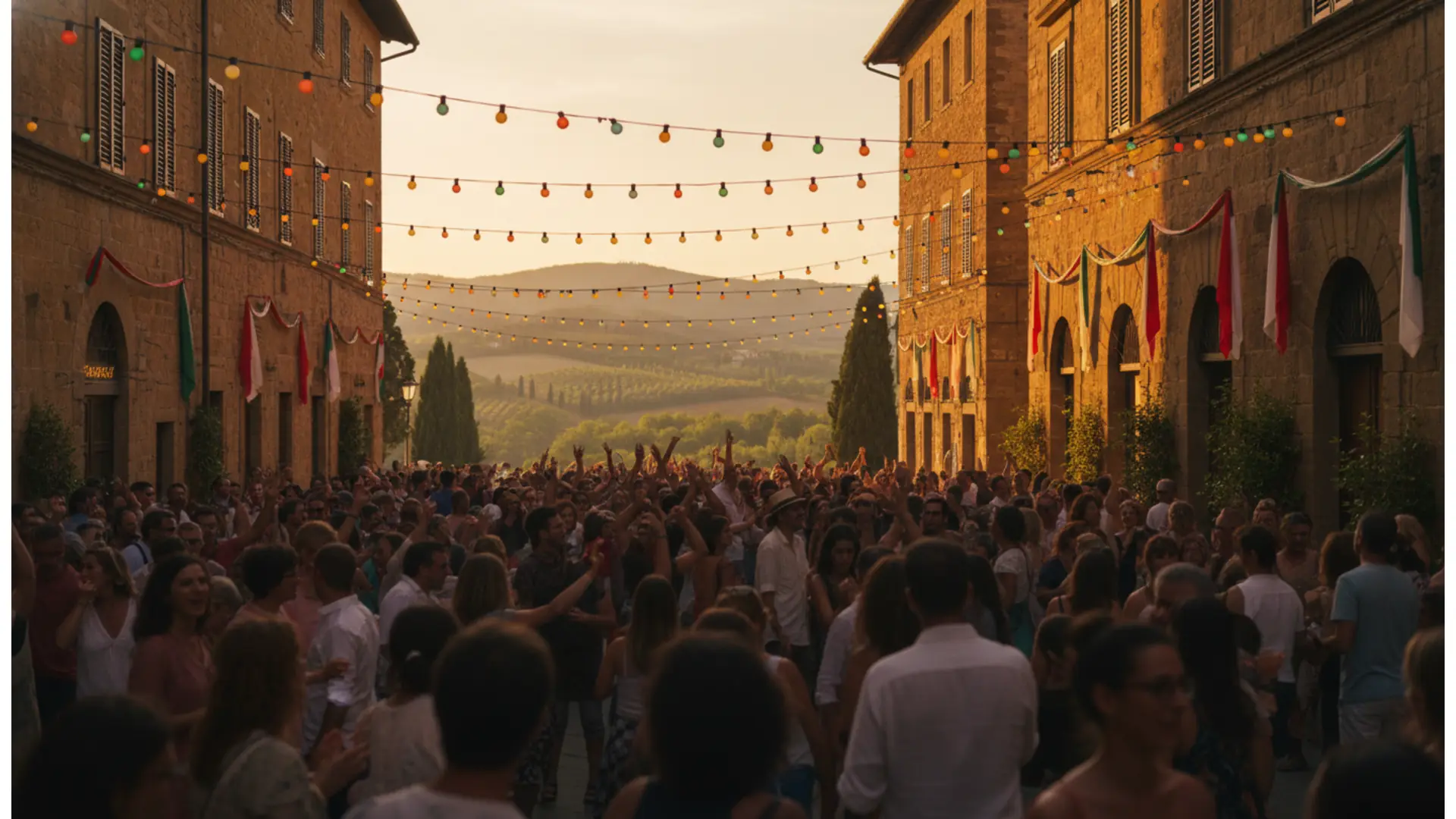
San Vito Feast and Turniata
The ancient millenary rite of blessing the flocks in the Salerno Apennines
About Turniata of San Vito
A millenary rite in the heart of the Salerno Apennines
Every June 15th, the feast day of Saint Vitus (San Vito Martire), the municipality of San Gregorio Magno, in the province of Salerno, on the border between Campania and Basilicata, relives one of the oldest and most evocative pastoral rites of rural Italy: the Turniata. This is not a re-enactment staged for visitors, but a living tradition practiced by the local farming families and passed down through generations in a village of just under four thousand inhabitants, nestled at an altitude of about 475 meters between the Upper Sele Valley and the Tanagro.
How the Turniata takes place
At the first light of dawn, shepherds descend from the high pastures with their flocks. Sheep, goats, cattle, horses, and donkeys are decorated with colorful ribbons, ringing cowbells, and patterns traced directly onto their fleece: it is a procession that winds through the town center to the chapel of San Vito Martire.
- The animals complete three laps around the church, in a counter-clockwise direction;
- The priest imparts the solemn blessing of the animals, the Benedictio Sollemnis Super Animalia, recited in Latin;
- The owners accompany the beasts on foot, often with their entire families in tow.
The odd number of laps is no coincidence: in folk culture, it ensures immunity from evil and prosperity for the pastoral cycle of the coming year. First-time observers are struck by the contrast between the hushed silence of the prayer and the thunderous clatter of cowbells that envelops the square.
From Roman circumambulatio to Christian devotion
Scholars trace the Turniata back to the circumambulatio, the ritual circuit around a sacred center that the Romans practiced during the Lupercalia and Parilia, pastoral festivals dedicated to the purification of flocks and the fertility of the fields. With Christianization, the gesture remained identical, but the recipient became Saint Vitus, invoked as the protector of animals. The same rite is repeated on the same day in the nearby municipality of Ricigliano, a sign of a cultural koinè that unites the pastoral towns of this corner of Campania.
A heritage recognized by the Campania Region
The Turniata is included in the Inventory of the Intangible Cultural Heritage of Campania (IPIC), the register through which the Region protects the identity-defining expressions of its territory. This recognition certifies the historical and anthropological value of the rite and places it among the most significant intangible manifestations of the entire Salerno hinterland, alongside the great pastoral festivals of the Southern Apennines.
The convivial moment and the procession
Once the blessing is over, the space in front of the chapel transforms into a great meeting point: fresh cheeses and freshly made curd, cured meats, local bread, and regional wine are shared by the farmers and local associations. In the late afternoon, the festival continues with a religious procession, accompanied by traditional songs from the women of the village, and concludes in the evening with entertainment in the square.
The gateway to the Gregorian Summer
The Feast of San Vito officially opens the calendar of the Gregorian Summer, the festival series that enlivens San Gregorio Magno from June to September with the San Vito Tournament, the Angiolillo Folk Festival, the Bacco Festival, and above all Baccanalia, the event in August that opens the over six hundred centuries-old cellars carved into the rock along Via Bacco. Those arriving for the Turniata will find a village already looking forward to the season of festivities.
Why it is worth the trip
The Turniata is one of those experiences not found on standard tourist circuits: it lasts only a few hours, begins when the rest of the world is still asleep, and has nothing staged about it. For those traveling in Campania in search of the deep identity of inland villages, this June morning in San Gregorio Magno is worth the detour from the Cilento coast or the Mediterranean motorway.
Turniata of San Vito — edition 2026
2026 Edition
The San Vito Feast and Turniata returned to San Gregorio Magno on Monday, June 15, 2026, faithful to the liturgical calendar date. The event officially opened the 2026 Gregorian Summer program, presented on June 11th at Palazzo Sant'Agostino, seat of the Province of Salerno, by Mayor Nicola Padula together with the Pro Loco, the Youth Forum, and local associations.
The day began before dawn with the descent of shepherds from the high pastures: sheep, goats, cattle, horses, and donkeys adorned with colorful ribbons, cowbells, and patterns traced on their fleece crossed the center to the Church of San Vito Martire, where they completed the three propitiatory laps in a counter-clockwise direction before the blessing of the animals. In the late morning, the square came alive with tastings of fresh cheeses, curd, cured meats, bread, and local wine; the afternoon featured a procession with traditional songs, while the evening concluded the festival with musical entertainment in the square.
During the same week, the 25th edition of the San Vito Tournament took place, organized by the Leoncini Gregoriani Soccer School, involving hundreds of young athletes and their families.
Programme Turniata of San Vito 2026
Wednesday, June 10 to Friday, June 12
- Novena to Saint Vitus in the church dedicated to the Saint: prayer at 6:30 PM and celebration at 7:00 PM.
Saturday, June 13 to Sunday, June 21
- 25th edition of the San Vito Tournament, organized by the Leoncini Gregoriani Soccer School.
Monday, June 15 — The Turniata
- 7:00 AM — Chaplet with the mysteries of the life of Saint Vitus.
- 7:30 AM — Holy Mass.
- 8:00-8:30 AM — Turniata: flocks, herds, and individual animals complete three laps around the Church of San Vito Martire; solemn blessing of the animals in Latin.
- Late morning — Tasting in the square of fresh cheeses, curd, cured meats, bread, and local wine.
- 5:30 PM — Procession starting from Piazza San Vito, accompanied by traditional songs.
- Evening — Entertainment in the square with live music and cabaret.
Highlights Turniata of San Vito 2026
- The three ritual laps of the flocks around the Church of San Vito Martire at dawn
- The solemn blessing of the animals recited in Latin
- Animals adorned with colorful ribbons, cowbells, and patterns on their fleece
- Tasting of fresh cheeses and freshly made curd in the square
- Afternoon procession from Piazza San Vito with traditional songs
- Official opening of the Gregorian Summer festival series
Prices Turniata of San Vito 2026
Practical information — Turniata of San Vito
How to get there
San Gregorio Magno is easily reached by car: from the A2 Mediterranean motorway, take the exit for Sicignano degli Alburni and continue on the Sicignano-Potenza junction, then follow the signs for the town. The village is located at an altitude of about 475 meters, just over an hour's drive from Salerno and Potenza. The reference railway station is Sicignano degli Alburni.
Hours and access
The rite takes place early in the morning: it is advisable to be in town by 7:30 AM to attend the mass and find a spot near the Church of San Vito Martire before the flocks arrive. Access is free, with no tickets or reservations required.
Useful tips
- Wear comfortable shoes: the town center streets are steep and crowded with animals.
- Always follow the shepherds' instructions and do not get too close to the moving flocks.
- The dawn light makes the Turniata an exceptional photographic opportunity.
- Accommodation in the village is limited: it is advisable to book farm stays and B&Bs in the area well in advance.
Information
Pro Loco San Gregorio Magno — tel. +39 377 3852296, [email protected].
Municipality of San Gregorio Magno, Piazza Municipio 1 — tel. +39 0828 955244.
Festival-goer photos
No photos yet. Share yours!
Share your photos
5 photos max, 5 MB per photo (JPG, PNG, WebP)
Noticed an error or missing information?
Help us keep this listing up to date. Every proposal is verified by our team before publication.
Festival-goer reviews
No rating yet — be the first!
No comments yet. Be the first!
Were you there?
Share your experience with the community.
Published by Valentin Contard, festival listings writer. Reviewed, corrected and approved by Christophe Contard, editor-in-chief. .
Where does it take place — Turniata of San Vito
Chiesa di San Vito Martire