Intrecci: Narrative and Philosophical Itineraries in the Villages of Irpinia
Philosophy, literature, and wine across Sant'Angelo all'Esca, Luogosano, and Taurasi
About Intrecci
A festival of thought in the heart of Irpinia
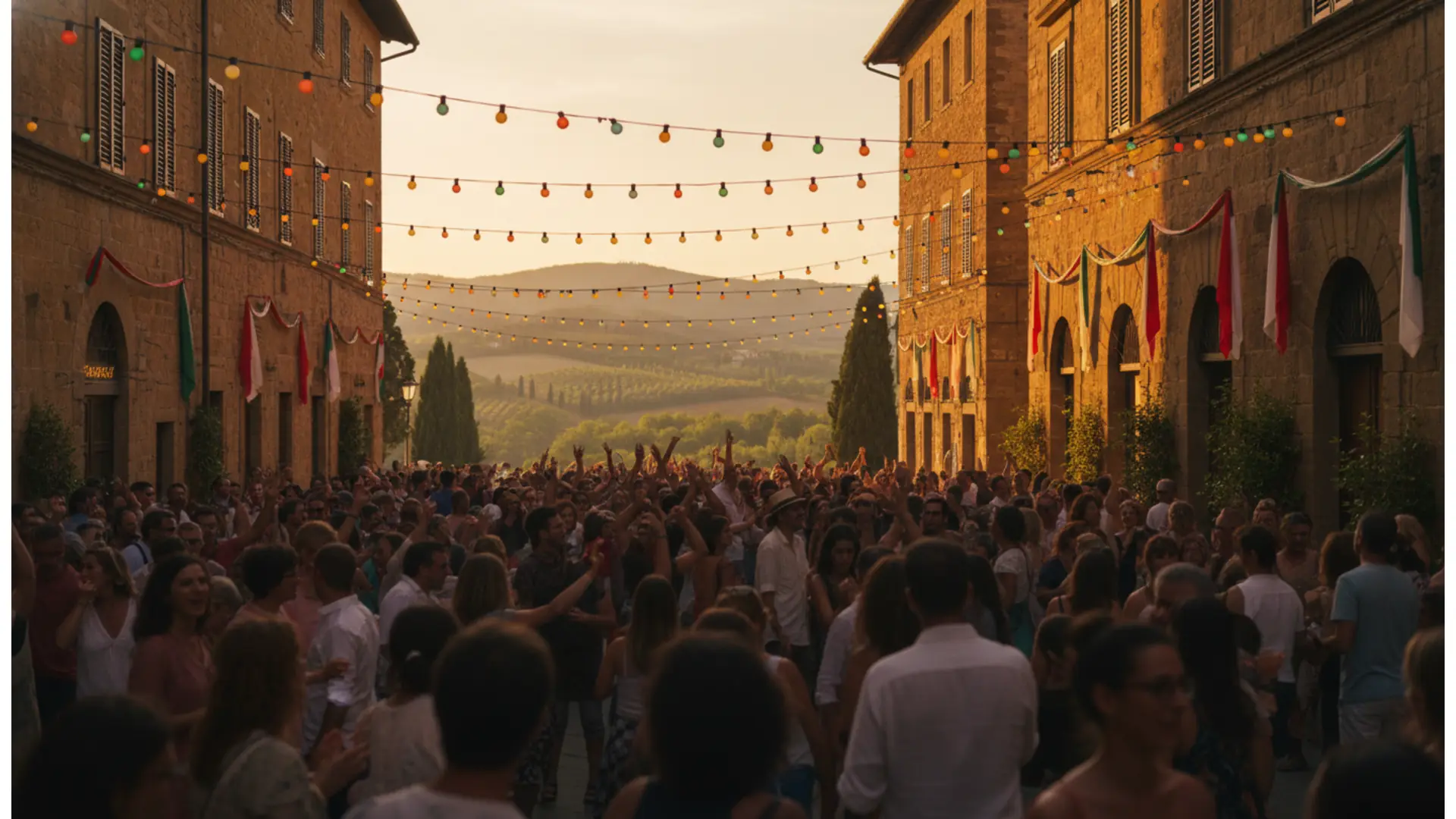
Intrecci: Narrative and Philosophical Itineraries in the Villages of Irpinia is a cultural festival held from May to September across the small towns of the province of Avellino, in Campania. This is not a festival of large crowds or grand stages: its scale is that of a town hall, a castle courtyard, or a cellar carved into the tuff rock. It consists of six days of thematic meetings built around the questions that philosophy continues to pose to the present day, featuring guests from the national debate who agree to speak to an intimate audience.
The formula is intentionally hybrid: territorial storytelling and philosophical reflection go hand in hand, and each meeting is almost always accompanied by a moment dedicated to local food and wine, a visit to a village, or the discovery of a winery. It is a way of saying that thought cannot be separated from the places that host it.
Sant'Angelo all'Esca and the legacy of Paolo Raffaele Troiano
The Municipality of Sant'Angelo all'Esca, a tiny village in the province of Avellino overlooking the Calore Valley, is the origin of the project. This is the birthplace of Paolo Raffaele Troiano, a philosopher who taught at the University of Turin between the 19th and 20th centuries, rediscovered and studied by the philosopher Antimo Negri. The festival was conceived around his figure: a thinker who left a town of a few hundred inhabitants to enter the history of Italian philosophy, and who today gives meaning to a festival that aims to bring ideas back to where they were born.
The town has named a square after the philosopher, and for years Sant'Angelo all'Esca has hosted some of the most anticipated stages of the festival: in a past edition, it was here that Massimo Cacciari held his lectio magistralis dedicated to metaphysics, introduced by journalist Generoso Picone.
A traveling path through the villages
Intrecci is by vocation a traveling event: over the years, it has touched Sant'Angelo all'Esca, Luogosano, Taurasi, and in the past, Avella and Villamaina. The mayors of the involved municipalities are part of the organizing committee, a sign of shared planning that keeps small but cohesive administrations together.
- Sant'Angelo all'Esca — the village of the philosopher Troiano, the symbolic heart of the festival
- Luogosano — the Council Chamber traditionally hosts the opening lectures
- Taurasi — the Marchional Castle with the Carlo Gesualdo hall and the historic cellars of the Taurasi DOCG
Philosophy, literature, and current events
The program alternates between long-standing philosophers, writers, and journalists. Recent editions have featured names such as Massimo Cacciari, Massimo Donà, Umberto Curi, Sergio Givone, political scientist Marco Tarchi, and journalist Antonello Caporale. Themes range from metaphysics to the roots of belonging, from the relationship between the individual and their land to the issues that animate contemporary public debate.
Wine as a key to interpretation
We are in the heart of the Taurasi DOCG triangle, and the festival makes it a cultural resource even before a gastronomic one. It is no coincidence that the 2026 edition opened with a reflection on wine "between philosophy, literature, art, and politics," followed the next day by a visit to the Antonio Caggiano winery and the Marchional Castle of Taurasi. Tastings and thematic dinners regularly accompany the meetings: the glass is not an accessory, but part of the reasoning.
Organizers
The festival is promoted by the Elis APS Association and directed by Raffaella Luise, with scientific advice from Daniela Calabrò (University of Salerno) and Pietro Luise. The operational coordination includes Pierluigi D'Ambrosio, Pietro Di Fronzo, Michele Ferrante, and Michele Venezia, together with the mayors of the host municipalities.
Why it's worth the trip
Those who come to Intrecci will not find a fair, but a rare opportunity: to listen to a nationally renowned philosopher in a village council chamber, and then walk at sunset among vineyards and stone houses. It is a formula that restores to the inland areas of Campania a role that is rarely recognized—that of a place where one thinks, and not just where one produces. For the visitor, it is also the best pretext to discover the most authentic Irpinia, that of villages under a thousand inhabitants where the quality of life is measured in silence and hospitality.
Intrecci — edition 2026
Intrecci 2026: six days between May and September
The 2026 edition confirms the festival's structure: six appointments spread over five months, between Luogosano, Taurasi, and Sant'Angelo all'Esca, in the province of Avellino. The inauguration was held on Saturday, May 9, in the Council Chamber of Luogosano with philosopher Massimo Donà, who spoke about wine "between Philosophy, Literature, Art, and Politics" with the coordination of Carmelina D'Amore and in the presence of Mayor Carmine Ferrante.
The following day, the festival moved to Taurasi for a morning dedicated to the territory: a visit to the Antonio Caggiano winery, the Marchional Castle, and a tasting of local wine products. At the end of his visit, Donà announced his intention to develop a cultural project titled "Hirpinia Mirabilis" with the organizers, to be presented in September at the castle of Taurasi.
The guest lineup
The program continues with philosopher Umberto Curi (June 13, Luogosano), journalist and writer Antonello Caporale (June 19), political scientist Marco Tarchi (September 19), and philosopher Sergio Givone (September 26). A lineup that brings together theoretical philosophy, political science, and journalistic storytelling of contemporary Italy.
Culture, food and wine, and the beauty of the places
As in previous editions, each day combines a reflection session with a discovery path: wineries, historic palaces, and ancient centers. The organizing committee is composed of Raffaella Luise and the mayors of the three municipalities — Carmine Ferrante for Luogosano, Attilio Iannuzzo for Sant'Angelo all'Esca, and Antonio Caggiano for Taurasi — confirming an inter-municipal collaboration that is now the hallmark of the event.
Programme Intrecci 2026
Saturday, May 9, 2026 — Luogosano
6:00 PM, Council Chamber: opening of the festival with philosopher Massimo Donà, "Wine between Philosophy, Literature, Art, and Politics." Coordinated by Carmelina D'Amore; greetings from Mayor Carmine Ferrante.
Sunday, May 10, 2026 — Taurasi
10:00 AM: visit to the Antonio Caggiano winery and the Marchional Castle, with a tasting of local wine products.
Saturday, June 13, 2026 — Luogosano
Meeting with philosopher Umberto Curi.
Friday, June 19, 2026
Meeting with journalist and writer Antonello Caporale.
Saturday, September 19, 2026
Meeting with political scientist Marco Tarchi.
Saturday, September 26, 2026
Closing appointment with philosopher Sergio Givone.
The locations for the June and September stages and detailed times are communicated by the organizers in the days preceding each appointment.
Highlights Intrecci 2026
- Massimo Donà opens the festival in Luogosano with a lecture on wine as an object of thought
- The morning in Taurasi between the Antonio Caggiano winery and the Marchional Castle
- The return of Umberto Curi and Sergio Givone, two historic voices of Italian philosophy
- A look at current events with Antonello Caporale and Marco Tarchi
- The "Hirpinia Mirabilis" project announced for September at the castle of Taurasi
Practical information — Intrecci
How to get there
Sant'Angelo all'Esca can be reached by car from the Grottaminarda exit of the A16 Naples-Canosa motorway, continuing towards the Calore Valley (about 25 km). From Avellino, take the SS7 Appia road east for about 30 km. Luogosano and Taurasi are a few kilometers away and can be reached via internal provincial roads.
Train and plane
The most convenient train station is Benevento; the reference airport is Naples-Capodichino, about an hour and a half away by car. Local public transport is limited: a car is essential to follow the festival's traveling stages.
Admission and reservations
Updated information on admissions, reservations for guided tours, and thematic dinners should be requested from the host municipalities (Sant'Angelo all'Esca, Luogosano, Taurasi) or the Elis APS Association. Meetings are generally held in the late afternoon, around 6:00 PM.
Where to sleep and eat
The area offers farmhouses and wineries with hospitality between Taurasi, Paternopoli, and Castelfranci. This is the land of Taurasi DOCG: it is worth planning at least one tasting in a cellar and a stop at the trattorias of the Calore Valley.
Tips
- Book your accommodation in advance: the facilities in the villages are few and small
- Bring comfortable shoes, as the historic centers are hilly and cobbled
- May and September evenings in the hills can be cool: a light jacket is useful
Festival-goer photos
No photos yet. Share yours!
Share your photos
5 photos max, 5 MB per photo (JPG, PNG, WebP)
Noticed an error or missing information?
Help us keep this listing up to date. Every proposal is verified by our team before publication.
Festival-goer reviews
No rating yet — be the first!
No comments yet. Be the first!
Were you there?
Share your experience with the community.
Published by Valentin Contard, festival listings writer. Reviewed, corrected and approved by Christophe Contard, editor-in-chief. .