Saint Joseph's Feast - Saint Joseph's Tables
Votive tables and the March 19th procession in the heart of Sicily
About Saint Joseph in Bivona
A devotion that becomes domestic art
In Bivona, a village in the Sicani Mountains in the province of Agrigento, the Saint Joseph's Feast is experienced not only in church but above all inside private homes. On March 18th and 19th, numerous Bivona families set up the famous Saint Joseph's tables: true domestic altars erected in a corner of the house, leaning against a wall adorned with the image of the Holy Patriarch. It is a vow, an act of thanksgiving "for graces received," which transforms the entire community into an itinerary of devotion, gastronomy, and folklore.
The altars and the votive bread
The tables are covered with finely embroidered tablecloths and sheets, decorated in the background with laurel, flowers, oranges, palms, and glass vases filled with wild asparagus. At the center of it all is the votive bread, handcrafted and modeled into shapes that recall the trade of Saint Joseph the carpenter: the saw, the hammer, the nails, the ladder, as well as ring-shaped breads called vucciddati and the flowering staff. There is no shortage of large lambs and almond paste sheep, traditional sweets like Saint Joseph's sfingi, pignolata, mastazzola, dried fruit, and a book-shaped cake with the inscription "Viva San Giuseppe".
The Saints and the Holy Family banquet
The heart of the ritual is the invitation to the table of three less fortunate people, often children, who represent the Holy Family: they are the "Saints". The number of almond paste lambs corresponds exactly to the number of Saints who will participate in the banquet on March 19th. This is the charitable dimension of the feast: needy families are welcomed into Bivona homes in a gesture of sharing that has its roots in Sicilian popular tradition, according to which the cult was born as a vow to the Saint to free the island from a terrible famine.
Symbols on the table
Every element on the table has a precise meaning: sprouted wheat (luvureddu) symbolizes prosperity, boiled cod recalls Christ, the octopus represents Lucifer, and the live eel kept in water embodies evil, whose death coincides with the victory of good. Water and wine are kept separate in a pitcher. It is a ritual language that makes every home a small sacred theater.
The procession and the religious feast
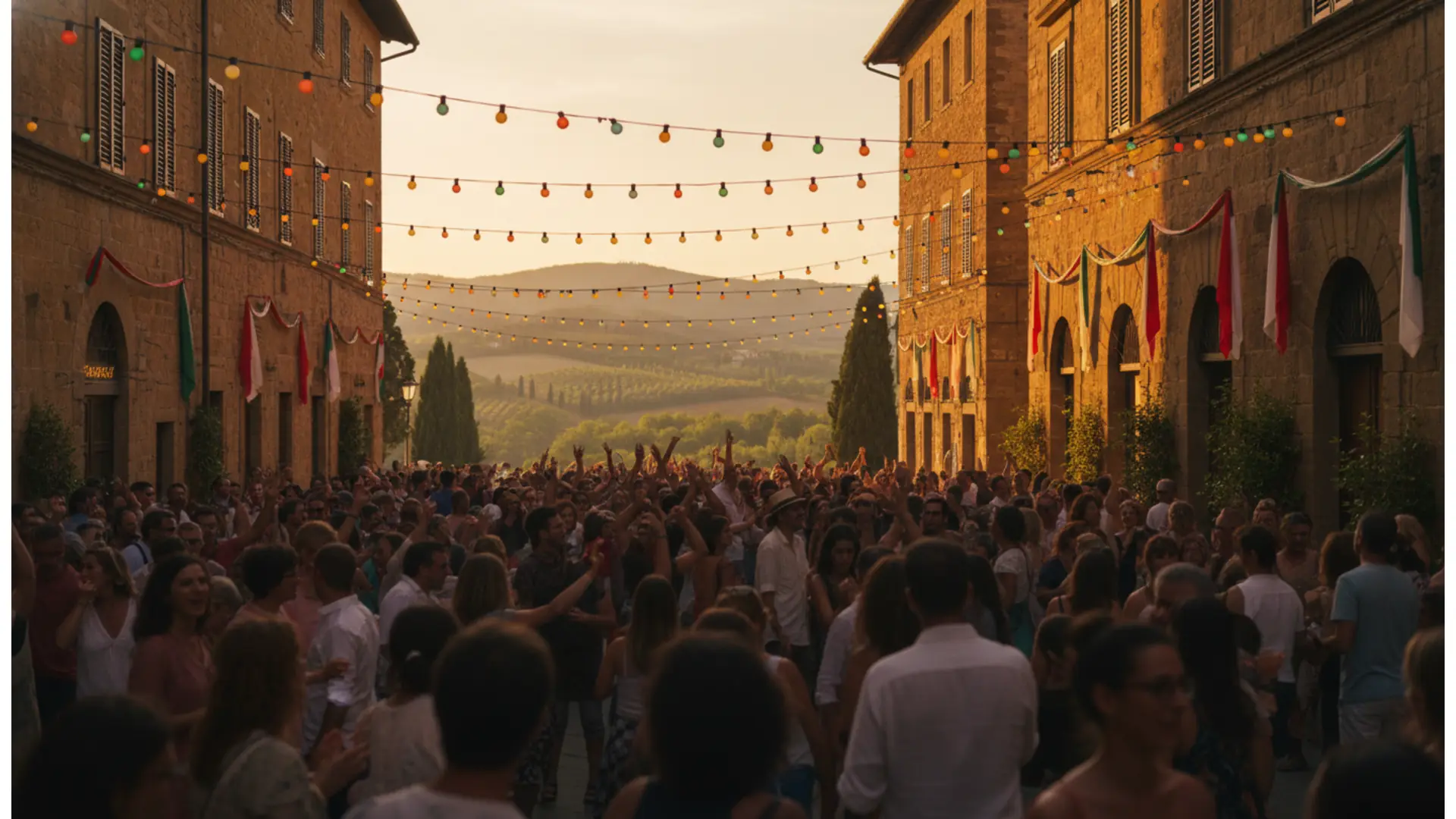
On the eve of the feast, the evening of March 18th, the parish priest blesses the large tables, which are then opened to the public: visitors can enter the homes and taste the sweets and dishes of Bivona cuisine. On March 19th, Saint Joseph's Day, blessed bread is distributed, and in the late afternoon, the solemn procession of the statue winds through the narrow streets of the historic center, amidst music and devotion, concluding with traditional fireworks. The ViviVivona tourist association offers guided tours on this occasion to discover the village, from the Mother Church to the Carmine Church, up to the 1374 Chiaramonte portal and the Palazzo Marchese Greco, including visits to the tables in private homes.
Saint Joseph in Bivona — edition 2026
The 2026 edition followed the traditional calendar: March 18th, blessing of the tables at 5:00 PM and opening of the homes to the public; March 19th, the solemn Saint Joseph's Day, with the distribution of blessed bread, the procession of the statue in the late afternoon, and concluding fireworks. Once again this year, Bivona families set up domestic altars with votive bread shaped like carpenter's tools, almond paste sweets, sfingi, and pignolata, welcoming the "Saints" representing the Holy Family to their tables.
Programme Saint Joseph in Bivona 2026
Traditional program of the 2026 edition (Bivona, AG):
- March 18th, 5:00 PM — Blessing of the votive tables and opening of homes to visitors to admire altars, votive bread, and traditional dishes.
- March 19th — Solemn Saint Joseph's Feast: distribution of blessed bread and banquet of the "Saints" (the Holy Family).
- March 19th, late afternoon — Solemn procession of the Saint Joseph statue through the streets of the historic center.
- Following — Concluding fireworks.
The detailed calendar is published annually by the parish and local associations; the ViviVivona association offers guided tours to discover the tables and the village.
Highlights Saint Joseph in Bivona 2026
- Blessing and opening of the votive tables in Bivona homes (March 18th)
- Votive bread shaped like saws, hammers, and carpenter's tools
- The banquet of the "Saints", representing the Holy Family
- Procession of the statue and fireworks (March 19th)
Prices Saint Joseph in Bivona 2026
Practical information — Saint Joseph in Bivona
When
Every year on March 18th and 19th. On the eve (March 18th), the tables are blessed and opened to visitors; on March 19th, the statue procession takes place in the late afternoon, followed by fireworks.
Where
In private homes and along the streets of the historic center of Bivona (AG), in the Sicani Mountains, province of Agrigento. The tables are marked and open to visitors.
How to get there
Bivona can be reached by car via the SS 118 road in the Agrigento hinterland. The reference airports are Palermo (Punta Raisi) and Catania Fontanarossa, both about a two-hour drive away.
Costs
Visiting the tables and participating in the procession are free. It is customary to respect the devotional nature of the event.
Festival-goer photos
No photos yet. Share yours!
Share your photos
5 photos max, 5 MB per photo (JPG, PNG, WebP)
Noticed an error or missing information?
Help us keep this listing up to date. Every proposal is verified by our team before publication.
Festival-goer reviews
No rating yet — be the first!
No comments yet. Be the first!
Were you there?
Share your experience with the community.
Published by Valentin Contard, festival listings writer. Reviewed, corrected and approved by Christophe Contard, editor-in-chief. .
Where does it take place — Saint Joseph in Bivona
Centro storico di Bivona