Saint Blaise Patronal Festival (Solemn Procession and Feast of the Raising of the Cross)
The patron saint of Giuliano di Roma, celebrated between the February oil blessing and the solemn procession on the last Sunday of August
Edition 2026 not confirmed to date
This edition has not been confirmed by the organiser to date. We recommend checking before going.
About Saint Blaise Festival
A devotion that spans the entire year
In Giuliano di Roma, a town in the province of Frosinone in the heart of the Lazio Ciociaria region, the figure of Saint Blaise is not tied to a single calendar day. The bishop and martyr of Sebaste, a physician before he was a shepherd, is celebrated here twice: once in the dead of winter and again at the end of summer. This double recurrence illustrates how popular devotion in the villages of southern Lazio has layered over the centuries, intertwining liturgy, family memory, and village life.
February 3rd: The oil and the blessing of the throat
The first date is the canonical one from the liturgical calendar. On February 3rd, the community gathers in the church for the blessing of Saint Blaise's oil, with which the priest anoints the throats of the faithful: an ancient gesture linked to the hagiographic episode of the child saved by the saint while choking on a fish bone. In Giuliano, tradition also dictates that the blessed oil be taken to the homes of the sick and those unable to reach the church, a sign of a religiosity that cares for the village door-to-door. It is a more intimate celebration compared to the summer one, but for many locals, it remains the most personal.
The last Sunday of August: The solemn procession
The main festival, which fills the streets, takes place on the last Sunday of August. According to local tradition, the summer recurrence was born to commemorate the consecration of the Saint Blaise chapel, which took place on the last Sunday of August in 1739. Since then, the central moment has been the solemn procession: the statue of the saint leaves the church and is carried on shoulders through the village streets, among the stone houses of the historic center, accompanied by the clergy, confraternities, and a procession of the faithful that stretches into the early evening hours.
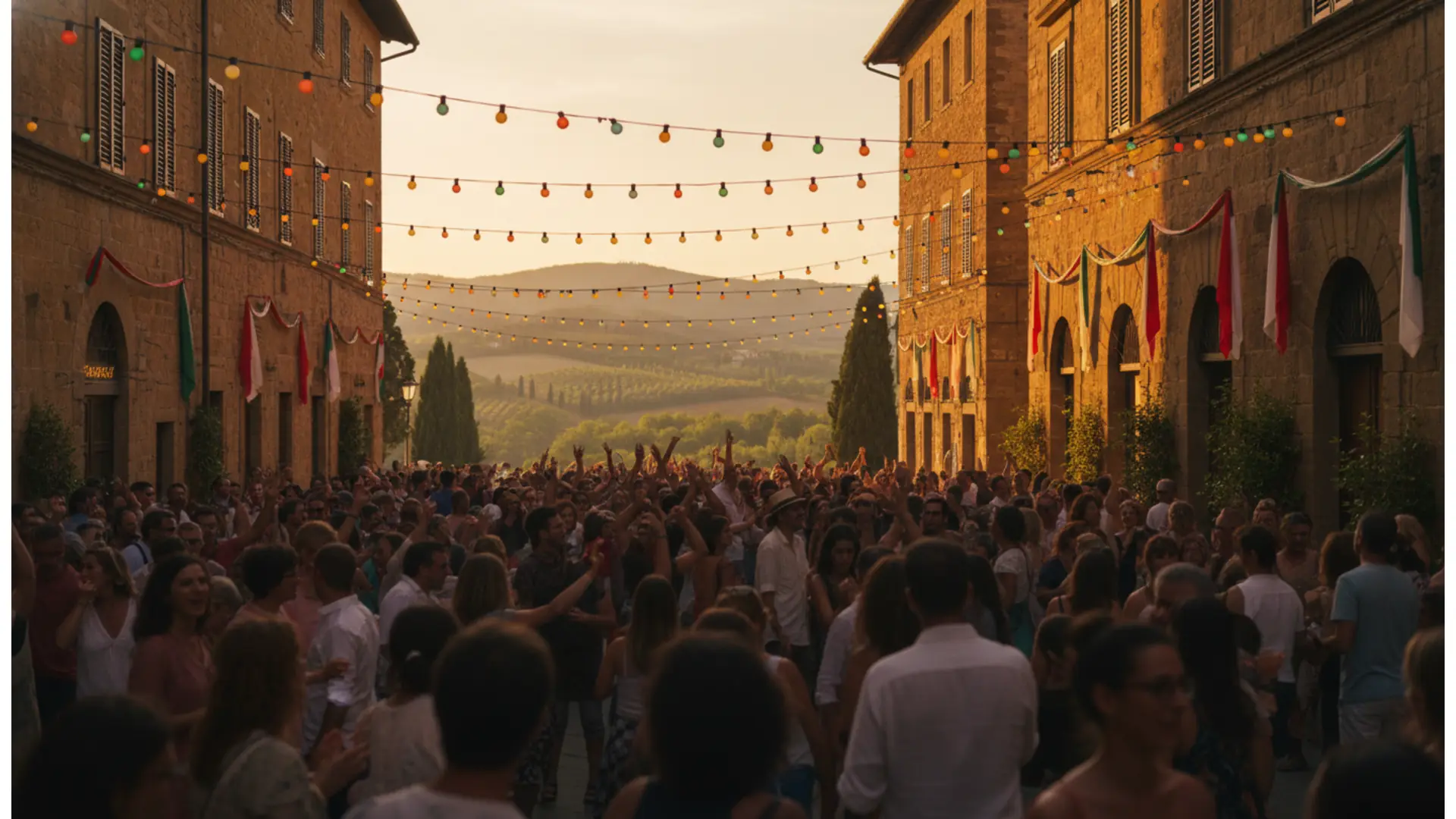
The procession is surrounded by the usual atmosphere of Ciociaria patronal festivals: solemn liturgical celebrations, illuminations on the main streets, musical moments in the square, and social evenings that, during a week when the village population peaks thanks to the return of emigrants and vacationers, become the most anticipated community event of the year.
The Feast of the Raising of the Cross, a 2025 innovation
In 2025, the parish priest Father Luigi Vitali decided to add a new celebration to the patronal festivities: the Feast of the Raising of the Cross. At its center is the iron cross that stands out on the highest point of Mount Siserno, the mountain that embraces the village. That cross originally stood near the elementary schools and was torn down to make room for a private building; in 1973, a group of about twenty local volunteers carried it by hand to the summit, where it still stands today. The Fochisti Giglianisi group, the same one that manages the traditional Christmas bonfire, restored it to its former glory with extensive restoration work.
On August 30, 2025, on the sidelines of the procession, a public meeting was held in Piazza Borgo Vittorio Emanuele to reconstruct that history, featuring the names and testimonies of the protagonists collected in research by Antonio Luzi and Cataldo Torella. A festival with a distinctly spiritual and identity-focused approach, made of history, faith, and belonging, destined to be repeated in the following years.
The village and its landscape
Giuliano di Roma stretches along a ridge on the slopes of the Lepini Mountains, in a position that dominates the Amaseno Valley. The historic center retains its medieval layout, with narrow alleys, arches, and stairways that suddenly open onto wide panoramas towards the plains. Mount Siserno, with its hiking trails and the cross at the summit, is the natural destination for those who want to combine the festival with a walk; the village is also crossed by the Cammino della Regina Camilla, a walking route that connects the villages in the area.
For those visiting Lazio off the beaten path, attending the end-of-August procession in Giuliano di Roma means encountering an authentic Ciociaria, where the patronal festival is not a tourist reconstruction but the moment when an entire community recognizes itself.
Saint Blaise Festival — edition 2026
The 2026 edition
As of the writing of this sheet, no official program has been published for the 2026 patronal festivities in Giuliano di Roma. However, the recurrence follows a very stable calendar: on February 3rd, the blessing of Saint Blaise's oil in the church, and on the last Sunday of August, the solemn procession along the streets of the historic center.
The second edition of the Feast of the Raising of the Cross is also expected, the celebration established in 2025 by Father Luigi Vitali around the cross that has stood on the summit of Mount Siserno since 1973. The detailed program, with times of celebrations, musical appointments, and initiatives in Piazza Borgo Vittorio Emanuele, is normally distributed by the parish and the Municipality in the weeks immediately preceding the festival.
Programme Saint Blaise Festival 2026
2026 program not yet published. Usual structure of the festival:
- February 3rd — Holy Masses, blessing of Saint Blaise's oil, and anointing of the throats of the faithful; the blessed oil is taken to the sick who are unable to reach the church.
- Last Sunday of August — Solemn liturgical celebrations and solemn procession with the statue of the patron saint through the streets of the historic center.
- Feast of the Raising of the Cross — A moment of memory and testimony dedicated to the cross of Mount Siserno, in Piazza Borgo Vittorio Emanuele.
Dates and times are to be confirmed with the Saint Blaise Parish.
Highlights Saint Blaise Festival 2026
- The solemn procession with the statue of Saint Blaise in the medieval village
- The blessing of the oil and the anointing of the throat on February 3rd
- The Feast of the Raising of the Cross on Mount Siserno, established in 2025
- The panorama over the Amaseno Valley from the upper streets of the village
Prices Saint Blaise Festival 2026
Practical information — Saint Blaise Festival
How to get there
Giuliano di Roma can be reached by car from the A1 Rome-Naples motorway, taking the Frosinone exit and continuing towards Ceccano and the Amaseno Valley (about 25 km from the toll booth). By train, the reference station is Frosinone, on the Rome-Cassino line, connected to the village by local bus lines.
When
Double recurrence: February 3rd for the blessing of the oil and the anointing of the throat, and the last Sunday of August for the solemn patronal procession, preceded by weekend festivities.
Admission and tips
Religious celebrations and the procession are free to attend. The historic center is on a slope and largely pedestrianized during the festival: comfortable shoes are recommended, and parking is available in areas outside the village. For those wishing to reach the cross on the summit of Mount Siserno, the hike requires trekking gear and should be tackled during the cooler hours of the day.
Information
For the updated program, it is best to contact the Saint Blaise Parish of Giuliano di Roma or consult the notices from the Municipality, generally distributed in the weeks preceding the festival.
Festival-goer photos
No photos yet. Share yours!
Share your photos
5 photos max, 5 MB per photo (JPG, PNG, WebP)
Noticed an error or missing information?
Help us keep this listing up to date. Every proposal is verified by our team before publication.
Festival-goer reviews
No rating yet — be the first!
No comments yet. Be the first!
Were you there?
Share your experience with the community.
Published by Valentin Contard, festival listings writer. Reviewed, corrected and approved by Christophe Contard, editor-in-chief. .
Where does it take place — Saint Blaise Festival
Centro storico e piazza Borgo Vittorio Emanuele