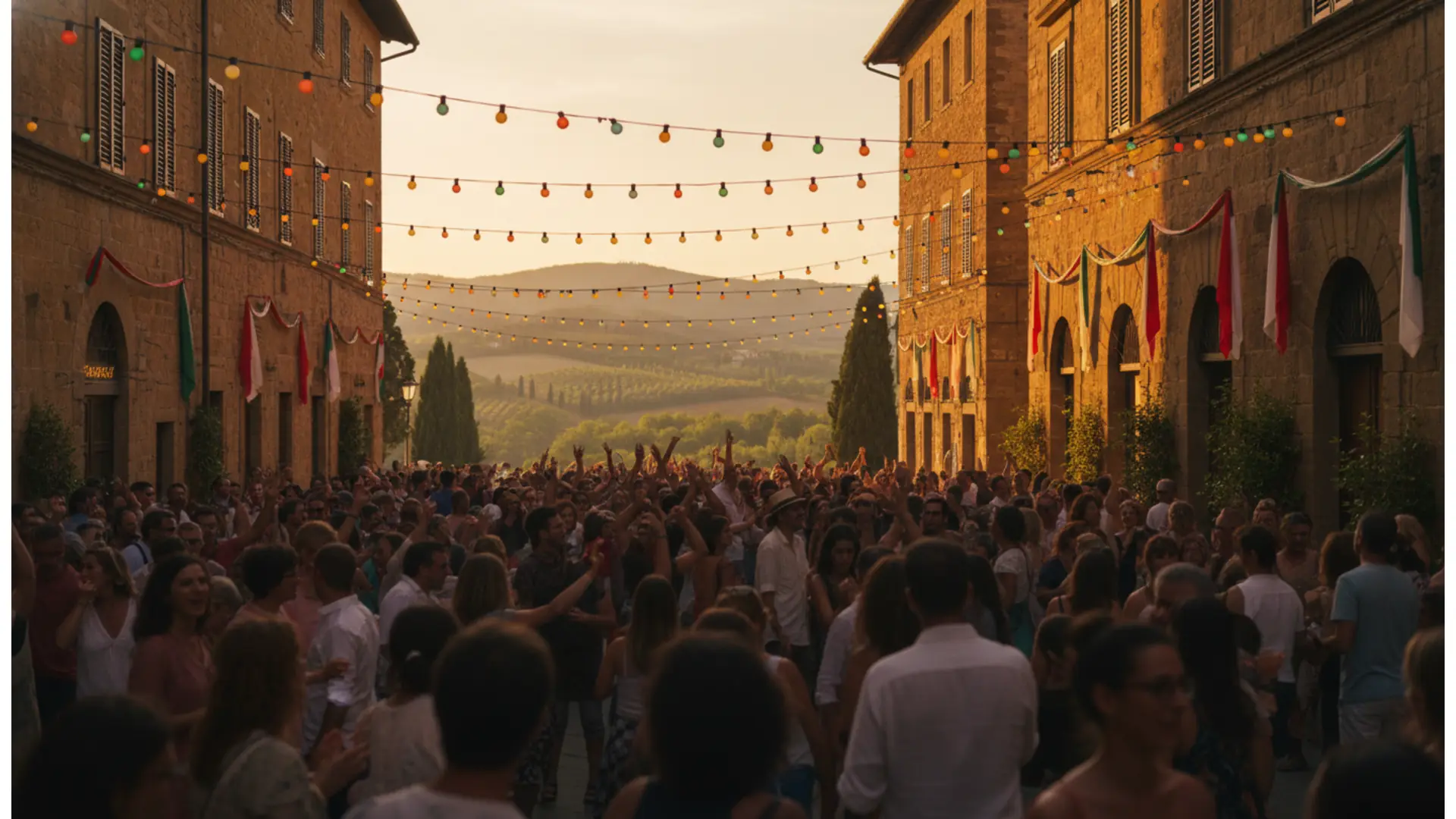
Saint Blaise Patronal Festival
On February 3rd, Marano Equo celebrates its patron saint with a procession, anise doughnuts, and colorful hot-air balloons.
Edition 2026 not confirmed to date
This edition has not been confirmed by the organiser to date. We recommend checking before going.
About Saint Blaise in Marano Equo
A devotion that warms the February air in Marano
In Marano Equo, a village of a few hundred inhabitants perched between Monte Ruffi and the Aniene Valley, about sixty kilometers from Rome, February 3rd is no ordinary date. It is the day of Saint Blaise, bishop and martyr, the patron saint of the municipality and namesake of the parish church that dominates the historic center. The Saint Blaise Patronal Festival is the quintessential identity-defining event for this community in the Metropolitan City of Rome, located in the mountainous heart of the Lazio region: an appointment that the population prepares for weeks in advance and that draws back to the village even those who live elsewhere.
The protector of the throat
Saint Blaise was a bishop of Sebaste, in Armenia, and suffered martyrdom in the 4th century during the persecutions. Tradition remembers him above all for the miracle performed on a child who was choking on a fish bone: hence his fame as the protector of the throat and respiratory diseases. This is the reason for the most characteristic ritual of the day, the blessing of the throat imparted to the faithful during the solemn service, using blessed oil and crossed candles. A simple and ancient gesture that, in Marano Equo as in many other Italian communities, continues to draw people of all ages to the church.
The procession through the village streets
The heart of the day is the procession, which departs from the Church of Saint Blaise Bishop and Martyr after the solemn mass. The saint's effigy is carried on shoulders along the maze of alleys that the locals call rue, connected by the characteristic trabucchi—small covered arches that link the buildings and give the medieval historic center its unmistakable appearance. The procession is attended by the clergy, confraternities, the municipal banners, and—in recent years—that of the Metropolitan City of Rome, testifying to the value this tradition has assumed beyond the village borders.
Anise doughnuts and colorful balloons
The religious dimension has always been accompanied by a festive and convivial one. In the days leading up to the anniversary, the women of Marano Equo prepare anise doughnuts, simple sweets linked to the saint, which are then distributed for free in the square along with local wine. It is the moment when the festival becomes a village gathering, an opportunity to reconnect with neighbors and welcome visitors.
The most spectacular sign, however, remains the launch of the hot-air balloons: large globes handcrafted with multicolored tissue paper that, inflated with hot air, rise above the village rooftops and drift toward the ridges of the Simbruini Mountains. A popular spectacle, modest in its means but highly effective, which gathers young and old in the square with their eyes turned upward.
Three days of celebration and the pizzigli festival
When the calendar and weather permit, the festivities extend over three days of celebrations, masses, music, and convivial moments. This also includes the so-called sagra dei pizzigli, linked to local peasant cuisine, which completes the gastronomic picture of the event. Recent editions have recorded very high participation: in 2024, the mild climate allowed, as the municipal administration recalled, "three splendid days of celebration" experienced by families and the entire community.
A village to discover around the festival
Those arriving in Marano Equo for Saint Blaise find much more than just an event. The village preserves an intact medieval historic center, with panoramic views of the Simbruini Mountains that are particularly evocative at sunset, and it is a starting point for easy hikes through oak and chestnut woods toward the Piana del Merro and the ruins of the Martino and Suraci fortresses. About a kilometer from the town stands the Sanctuary of the Madonna della Quercia, one of the main Marian sanctuaries in the area. The territory, rich in springs—including the historic Acqua Marcia springs that fed the Roman aqueduct—owes its name to the Aequi, the Italic people who inhabited the Aniene Valley before the Roman conquest.
Saint Blaise in Marano Equo — edition 2026
2026 Edition: information to be confirmed
The Saint Blaise Patronal Festival in Marano Equo is traditionally celebrated on February 3rd, the liturgical day of the saint, extending to the days immediately surrounding it when conditions allow. For the 2026 edition, no official program or press coverage has been found: this is likely just an absence of online communication, common for patronal festivals in small villages, and not a suspension of the event.
The usual appointments are expected: the solemn mass with the blessing of the throat, the procession of the saint's effigy through the historic streets, the distribution of anise doughnuts and wine in the square, and the launch of tissue-paper hot-air balloons. It is advisable to check dates and times directly with the Municipality of Marano Equo.
Programme Saint Blaise in Marano Equo 2026
Highlights Saint Blaise in Marano Equo 2026
Prices Saint Blaise in Marano Equo 2026
Practical information — Saint Blaise in Marano Equo
How to get there
Marano Equo is located about 60 km from Rome, in the Aniene Valley. By car: A24 Rome-L'Aquila, exit Vicovaro-Mandela, then SS5 Tiburtina Valeria and local roads toward Agosta-Marano Equo. By train: Rome Tiburtina-Avezzano line, Mandela-Sambuci station, then Cotral bus connection.
Admission and costs
Religious celebrations and gatherings in the square are free and open to all; anise doughnuts and wine are offered by the community. Some gastronomic events may require a small contribution.
Tips
This is a winter festival in a mountain village: bring warm clothing and comfortable shoes for the steep alleys of the historic center. Parking is limited in the village, so it is advisable to arrive early. For updated dates and programs, we recommend contacting the Municipality of Marano Equo or the parish of Saint Blaise Martyr (Diocese of Tivoli and Palestrina).
Festival-goer photos
No photos yet. Share yours!
Share your photos
5 photos max, 5 MB per photo (JPG, PNG, WebP)
Noticed an error or missing information?
Help us keep this listing up to date. Every proposal is verified by our team before publication.
Festival-goer reviews
No rating yet — be the first!
No comments yet. Be the first!
Were you there?
Share your experience with the community.
Where does it take place — Saint Blaise in Marano Equo
Chiesa di San Biagio Vescovo e Martire e centro storico