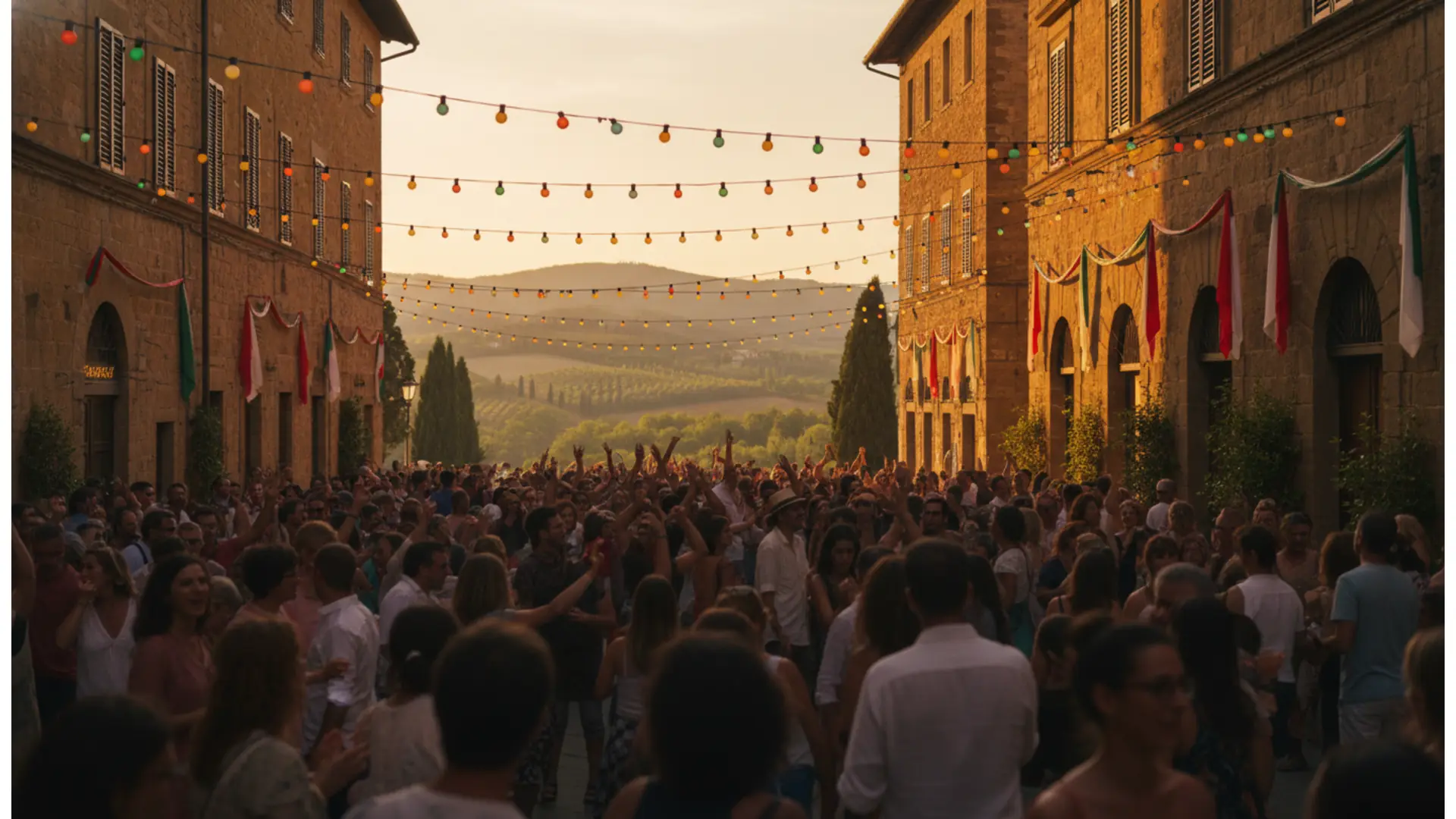
Procession of the Most Holy Crucifix on the Vara
The centuries-old procession of the Crucifix by Fra Umile da Petralia, held once a year through the streets of Campobello di Mazara
Edition 2026 not confirmed to date
This edition has not been confirmed by the organiser to date. We recommend checking before going.
About Most Holy Crucifix on the Vara
A procession held only once a year
In the heart of the Belice Valley, in Campobello di Mazara, province of Trapani, one of the most deep-rooted religious traditions of Western Sicily is renewed every year: the procession of the Most Holy Crucifix on the Vara. Unlike many patronal festivals, the simulacrum is carried through the town's streets only once a year, on the last Sunday of September. It is a moment awaited for months, capable of bringing the entire town to a standstill and drawing back emigrants who return specifically to witness it.
The Crucifix by Fra Umile da Petralia
At the center of this devotion lies a masterpiece of Sicilian wood carving: the Crucifix created between 1633 and 1634 by Fra Umile da Petralia (born Giovanni Francesco Pintorno), a Franciscan friar who viewed his art as an act of prayer and meditation. The work, one of thirty-three attributed to the friar, is striking for its dramatic realism: the crown of thorns intertwined multiple times with rope, the splinters piercing the eyebrows, and the face marked by the Passion. According to tradition, the Crucifix was donated to the community by Duke Giuseppe Di Napoli in 1666, marking the beginning of the deep-seated devotion in Campobello.
The Vara, a small moving temple
The Crucifix is housed inside the Vara, a neoclassical wooden processional float built in 1856 under Archpriest Don Giuseppe Guccione, gilded in 1858, and later restored in 1909 and 1981. Eight Corinthian columns support a dome, forming a sort of small temple that encloses the statue. Once carried on the shoulders of forty men, the Vara now moves on a dedicated carriage through the streets of the historic center.
Faith, community, and identity
The procession is preceded by days of religious celebrations at the Mother Church on Via Garibaldi, the town's spiritual hub. It is traditional for children to be brought close to the Crucifix as the Vara passes, a devotional gesture that testifies to the intimate bond between the community and the sacred image. In recent years, the Pro Loco "Costa di Cusa," with the help of Civil Service volunteers, has complemented the festivities with free guided tours of the Mother Church to share the history of the artwork, the ancient small church at the well, and the Vara with visitors. It is an opportunity to discover the historical and artistic heritage of Campobello di Mazara beyond the ritual itself.
Most Holy Crucifix on the Vara — edition 2026
The procession of the Most Holy Crucifix on the Vara is expected to take place in 2026 in the historic center of Campobello di Mazara (Trapani), continuing the centuries-old tradition that sets the outing of the simulacrum for the last Sunday of September.
The exact dates and the detailed program for the 2026 edition have not yet been published. As in previous years, religious festivities in the Mother Church are expected to be accompanied by free guided tours organized by the Pro Loco "Costa di Cusa". The program will be released in the weeks leading up to the event.
Prices Most Holy Crucifix on the Vara 2026
Practical information — Most Holy Crucifix on the Vara
Location
Mother Church, Via Garibaldi, Campobello di Mazara (TP). The procession winds through the streets of the historic center.
When
The last Sunday of September. Religious festivities take place in the preceding days.
Guided Tours
During the festival period, the Pro Loco "Costa di Cusa" organizes free guided tours of the Mother Church (duration approx. 25 minutes). Info: +39 331 6061729.
Admission
Free event, open to all.
Festival-goer photos
No photos yet. Share yours!
Share your photos
5 photos max, 5 MB per photo (JPG, PNG, WebP)
Noticed an error or missing information?
Help us keep this listing up to date. Every proposal is verified by our team before publication.
Festival-goer reviews
No rating yet — be the first!
No comments yet. Be the first!
Were you there?
Share your experience with the community.
Published by Valentin Contard, festival listings writer. Reviewed, corrected and approved by Christophe Contard, editor-in-chief. .
Where does it take place — Most Holy Crucifix on the Vara
Chiesa Madre
Via Garibaldi, 91021 Campobello di Mazara