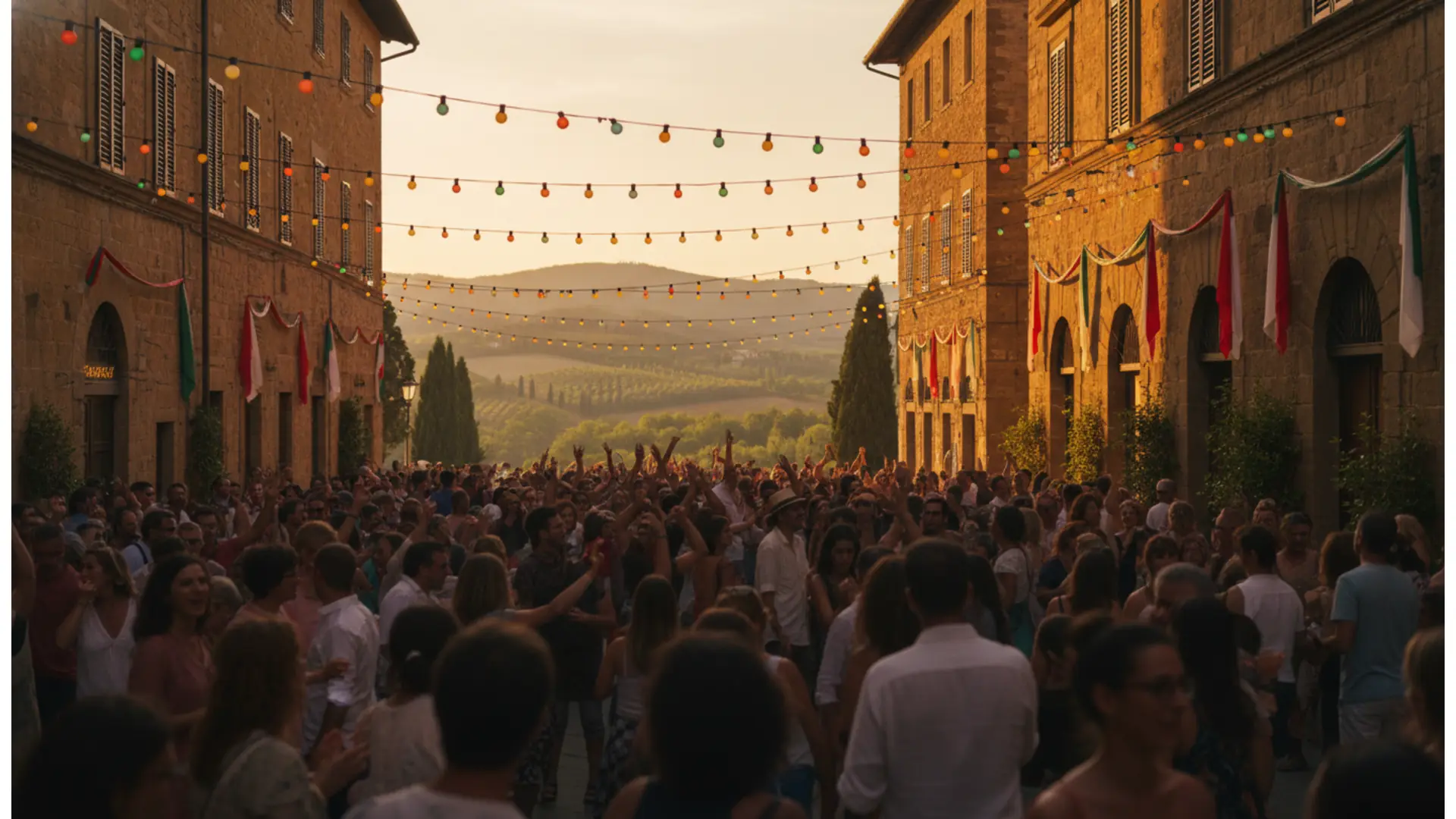
Patronal Feast of Maria Santissima Assunta (with the Aragonese Historical Pageant of King Ferdinand I)
Faith, illuminations, and an Aragonese re-enactment in Santa Maria a Vico, in the Suessola Valley
Edition 2026 not confirmed to date
This edition has not been confirmed by the organiser to date. We recommend checking before going.
About Assunta Feast
A patronal feast in the heart of the Suessola Valley
In mid-August, Santa Maria a Vico, a town of just over fourteen thousand inhabitants in the province of Caserta, Campania, pauses for its most heartfelt tradition: the festivities in honor of Maria Santissima Assunta in Cielo, the town's patron saint and a devotional landmark for the entire Suessola Valley. For several days, the streets of the center are filled with illuminations, market stalls, and parades, while the basilica becomes a destination for pilgrims arriving from neighboring towns and the provinces of Naples and Benevento.
The Basilica of the Assunta and the Aragonese legacy
The heart of the festival is the Minor Basilica of Maria Santissima Assunta, the community's oldest and most iconic monument. Its construction began in 1492 by the will of King Ferdinand I of Aragon, who, with the famous Instructiones dated January 1, 1492, ordered the creation of the Aragonese complex, including the church and convent, in a Gothic style with Catalan elegance. Next to the basilica stands the convent of the Missionary Oblates of Mary Immaculate, whose Salone Sant'Eugenio hosts an exhibition of the pageant's costumes during the festival. This direct link between Marian devotion and Aragonese history explains why the patronal feast here is not only religious but also a grand historical re-enactment.
The Aragonese Historical Pageant of King Ferdinand I
The most anticipated event is the Aragonese Historical Pageant, which in 2025 took place on August 13th, starting from Piazza Mercato in Messercola. The pageant brings the court of King Ferdinand I to life with over two hundred participants in period costumes, following a route that crosses the town to Piazza Aragona.
- Flag-wavers and musicians who lead the parade;
- Minstrels, archers, and falconers with their birds of prey;
- Knights, ladies, and dignitaries of the Aragonese court;
- Delegations from the municipal administrations of the Valley.
The pageant is part of the Appia Regina Viarum cultural project, promoted by the Municipality of Santa Maria a Vico as the lead partner together with the municipalities of Arpaia, Cervino, Forchia, San Felice a Cancello, and Airola: a way to remember the historical role of the territory along the ancient Appian Way, where the Vicus Novanensis, later known as Ad Novas, once stood.
Rites, floats, and votive gigli
The religious aspect follows a well-established calendar: the enthronement of the Madonna's statue and the lighting of the Emigrant's votive lamp open the festivities, followed by the welcoming of pilgrims at dawn, numerous holy masses, and the solemn celebration on August 15th, often presided over by the bishop of the Diocese of Acerra, Monsignor Antonio Di Donna. On the same day, votive floats and gigli (tall wooden spires) from the surrounding towns parade through the streets, while the solemn procession with the statue of the Assunta closes the week. August 17th is traditionally dedicated to the sick and suffering, with the basilica crowded with the faithful.
Music, lights, and square entertainment
Alongside the liturgy, a rich secular program unfolds: evening concerts in Piazza Aragona, flag-waver and archer performances, falconry demonstrations, the Palio dell'Assunta, and fireworks displays that accompany the festival's conclusion. In 2025, the main stage hosted a concert by the Neapolitan band La Maschera and the «Lights in the Night» event for younger crowds. Artistic illuminations and the typical market stalls of Campanian patronal feasts complete an atmosphere that draws thousands of people in just a few evenings.
What to know before you go
The festival takes place entirely outdoors in the center of Santa Maria a Vico: it is best to arrive early on the evenings of the pageant and August 15th, when the central streets are closed to traffic. Religious celebrations and performances in the square are free to enter, making the event suitable for families with children. Visitors to the area can combine the festival with a stop in Caserta, about fifteen kilometers away, or a walk along the stretch of the Appian Way that crosses the Suessola Valley.
Assunta Feast — edition 2026
The patronal feast of Maria Santissima Assunta is the most important event in Santa Maria a Vico, in the province of Caserta, and is celebrated every year in mid-August around the Minor Basilica commissioned by King Ferdinand I of Aragon.
For 2026, an official program has not yet been published. Based on previous editions, one can expect a week of celebrations including the enthronement of the statue, holy masses, the solemnity of August 15th with votive floats and gigli, the solemn procession, the Aragonese Historical Pageant with its participants, and evenings of music and fireworks in the square. Dates and the detailed calendar will be confirmed by the organizers: it is recommended to check official channels before planning your trip.
Prices Assunta Feast 2026
Practical information — Assunta Feast
How to get there
Santa Maria a Vico is located along the Appian Way (SS 7), about 13 km from Caserta and 30 km from Naples. By car, it is best to leave your vehicle in the outskirts of the town, as the center is closed to traffic during the main evenings. The area is served by bus connections to Caserta, Nola, and Benevento.
Admission and costs
Liturgical celebrations, the Aragonese Historical Pageant, and performances in the square are traditionally free of charge. Only purchases at stalls and food stands require payment.
Tips
- The mid-August heat is intense: bring water and prioritize evening events.
- For the pageant, arrive at least half an hour early along the route to find a spot.
- The basilica remains open for long hours on August 15th: please respect the silence during celebrations.
Information
Maria SS. Assunta Festival Committee and the Parish of the Assunta in Santa Maria a Vico, with the patronage of the Municipal Administration. The program and updates are published on the committee's and the Municipality's social media channels (comunesantamariaavico.it) in the weeks leading up to the festival.
Festival-goer photos
No photos yet. Share yours!
Share your photos
5 photos max, 5 MB per photo (JPG, PNG, WebP)
Noticed an error or missing information?
Help us keep this listing up to date. Every proposal is verified by our team before publication.
Festival-goer reviews
No rating yet — be the first!
No comments yet. Be the first!
Were you there?
Share your experience with the community.
Published by Valentin Contard, festival listings writer. Reviewed, corrected and approved by Christophe Contard, editor-in-chief. .
Where does it take place — Assunta Feast
Basilica Minore di Maria Santissima Assunta e centro cittadino