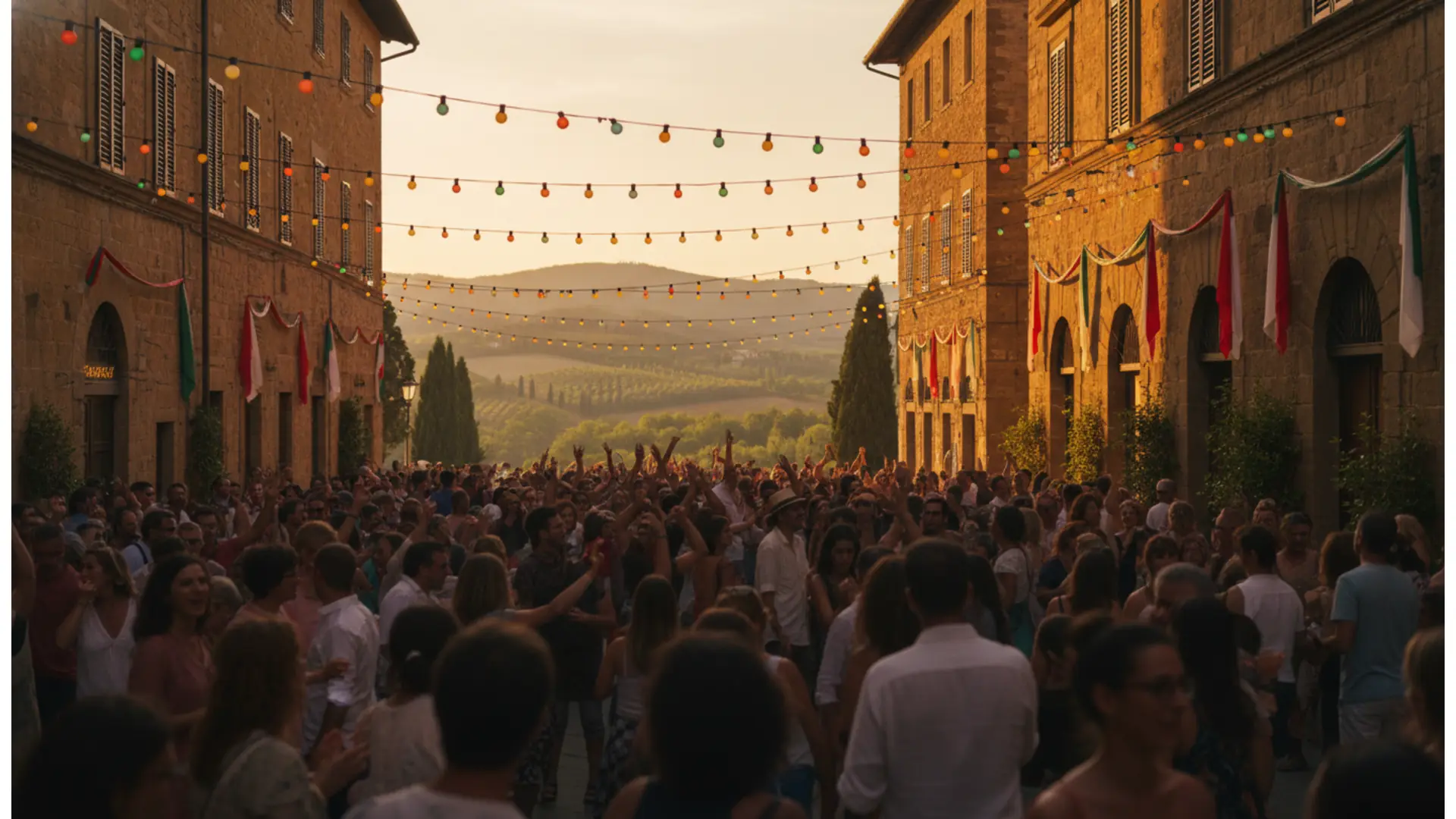
Majo Festival
The ancient ritual of the flowering tree between Roccapiemonte and Materdomini
About Majo Festival
A spring ritual that unites two communities
The Majo Festival is considered one of the oldest tree festivals in Italy. Every year on May 1st, it links the town of Roccapiemonte and neighboring Nocera Superiore in a single ritual, located in the province of Salerno, in the heart of the Agro Nocerino Sarnese, Campania. The 'Majo' is a flowering sapling, a branch laden with buds that participants in period costumes carry as a gift to the Madonna della Materdomini: a greeting to spring that, according to farming tradition, ensures a successful harvest in the fields.
The festival is one of those occasions where popular devotion and pre-Christian agricultural memory coexist without contradiction. The act of offering the rebirth of vegetation is ancient; the Christian tradition absorbed it and transformed it into a pilgrimage that, for nearly a thousand years, has brought the two communities together along the same path.
The legend of Materdomini and its anniversaries
The Pontifical Basilica of Santa Maria Materdomini in Nocera Superiore stands on the site where—according to tradition—a young woman named Caramari discovered an image of the Madonna while digging under an oak tree. Pope Nicholas II consecrated the temple in 1061: the 2026 edition therefore celebrates the 965th anniversary of that consecration. The entire festival calendar revolves around this anniversary, featuring a solemn mass and plenary indulgence granted to pilgrims.
The historical pageant from Piazza Zanardelli
The most anticipated moment is the historical pageant on May 1st. In the late afternoon, two processions depart simultaneously: one from Piazza Zanardelli in the center of Roccapiemonte, led by the mayor; the other from the parish of San Michele Arcangelo in Nocera Superiore, led by the local mayor. The two processions, animated by costumed figures, flag-wavers, and musicians, converge at the sanctuary, where the rector welcomes the delegations.
- Delivery of the Maj: the mayors offer the flowering saplings to the Madonna
- Solemn High Mass on the anniversary of the basilica's consecration
- Exchange of scrolls between the authorities of the two cities, a symbolic gesture of alliance
- Folklore evening in the square with medieval dances, music, and traditional games
The medieval village around the sanctuary
During the festival, the square of the sanctuary transforms into a medieval village: educational stalls featuring ancient trades, artisans at work, street performers, jugglers, re-enactment groups, falconry displays, and tastings of traditional cuisine. It is the most family-friendly part of the event, allowing children to touch tools, fabrics, and crafts that would otherwise remain confined to books.
The Rocchese May: from Majo to Santa Maria di Loreto
In Roccapiemonte, the Majo Festival opens a cycle of events that the municipality calls the 'Rocchese May'. A few days after the pageant, the Feast of Santa Maria di Loreto is celebrated, featuring a morning procession through the town streets, solemn masses at Santa Maria del Ponte and San Giovanni Battista, a celebration at the Hermitage—a historic destination for pilgrims—and, to conclude, an evening fireworks display. The processions are accompanied by the Città di Roccapiemonte Band.
Why it's worth the trip
The Majo Festival is not a re-enactment staged for tourists; it is a civic liturgy that two towns have repeated for centuries and which still brings entire families out into the streets today. Visitors from outside will find a free, intimate event deeply felt by the locals, located just a few kilometers from Salerno, Pompeii, and the Amalfi Coast. It is an excellent way to experience how spring is celebrated in the Campanian hinterland, far from the most crowded tourist circuits.
Majo Festival — edition 2026
Majo Festival 2026: 965 years of history
The 2026 edition took place from Friday, May 1st to Sunday, May 3rd between Roccapiemonte and Nocera Superiore, with the patronage of the two municipalities and organized by the Pontifical Basilica and the 'Il Santuario' Association. The central theme was the 965th anniversary of the consecration of the Materdomini temple by Pope Nicholas II in 1061.
The afternoon of May 1st saw the two historical pageants move: at 5:00 PM, the departure from Piazza Zanardelli, led by Roccapiemonte Mayor Carmine Pagano; at 5:30 PM, the departure from the church of San Michele Arcangelo in Nocera Superiore, with Mayor Gennaro D'Acunzi. At 6:00 PM, the two processions reunited at the sanctuary for the symbolic delivery of the Majo and the Holy Mass; at 7:00 PM, the exchange of scrolls between the authorities opened the evening of folklore performances, medieval dances, and traditional games.
On May 2nd and 3rd, the sanctuary area remained animated by the medieval village, with re-enactments, artisans, street performers, and period cuisine; on Sunday morning at 11:00 AM, a falconry display was held. In Roccapiemonte, Sunday was also dedicated to the Feast of Santa Maria di Loreto, with the 7:30 AM procession, masses at 9:00 AM and 10:30 AM at Santa Maria del Ponte and San Giovanni Battista, the 12:00 PM celebration at the Hermitage, and, at approximately 9:30 PM, the final fireworks display.
Programme Majo Festival 2026
Friday, May 1st, 2026 — Majo Festival
- 5:00 PM — Departure of the historical pageant in period costume from Piazza Zanardelli (Roccapiemonte), led by Mayor Carmine Pagano
- 5:30 PM — Departure of the second pageant from the parish of San Michele Arcangelo, Viale Croce (Nocera Superiore), with Mayor Gennaro D'Acunzi
- 6:00 PM — Arrival of the two pageants at the Pontifical Basilica of Santa Maria Materdomini, welcome by the rector, delivery of the Maj, and Holy Mass with plenary indulgence
- 7:00 PM — Exchange of scrolls between the authorities of the two cities
- Following — Folklore evening in the square: musical performances, medieval dances, and traditional games
Saturday, May 2nd and Sunday, May 3rd, 2026 — Medieval Village
- Historical re-enactments, ancient trade stalls, and artisans at work
- Street performers, music, and games for children
- Tastings of traditional dishes
- Sunday at 11:00 AM — Falconry display
Sunday, May 3rd, 2026 — Santa Maria di Loreto (Roccapiemonte)
- 7:30 AM — City procession, accompanied by the Città di Roccapiemonte Band
- 9:00 AM and 10:30 AM — Holy Masses at Santa Maria del Ponte and San Giovanni Battista
- 12:00 PM — Holy Mass at the Hermitage
- 7:00 PM — Evening mass and procession from Santa Maria del Ponte
- Approx. 9:30 PM — Fireworks display
Highlights Majo Festival 2026
- The historical pageant in period costume from Piazza Zanardelli to the Basilica of Materdomini
- The delivery of the Maj, the flowering saplings offered to the Madonna by the two mayors
- The exchange of scrolls between Roccapiemonte and Nocera Superiore
- The medieval village with ancient crafts, street performers, and tastings
- The falconry display on Sunday morning
- The fireworks display closing the Feast of Santa Maria di Loreto
Prices Majo Festival 2026
Practical information — Majo Festival
How to get there
By car: Take the Castel San Giorgio exit on the A30 Caserta-Salerno motorway, then follow signs for Roccapiemonte (a few minutes). From Salerno, it is about 20 km along the SS18.
By train: Nocera Inferiore or Nocera Superiore station on the Naples-Salerno line, connected to Roccapiemonte by local buses and taxis.
By plane: Naples-Capodichino Airport is about 45 km away; Salerno-Costa d'Amalfi Airport is about 25 km away.
Admission and hours
Participation in the processions, celebrations, and square performances is free. Only tastings and purchases at the medieval village stalls require payment. The procession departs from Piazza Zanardelli in the late afternoon of May 1st: it is advisable to arrive at least half an hour early to find a spot.
Tips
- The procession route is on foot and slightly uphill towards the sanctuary: wear comfortable shoes.
- Park in the center of Roccapiemonte and walk to the square, as the procession streets are closed to traffic.
- For updated information on times and the program, contact the Municipality of Roccapiemonte (tel. +39 081 936352).
Where to stay
Accommodation is available in Nocera Inferiore, Cava de' Tirreni, and Salerno, all within a 25-minute drive; the location is also convenient for visiting Pompeii, Paestum, and the Amalfi Coast.
Festival-goer photos
No photos yet. Share yours!
Share your photos
5 photos max, 5 MB per photo (JPG, PNG, WebP)
Noticed an error or missing information?
Help us keep this listing up to date. Every proposal is verified by our team before publication.
Festival-goer reviews
No rating yet — be the first!
No comments yet. Be the first!
Were you there?
Share your experience with the community.
Published by Valentin Contard, festival listings writer. Reviewed, corrected and approved by Christophe Contard, editor-in-chief. .
Where does it take place — Majo Festival
Piazza Zanardelli e Basilica Pontificia di Santa Maria Materdomini
Piazza Zanardelli, 84086 Roccapiemonte