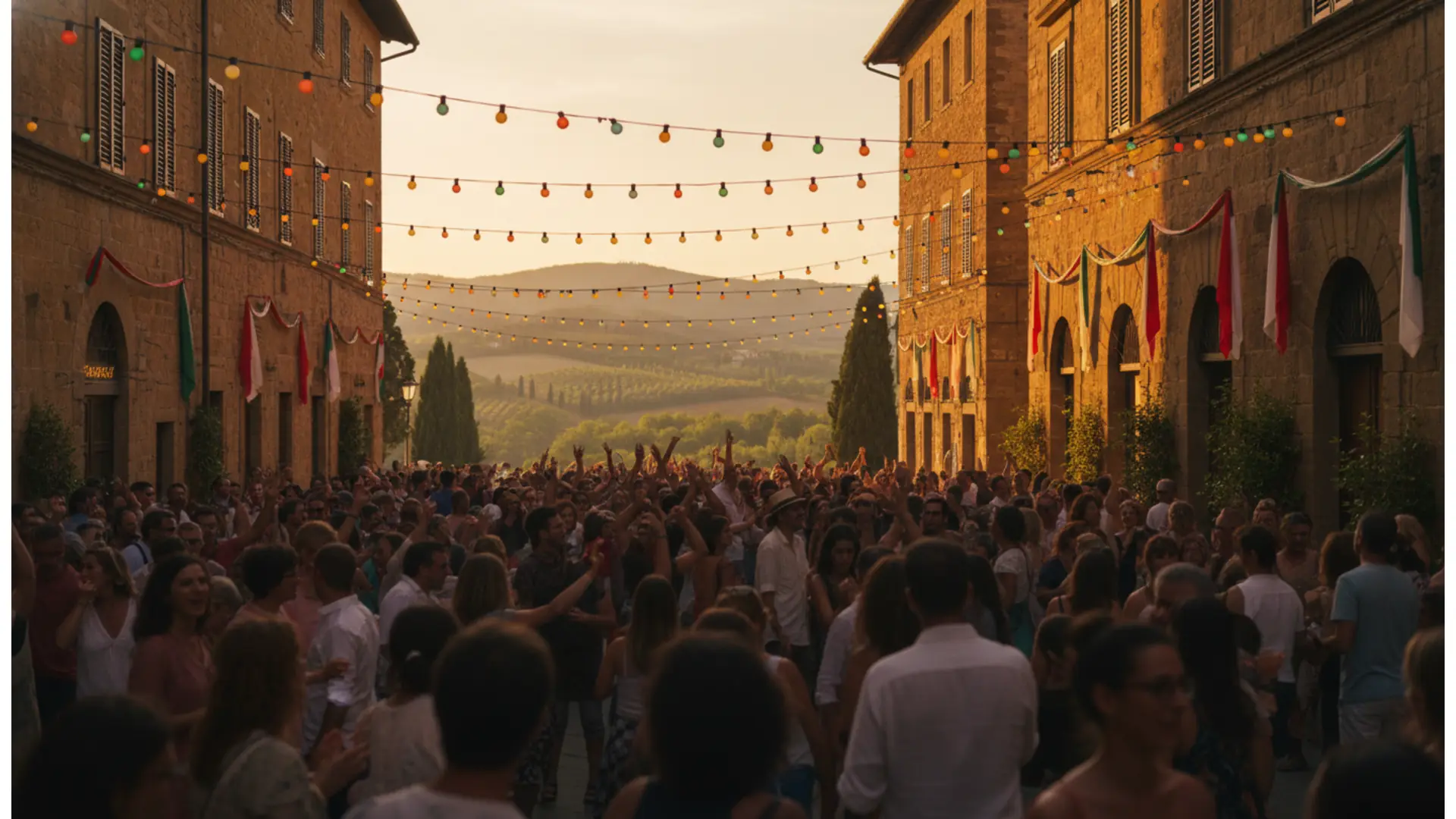
Madonna delle Galline Festival
Toselli, tammurriate, and processions during the Easter Octave in Pagani
About Madonna delle Galline
A devotion born among the chickens
The Madonna delle Galline Festival is the heart and soul of Pagani, in the province of Salerno, Campania. Tradition tells that a wooden panel depicting the Madonna del Carmelo, which had disappeared from a mountain chapel in the Tramonti area, reappeared in the Pagani countryside during Easter week, discovered by chickens scratching in the yard. From that discovery and the miracles attributed to the image between 1609 and 1610, the cult of the 'Madonna delle Galline' (Our Lady of the Hens) was born, marking the city's spring for over four centuries.
When it is celebrated
The festivities take place during the Easter Octave and culminate on Sunday in Albis, the first Sunday after Easter, when the Virgin's effigy is carried in procession through all the city streets. There are no fixed dates: the calendar follows the Easter cycle, meaning the festival can fall anywhere between early April and early May. In 2026, the program ran from April 10th to 14th, under the theme 'Morning Star', inspired by one of the Marian invocations of Saint Alphonsus Maria de' Liguori.
The 'toselli', courtyard altars
During the festival, the historic center fills with toselli: small votive altars set up by residents in courtyards, alleys, and entryways, decorated with drapes, flowers, lights, and sacred images. Each 'tosello' is a place for stopping and singing, and together they form an experiential path that can be followed on foot throughout the city. In 2026, thirty-seven were set up, and thirty-one in 2025—a number that grows year by year, testifying to how the festival remains a collective, neighborhood-driven event rather than a tourist spectacle.
Tammurriate, tammorre, and canti a figliola
- The sound of the tammorra, the large frame drum, accompanies the festival non-stop from Friday evening until Monday dawn.
- The paranze, groups of musicians and singers, take turns in courtyards and squares with tammurriate dances and canti a figliola songs, supported by castanets.
- The most moving ritual is the deposition of the tammorre at the feet of the Virgin at dawn on Monday: the instruments are left in the sanctuary, symbolically closing the festive cycle.
- The night before is occupied by the 'Battendo la Diana' vigil, which accompanies the devotees until sunrise.
The Ritmo Festival
For years, the religious program has been accompanied by the Ritmo Festival, an international review dedicated to traditional music and dance, under the artistic direction of Vincenzo Romano. Two days of workshops on 'tammorra', singing, and folk dance in the late afternoon are followed by evening concerts in Piazza Corpo di Cristo and Piazza Sant'Alfonso. It is the most open and contemporary part of the festival, drawing scholars, musicians, and enthusiasts to Pagani from all over Italy and abroad.
Intangible Heritage of Italy
The festival has been included by the Central Institute for Intangible Heritage among the intangible assets of Italy as a living example of Campanian popular religiosity. This recognition has strengthened documentation efforts: photographic exhibitions, guided cultural tours, and in-depth seminars now permanently accompany the liturgical calendar.
What to expect as a visitor
Those arriving in Pagani during these days will find a city that never stops: masses and liturgies at the sanctuary, processions of 'tammorre' moving from one alley to another, stalls selling local products, refreshment points, and families opening their doors to show off their 'tosello'. Traditionally, tortani and other rustic breads are offered to the Madonna, along with the barnyard animals that give the festival its name. We recommend dedicating at least one full day to the historic center, arriving early on Sunday to witness the procession and staying into the evening for the concerts.
An event that involves all of Campania
Although deeply rooted in Pagani, the Madonna delle Galline Festival attracts tens of thousands of people every year from the entire province of Salerno, the Vesuvius area, and Naples. It is one of the rituals that best captures the continuity between Marian devotion and peasant culture in Southern Italy, and it remains one of the most authentic religious folklore events in the Campanian calendar.
Madonna delle Galline — edition 2026
The theme: 'Morning Star'
The title chosen for the 2026 edition recalls one of the Marian invocations of Saint Alphonsus Maria de' Liguori and guided the entire program around the theme of light, understood as a sign of faith, hope, and rebirth. The Municipality of Pagani allocated approximately 60,000 euros for the organization of security services, parking, and medical assistance.
The locations
The sanctuary of the Madonna del Carmine, the courtyards of the historic center with their thirty-seven toselli, Piazza Corpo di Cristo, and Piazza Sant'Alfonso hosted the main stages of the festival. Added to the widespread city event was the photographic exhibition 'In Lumine – the faces of the Festival', fifteen portraits placed in as many corners of the historic center in tribute to photographer Gaetano De Mauro.
The Ritmo Festival
The musical section, under the artistic direction of Vincenzo Romano, offered two afternoons of workshops and in-depth studies on the art of the 'tammorra', dance, and singing, and two evenings of concerts with local 'paranze', the Ars Nova and Uhamena orchestras, the Canzoniere Grecanico Salentino, and the final Dance Tarantella concert.
Programme Madonna delle Galline 2026
Friday, April 10th
- 18:00 — Opening of the sanctuary
- 19:00 — Blessing of the 'Miezz'a Chiazz' tosello, Piazza Corpo di Cristo
- 19:30 — Inauguration of the widespread exhibition 'In Lumine – the faces of the Festival'
- 20:00 — Procession of 'tammorre' and folk music, from Cortile Califano to the Villa Comunale
Saturday, April 11th
- 9:30 — Cultural tour 'Discovering the treasures of Pagani'
- 10:00 — Illustration contest 'Snapshots of the Festival'
- 16:30 — Musical parade of the Nakkaria project
- 17:30 — 'Spaccapaese in Cammino'
- 18:00 — Award ceremony of the photo contest
- 20:30 — Prayer vigil for peace at the sanctuary
- In the evening — Folk music and 'tammorre' in the courtyards
Sunday, April 12th (Sunday in Albis)
- 8:00 — Holy Mass
- 9:00 — Solemn procession of the Madonna delle Galline effigy through the city streets, all day long
- 23:30 — Night vigil 'Battendo la Diana'
Monday, April 13th
- At dawn — Deposition of the 'tammorre' at the feet of the Virgin
- 18:00-20:00 — Folk music and culture workshops (Ritmo Festival)
- 19:00 — 'Tales in the courtyard'
- 20:00 — Concert by Canzoniere Grecanico Salentino, Piazza Corpo di Cristo, with local 'paranze'
Tuesday, April 14th
- 18:00-20:00 — 'Tammorra', singing, and dance workshops
- 21:00 — Final concert 'Dance Tarantella', Piazza Sant'Alfonso
Highlights Madonna delle Galline 2026
- Edition theme: 'Morning Star'
- Thirty-seven 'toselli' set up in the historic center's courtyards
- Procession of the Madonna delle Galline effigy on Sunday in Albis, April 12th
- Night vigil 'Battendo la Diana' and deposition of the 'tammorre' at dawn on April 13th
- Ritmo Festival with artistic direction by Vincenzo Romano: workshops, Ars Nova, Uhamena
- Concert by Canzoniere Grecanico Salentino in Piazza Corpo di Cristo
- Closing with 'Dance Tarantella' in Piazza Sant'Alfonso
- Widespread exhibition 'In Lumine – the faces of the Festival' in fifteen points of the historic center
Prices Madonna delle Galline 2026
Practical information — Madonna delle Galline
Getting there
By train: The Pagani station is on the Salerno-Naples line via Nocera Inferiore; alternatively, the Circumvesuviana connects the area with Naples. By car: A3 Naples-Salerno motorway, Pagani exit; during the festival, the historic center is closed to traffic, so it is best to leave the car in the parking lots set up on the outskirts. By plane: Naples-Capodichino airport, about 40 km away.
Admission and costs
All religious and secular events are free of charge, including concerts in the squares. The Ritmo Festival workshops require prior registration.
Tips
- Wear comfortable shoes: the 'toselli' route is entirely on foot.
- The Sunday in Albis procession starts in the morning and lasts for many hours: arrive early to find a spot.
- The nights between Saturday and Monday are the most intense for those wanting to follow the 'tammurriate'.
- For accommodation, in addition to Pagani, you can rely on facilities in Nocera Inferiore, Sarno, and the Amalfi Coast, all a short distance away.
Information
Phone: +39 389 1572745. The official program is published every year on the Municipality of Pagani website.
Festival-goer photos
No photos yet. Share yours!
Share your photos
5 photos max, 5 MB per photo (JPG, PNG, WebP)
Noticed an error or missing information?
Help us keep this listing up to date. Every proposal is verified by our team before publication.
Festival-goer reviews
No rating yet — be the first!
No comments yet. Be the first!
Were you there?
Share your experience with the community.
Published by Valentin Contard, festival listings writer. Reviewed, corrected and approved by Christophe Contard, editor-in-chief. .
Where does it take place — Madonna delle Galline
Santuario della Madonna delle Galline e centro storico