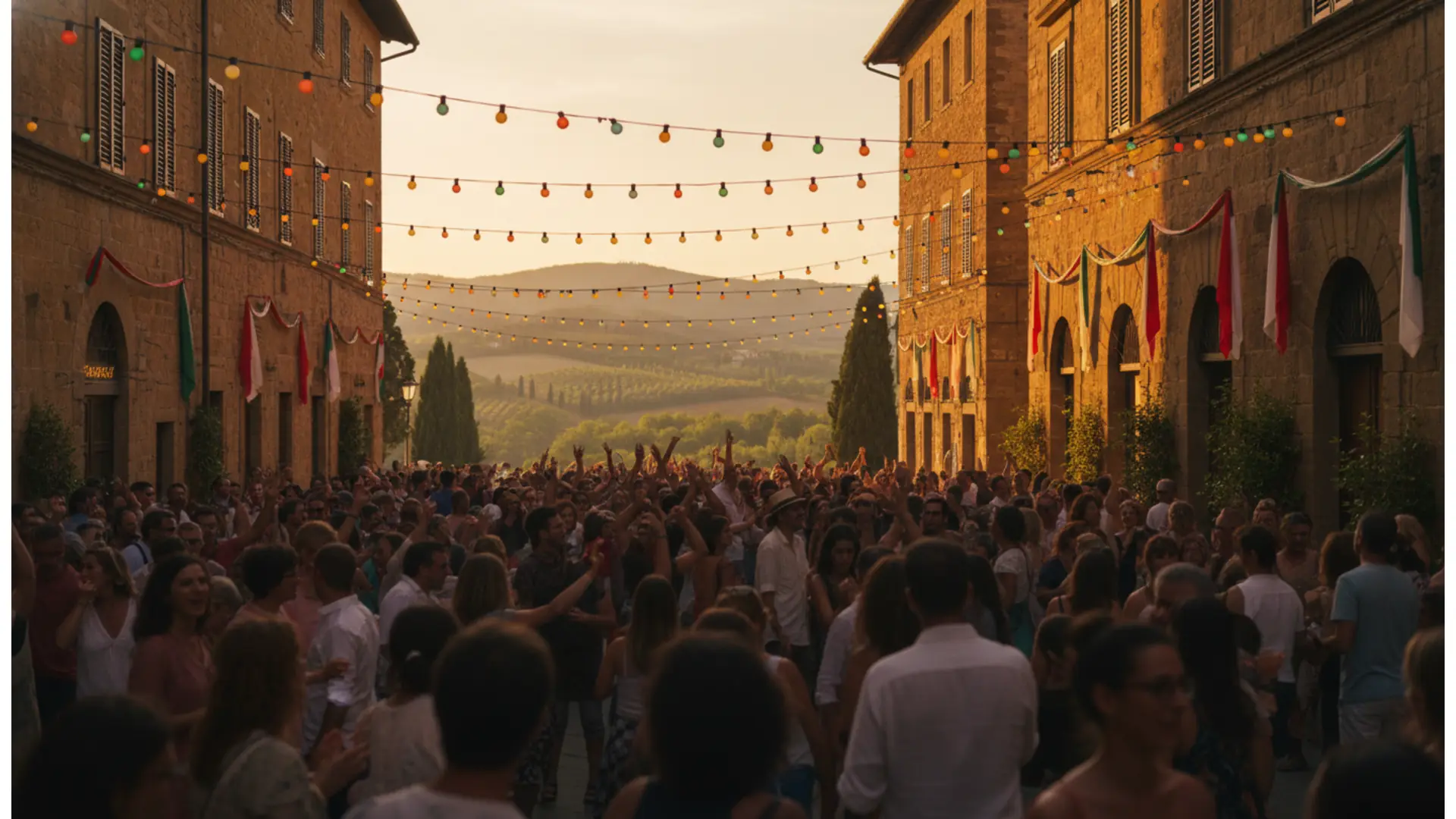
La Zeza Itinerante – Traditional Carnival
Sung farce, masks, and tarantellas across Torrioni, Petruro Irpino, and Chianche
About La Zeza Itinerante
La Zeza Itinerante: A Carnival that moves from square to square
In the heart of the Valle del Sabato, in the province of Avellino, three small municipalities have chosen not to celebrate Carnival individually. La Zeza Itinerante – Traditional Carnival is a shared event between Torrioni, Petruro Irpino, and Chianche: a single masked parade, one troupe of actor-singers, and three villages visited in the same afternoon. The formula is simple and creates critical mass where numbers alone would be small: we are talking about villages with only a few hundred inhabitants, overlooking the valleys that descend toward the Sabato river.
What is the Zeza?
The Zeza is the sung farce of the Irpinian Carnival, a form of popular theater that descends from the 17th-century Neapolitan comedy and Commedia dell'Arte. On stage are Pulcinella, his wife Zeza, and their daughter Vicenzella, who is courted by suitors that Pulcinella does not want in his house: from this conflict arises a story of arguments, ambushes, and forced reconciliations that ends with everyone dancing. According to ancient custom, all roles, including female parts, are played by men, and the text is not recited but sung, with verses in dialect punctuated by music.
- Pulcinella: the overly jealous father and iconic mask of the Neapolitan tradition.
- Zeza: the wife, who gives her name to the entire performance.
- Vicenzella: the daughter to be married off, the comic engine of the entire plot.
- The suitors: including the wealthy doctor, who comes to blows with Pulcinella.
The rest of the procession moves around the farce: masked groups, tarantellas, quadrilles, and folk songs performed with traditional peasant instruments. It is an intangible heritage that survives in many Irpinian towns—Mercogliano, Cesinali, Capriglia Irpina, Montemiletto, and Volturara Irpina are among the most well-known—and which here takes the unusual form of a journey from one municipality to another.
The afternoon of February 15, 2026
The 2026 edition took place on Sunday, February 15, the Sunday of Carnival. The route started in Torrioni at 3:30 PM, stopped in Petruro Irpino at 5:00 PM, and concluded in Chianche, in the hamlet of Chianchetelle, at 6:30 PM. Those who arrive early can follow the entire itinerary by traveling by car along with the caravan, with the advantage of seeing the same Zeza in three different settings and in front of three different audiences.
Torrioni, the village that opens the festival
Torrioni is a municipality of just over four hundred inhabitants, at about 645 meters above sea level, in a panoramic position over the middle Valle del Sabato. The town center gathers around the mother church of San Michele Arcangelo, the patron saint celebrated on September 29, and preserves traces of the ancient Turris Ayonis from which its name derives. It is the starting point of the La Zeza Itinerante, and for one day a year, the village fills with visitors arriving from neighboring towns.
A territory to discover
Torrioni, Petruro Irpino, and Chianche all belong to the area of Greco di Tufo DOCG, one of the most important white wines of Campania: the festival therefore falls in a land of wineries, halfway between Avellino and Benevento, where wine is as much a part of the collective identity as the Carnival.
Why it is worth a visit
Those looking for the spectacular Carnival of large allegorical floats will find something different here and, for many, more interesting: a raw, community ritual where the line between actors and spectators is thin and the language of the festival is the local dialect. La Zeza Itinerante requires no more than a few hours of your time, but it provides an authentic image of the Irpinian peasant Carnival, the kind performed in the square rather than on grandstands.
La Zeza Itinerante — edition 2026
2026 Carnival in the Valle del Sabato
Carnival Sunday in 2026 fell on February 15, and the municipalities of Torrioni, Petruro Irpino, and Chianche, in the province of Avellino, celebrated it together with a single traveling Zeza. The masked procession crossed the three villages during the same afternoon, re-enacting the traditional Irpinian sung farce in each square.
The initiative was included in the 2026 Irpinia Carnival calendar, which featured the 'zeze' of Montemiletto, Mercogliano, Cesinali, and Capriglia Irpina, the tarantella of Montemarano, and the Mascarata of Serino on the same days. However, the traveling formula remains a unique feature of these three small municipalities in the middle Valle del Sabato, which choose to share the festival rather than fragment it.
Programme La Zeza Itinerante 2026
Sunday, February 15, 2026 — The route of the Zeza Itinerante
- 3:30 PM — Torrioni: Departure of the masked procession and first performance of the Zeza.
- 5:00 PM — Petruro Irpino: Second stop, with the sung farce performed in the center of the village.
- 6:30 PM — Chianche, hamlet of Chianchetelle: Final stop of the day.
The program released by the organizers is limited to the times and the three stops: local sources do not publish the list of participating folk groups. Movements between one municipality and another take place in the afternoon, so that the public can follow the entire itinerary.
Highlights La Zeza Itinerante 2026
- One day and three villages: the Zeza moves from Torrioni to Petruro Irpino and finally to Chianchetelle.
- The sung farce of the Irpinian tradition, with Pulcinella, Zeza, and Vicenzella performed according to ancient custom.
- Tarantellas, quadrilles, and folk songs performed with traditional peasant instruments.
- Masks and costumes curated by local associations.
- A traveling format that enhances three municipalities of only a few hundred inhabitants each.
Prices La Zeza Itinerante 2026
Practical information — La Zeza Itinerante
How to get there
Torrioni is easily reached by car: from the A16 Naples–Canosa motorway, take the Avellino Est exit and head up the Valle del Sabato towards Altavilla Irpina and Tufo; the distance from Benevento is similar. The town center is small; it is best to leave your car on the outskirts and continue on foot.
Following the three stops
The three villages are only a few kilometers apart: by car, it is possible to follow the Zeza from Torrioni to Petruro Irpino and finally to Chianchetelle, a hamlet of Chianche, without missing any of the performances.
Useful tips
- The event takes place outdoors, in the square: in February and at over 600 meters of altitude, a heavy jacket and comfortable shoes are necessary.
- Public participation is free; there are no tickets or pre-sales.
- For final schedules, it is advisable to check the official channels of the municipalities of Torrioni, Petruro Irpino, and Chianche in the days leading up to the festival.
Where to sleep and eat
Accommodation options in the three villages are minimal: the most practical solutions are the farmhouses (agriturismi) in the Greco di Tufo area or hotels in Avellino and Benevento, both reachable in a short time by car. Local wineries allow you to combine the festival with a tasting.
Festival-goer photos
No photos yet. Share yours!
Share your photos
5 photos max, 5 MB per photo (JPG, PNG, WebP)
Noticed an error or missing information?
Help us keep this listing up to date. Every proposal is verified by our team before publication.
Festival-goer reviews
No rating yet — be the first!
No comments yet. Be the first!
Were you there?
Share your experience with the community.
Published by Valentin Contard, festival listings writer. Reviewed, corrected and approved by Christophe Contard, editor-in-chief. .