La Notte degli Osti
Two days of taverns, signature cuisine, and artisanal wines in the historic center of Eboli
About Notte degli Osti
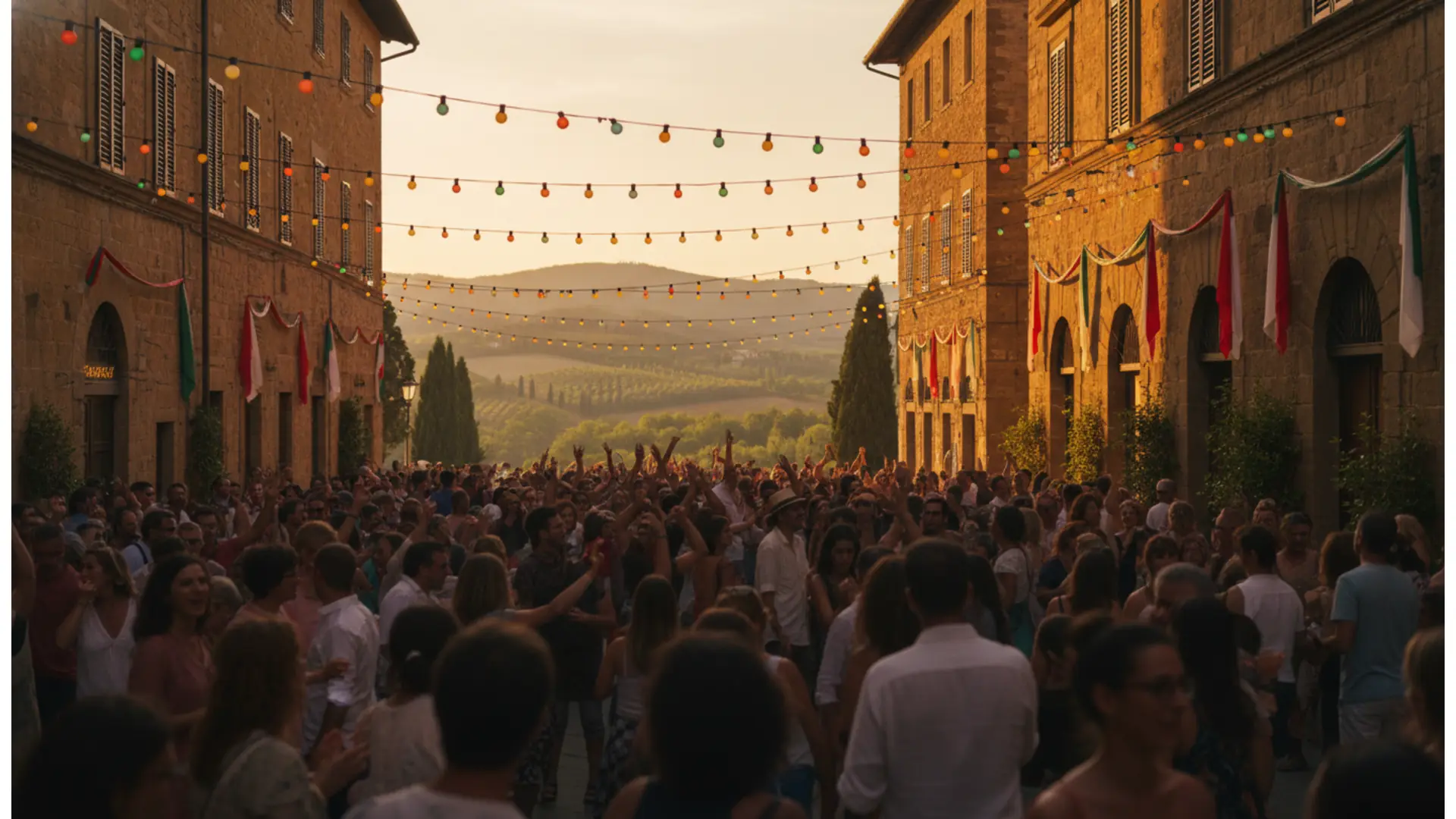
Eboli becomes an open-air tavern
Every year at the end of June, the historic center of Eboli, in the province of Salerno, is closed to traffic and transformed into a large, sprawling tavern. La Notte degli Osti is a food and wine festival that brings tables out into the streets, alleys, small squares, and courtyards of the upper town: for two days, people eat, drink, and converse in the open air, following the slow, warm rhythm of the traditional Italian tavern.
The event is neither a classic village fair nor a festival for celebrity chefs: it is a meeting of osti (innkeepers)—those who open their doors every day to welcome guests. From this simple idea, a format was born that in just a few years has become a recognized event well beyond the borders of Campania.
A story that began in 2019
La Notte degli Osti was born in 2019, almost as a game, from an intuition of Giovanni Sparano, innkeeper of the Alberto/Ritrovo wine bar and kitchen in Eboli. The goal was to network the taverns of the historic center and invite colleagues and chefs from all over Italy to cook together for one night. The project grew edition after edition, eventually occupying the entire village and involving artisanal wineries, bookstores, musicians, and scholars.
The event is held under the patronage of the Municipality of Eboli and has helped breathe new life into the ancient core of the city, which fills with long tables, wine stalls, and free concerts during the festival evenings.
The format: four-handed dinners
The heart of the festival is the four-handed dinner. Each tavern in the historic center—including regulars like Alberto/Ritrovo, Il Papavero, Dogana, Il Panigaccio, Piazzetta Santa Sofia, and the Osteria del Centro Storico—hosts a guest kitchen from Italy to create a fixed-price menu, served in the evening at outdoor tables. Alongside the dishes are artisanal wines: the winemakers are present in person to discuss their bottles table by table.
- Six Eboli taverns, six guest kitchens from across the peninsula
- Fixed-price menu agreed upon by the innkeeper and the guest chef
- Natural and artisanal wines served by the producers themselves
- Wine market and street food in the cloister of the National Museum
More than just food: cinema, books, and music
Each edition revolves around a theme developed through talks, book presentations, and screenings. Conversations are held in symbolic locations throughout the village—the Church of San Lorenzo, the Vacca de Dominicis Garden, the Cantina di Sor Diego al Pozzo—and are almost always free to attend.
In the evening, Piazza San Francesco becomes the festival's stage: over the years, it has hosted major national musical projects, with free concerts closing the day after dinner. Meanwhile, the cloister of the National Museum of Eboli hosts the artisanal wine market, paired with street food.
Why visit Eboli
La Notte degli Osti is the perfect opportunity to discover a historic center that usually remains off the beaten track of Piana del Sele tourism. Eboli is located just a few kilometers from Paestum, the Cilento coast, and Salerno: the event can be the start of a weekend dedicated to buffalo mozzarella, Greek temples, and the sea.
The atmosphere is that of a cultured village festival: you walk from table to table, meet winemakers and chefs without filters, drink well, and listen to music under the stars. It is one of the most original food and wine offerings in Campania and one of the reasons why it is worth stopping in Eboli today.
Notte degli Osti — edition 2026
"What remains of a World"
The sixth edition of La Notte degli Osti, held in Eboli on June 24 and 25, 2026, chose the theme "What remains of a World" as its guiding thread: a reflection on the tavern as a bastion of sociality, territorial identity, and hospitality in an era that has lost many of its reference points.
The theme intertwined with two anniversaries dear to Italian gastronomic culture: the fiftieth anniversary of Bernardo Bertolucci's "1900" and the memory of the Trattoria Cantarelli in Samboseto (1953-1982), where the film's crew had their headquarters. Talks, dinners, and tastings were held around this narrative.
The historic center closed to traffic
For two days, the ancient core of Eboli was pedestrianized and set for dining: six Eboli taverns hosted as many guest kitchens from all over Italy, while the artisanal wine market with street food was held in the cloister of the National Museum. Artistic direction by Giovanni Sparano, with the patronage of the Municipality of Eboli.
Programme Notte degli Osti 2026
Wednesday, June 24, 2026
- 12:00 PM — Church of San Lorenzo (free admission): "Via della Lungara, 3 — Chronicle of an extraordinary meeting," conversation with Giovanni Sparano, Diego Sorba, and Michele Guerra, Professor of Film History at the University of Parma, for the fiftieth anniversary of "1900."
- 1:30 PM — Vacca de Dominicis Garden (paid, by reservation): "Leave it to Me. Omakase and tavern," surprise menu lunch by the Piccolo Refettorio project with wines by Diego Sorba.
- 8:30 PM — Taverns of the historic center: the six four-handed dinners, with outdoor tables.
- Alberto/Ritrovo — Giovanni Sparano and Laura Fantastico with Andrea Poli (Il Gustificio, Carmignano sul Brenta)
- Il Papavero — Maurizio and Benedetta Somma with Fabio Pesticcio, guest Marco Ambrosino (Procida)
- Il Panigaccio — Gustavo Sparano and Paola Fulgione with Valeria Ghignone and Giovanni Della Monica (Generi di Conforto)
- Dogana — Morena Donnatuoni with Giovanni Civitillo (Millennium, Cusano Mutri)
- Piazzetta Santa Sofia — Dino Marchetta and Francesca Perretta with Gianmarco Vigilante (Il Salumaio, Salerno)
- Osteria del Centro Storico — Cosimo della Rocca and Francesca Montemurro with Francesco Leone (Res Lab Food and Beer, Montescaglioso)
- 11:59 PM — Cantina di Sor Diego al Pozzo (by reservation): "Samboseto with an M," a nocturnal tale dedicated to Trattoria Cantarelli.
Thursday, June 25, 2026
- 10:30 AM — Il Papavero Garden (paid): signature brunch with Peppe Guida, Pasquale Torrente, Antonino Mennella, and Filtro.
- 8:00 PM — Cloister of the National Museum of Eboli (free admission): opening of the artisanal wine market and street food.
- 10:00 PM — Piazza San Francesco (free admission): pop-jazz concert by the Piccola Orchestra Avion Travel.
Winemakers present at the dinners and the market included: Diego Sorba, Giulio Armani, Francesca Di Benedetto, Salvatore Magnoni, Giampiero Ventura, Gabriele Da Prato (Podere Còncori), Gaetano Guacci (RitroVino), Giuseppe Balzano and Alessandra Paudice (Brett), Davide Lima (Troppo Frizzante), Robb De Matt, Vito Settanni, Ultracosta, and Alex Della Vecchia.
Highlights Notte degli Osti 2026
- Sixth edition on the theme "What remains of a World"
- Tribute to the fiftieth anniversary of Bernardo Bertolucci's "1900" and Trattoria Cantarelli
- Six four-handed dinners in the historic center's taverns, menu at 50 euros
- Free talk with Michele Guerra in the Church of San Lorenzo
- Artisanal wine market and street food in the Cloister of the National Museum
- Free concert by the Piccola Orchestra Avion Travel in Piazza San Francesco
- Signature brunch with Peppe Guida, Pasquale Torrente, and Antonino Mennella
Prices Notte degli Osti 2026
Practical information — Notte degli Osti
How to get there
By car: A2 Mediterranean motorway, Eboli exit, then follow signs for the center. During the event, the historic center is closed to traffic: it is best to park in the lower town and walk up.
By train: Eboli station on the Salerno-Battipaglia-Potenza line, connected to Salerno and Naples; from the station, the historic center can be reached by bus or taxi.
By plane: Salerno-Costa d'Amalfi Airport (Pontecagnano), about 25 km away; alternatively, Naples-Capodichino, about 90 km away.
Reservations and tickets
Dinners at the taverns and paid events must be booked in advance and sell out quickly: it is best to act as soon as the program is released. Talks, the wine market, and evening concerts are generally free to attend.
Tips
Wear comfortable shoes: the village is hilly and cobblestoned. Those arriving from afar can stay in Eboli, Battipaglia, or on the coast of Paestum, about twenty minutes away by car.
Festival-goer photos
No photos yet. Share yours!
Share your photos
5 photos max, 5 MB per photo (JPG, PNG, WebP)
Noticed an error or missing information?
Help us keep this listing up to date. Every proposal is verified by our team before publication.
Festival-goer reviews
No rating yet — be the first!
No comments yet. Be the first!
Were you there?
Share your experience with the community.
Published by Valentin Contard, festival listings writer. Reviewed, corrected and approved by Christophe Contard, editor-in-chief. .
Where does it take place — Notte degli Osti
Centro storico di Eboli
Centro storico — Piazza San Francesco, 84025 Eboli