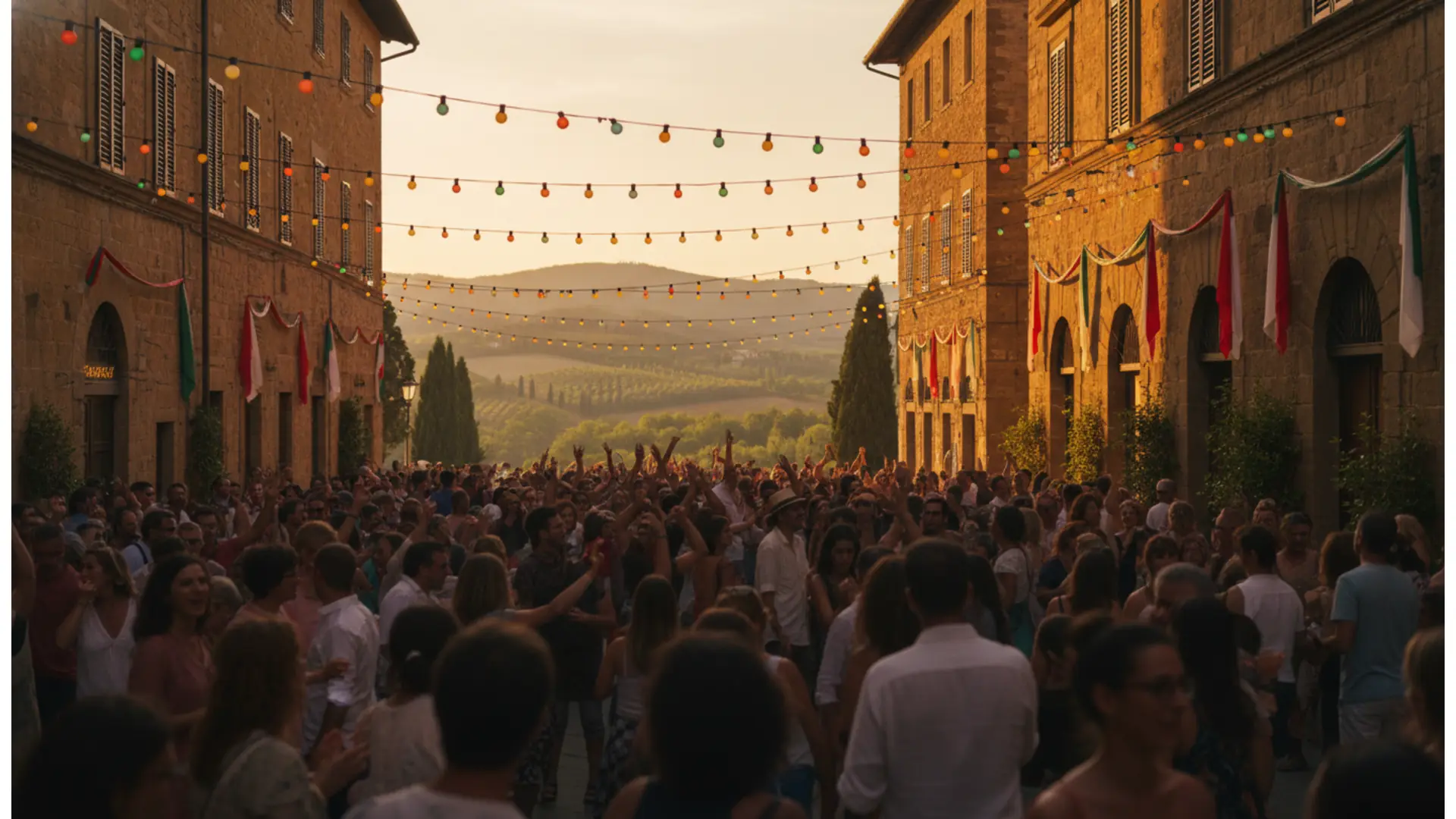
Holy Week of Piana degli Albanesi (Pashkët)
The Byzantine Easter of the Sicilian Arbëreshë, featuring Greek-Byzantine rites, 15th-century costumes, and red eggs
About Pashkët Arbëreshe
The Byzantine Easter of the Sicilian Arbëreshë heart
A few kilometers from Palermo, nestled on a plateau overlooking the lake of the same name, Piana degli Albanesi (Hora e Arbëreshëvet) is the most significant Arbëreshë center in Sicily. Founded at the end of the 15th century by Albanian refugees fleeing the Ottoman advance, the community has preserved its language, traditions, and above all, the Greek-Byzantine rite for over five centuries. It is during Holy Week — the Java e Madhe, culminating in Pashkët, or Easter — that this identity manifests in all its power, drawing thousands of faithful and visitors every year to this municipality in the Metropolitan City of Palermo, Sicily.
Ten days of liturgies and processions
Celebrations open on the Friday before Palm Sunday with the Feast of Lazarus (Lazëri), when the Divine Liturgy of the Presanctified begins at the Cathedral of Saint Demetrius the Great Martyr, and the song of the Resurrection echoes through the village streets. Palm Sunday (Rromollidhet) offers one of the most evocative sights: after the blessing of palms and olive branches at the Church of Saint Nicholas, the Eparch, riding a donkey and wrapped in his mantle (mandìas), travels along the main street to reach the Cathedral and celebrate the Pontifical Divine Liturgy in the Greek rite.
The Triduum: washing of the feet, laments, and Epitafios
On Holy Thursday (E Enjtja e Madhe), the ritual of the washing of the feet is renewed, and the village churches — Saint Nicholas, Saint George, Madonna dell'Odigitria, Saint Vitus, and the Annunziata — remain open for visits to the altars of repose. Good Friday (E Premtja e Madhe) is the most intense day: following the Great Hours and the Matins of Lamentations, the procession of the Dead Christ (the Epitafios) winds through the village, accompanied by ancient funeral chants (the vajtimet) and the somber sound of traditional wooden instruments, the cokë and the çikarrë. The bells remain silent from Thursday until noon on Holy Saturday, when the Cathedral fills with laurel leaves for baptisms and the Easter proclamation Christós Anésti rings out.
The costume parade and the red eggs
The most anticipated moment is Easter Sunday (Pashkët). At the end of the solemn Pontifical Liturgy, about three hundred women don precious traditional Arbëreshë costumes—outfits inspired by 15th-century fashion, dominated by red, green, and purple, and rich in embroidery, ribbons, veils, and jewelry—and parade along Corso Giorgio Kastriota to Piazza Vittorio Emanuele. The historical dress of Piana degli Albanesi has been inscribed in the Sicilian Registry of Intangible Heritage since 2016. In the square, the blessing (bekimi) is imparted, and the red eggs (vetë të kuqe), prepared by families on Holy Saturday, are distributed: their color recalls the blood of Christ and symbolizes the cyclical nature of life, fertility, and the Resurrection.
A living heritage
The Holy Week of Piana degli Albanesi is not merely a folkloric re-enactment, but a lived liturgy where the sacred and popular tradition merge into a rare example of identity continuity. Between storytelling performances, Easter concerts at the Seminary Theater, and the flavors of Arbëreshë cuisine, Pashkët remains one of the most authentic and fascinating events of the Sicilian spring.
Pashkët Arbëreshe — edition 2026
The 2026 Pashkët in Piana degli Albanesi followed the complete Greek-Byzantine rite calendar from March 27 to April 5. Celebrations opened on Friday, March 27, with the Feast of Lazarus (Divine Liturgy of the Presanctified in the Cathedral and the Resurrection chant through the village streets) and continued with the Living Stations of the Cross on March 28 and Palm Sunday on March 29, featuring the blessing of palms at the Church of Saint Nicholas and the Eparch on a donkey in procession to the Cathedral of Saint Demetrius.
The Easter Triduum included Holy Thursday (April 2) with the washing of the feet and the opening of the altars of repose, Good Friday (April 3) with the Matins of Lamentations and the procession of the Dead Christ, and Holy Saturday (April 4) with baptisms and the midnight Matins of the Resurrection. Easter Sunday (April 5) concluded with the Pontifical Liturgy, the traditional costume parade along Corso Giorgio Kastriota, the blessing and distribution of red eggs, and the Easter concert at the Seminary Theater.
Programme Pashkët Arbëreshe 2026
2026 Program
- Friday, March 27 (Feast of Lazarus): 18:30 Divine Liturgy of the Presanctified in the Cathedral; 21:00 Resurrection chant through the village
- Saturday, March 28: 8:30 Divine Liturgy; 17:00 Palm Vespers; 19:00 Living Stations of the Cross
- Sunday, March 29 (Palm Sunday): 10:30 Blessing of palms from the Church of Saint Nicholas with procession; 11:00 Pontifical Divine Liturgy at Saint Demetrius Cathedral; 18:00 Matins
- Thursday, April 2 (Holy Thursday): 10:30 Liturgy and Washing of the Feet; 17:00 Churches open (Saint Nicholas, Saint George, Madonna dell'Odigitria, Saint Vitus, Annunziata); 21:00 Traditional chant
- Friday, April 3 (Good Friday): 9:30 Great Hours; 18:00 Matins of Lamentations; 20:30 Procession of the Dead Christ through the village
- Saturday, April 4 (Holy Saturday): 10:30 Liturgy and baptisms; 24:00 Matins of the Resurrection
- Sunday, April 5 (Easter): 10:30 Pontifical Liturgy in the Cathedral; 12:00 Traditional costume parade along Corso Giorgio Kastriota to Piazza Vittorio Emanuele; 13:00 Blessing and distribution of red eggs with costume contest; 19:00 Easter concert at the Seminary Theater
Highlights Pashkët Arbëreshe 2026
- Palm Sunday with the Eparch riding a donkey through the village
- The Good Friday procession of the Dead Christ (Epitafios) with Byzantine funeral chants
- The parade of approximately 300 women in traditional Arbëreshë costumes on Easter Sunday
- The distribution of red eggs (vetë të kuqe) in Piazza Vittorio Emanuele
Prices Pashkët Arbëreshe 2026
Practical information — Pashkët Arbëreshe
Getting there
Piana degli Albanesi is about 30 km from Palermo. By car, take the A99 motorway (Palermo exit) and continue along the SS624 and SP5. As there is no train station, public transport connections are available via bus from the regional capital.
When
Celebrations take place throughout Holy Week, peaking on Easter Sunday. In 2026, the rites are held from March 27 to April 5.
Tips
The village becomes very crowded on Palm Sunday and Easter Sunday: it is advisable to arrive early to secure a spot for the costume parade along Corso Giorgio Kastriota. Services are held in the town center churches and the Cathedral of Saint Demetrius. Do not miss the chance to taste local Easter pastries and cannoli, for which Piana degli Albanesi is famous.
Festival-goer photos
No photos yet. Share yours!
Share your photos
5 photos max, 5 MB per photo (JPG, PNG, WebP)
Noticed an error or missing information?
Help us keep this listing up to date. Every proposal is verified by our team before publication.
Festival-goer reviews
No rating yet — be the first!
No comments yet. Be the first!
Were you there?
Share your experience with the community.
Published by Valentin Contard, festival listings writer. Reviewed, corrected and approved by Christophe Contard, editor-in-chief. .
Where does it take place — Pashkët Arbëreshe
Cattedrale San Demetrio Megalomartire