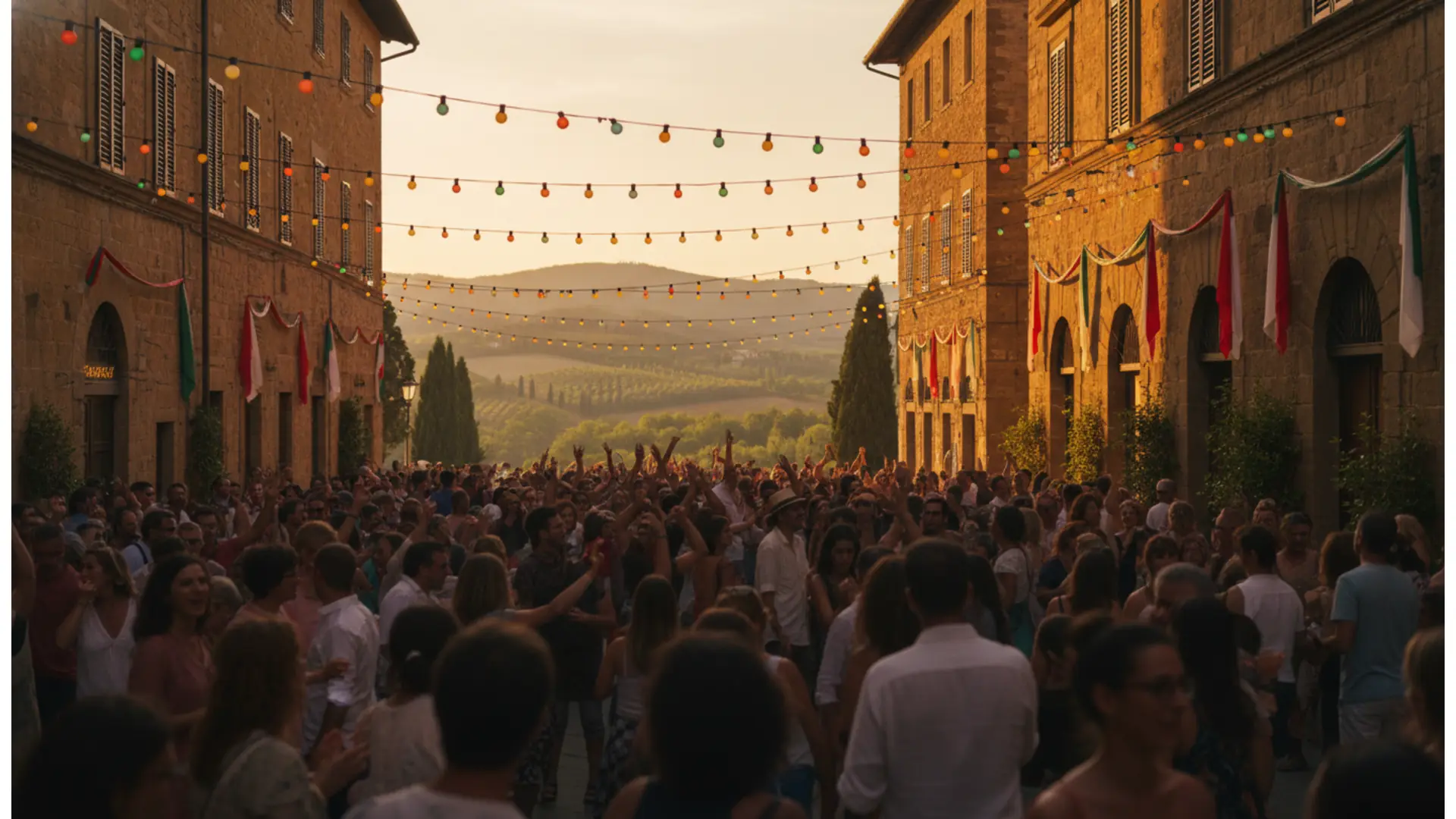
Historic Carnival of Frosinone and Festa della Ràdeca
The oldest carnival in the Ciociaria region, featuring agave leaves, allegorical floats, and the burning of General Championnet
About Festa della Ràdeca
A carnival like no other
In the landscape of Italian carnivals, the one in Frosinone holds a unique place. It is not just a festival of masks and confetti: it is a popular re-enactment that the entire city identifies with, so much so that it has been awarded the title of «Historic Carnival» by the Ministry of Culture. The capital of the Frosinone province, the heart of the Ciociaria region in southern Lazio, dedicates ten days of programming to the event, involving schools, families, associations, and local merchants.
The ràdeca, the absolute symbol of the festival
The true protagonist is the ràdeca, the fleshy leaf of the agave that every participant must carry. Scholars recognize it as an ancient symbol of fertility, likely arriving in Ciociaria during the Spanish era, a distant heir to the rites already celebrated in February during Roman times. Those who show up in the center without their ràdeca risk the famous «radecate», playful taps administered with the leaf: a humorous baptism reserved for first-timers. The Scottish anthropologist James Frazer cited this tradition in his The Golden Bough, recognizing its ancestral nature.
General Championnet and his trial
The legend that shapes the festival dates back to 1799. The people of Frosinone, weary from the devastation caused by French troops, decided to celebrate the carnival anyway and sent a messenger to invite General Jean Antoine Étienne Championnet. Instead of reacting harshly to the mockery, the military man joined the crowd, drinking red wine and tasting local dishes. Since then, he has become the city's symbolic mask: every year his effigy is put on trial on the stage in Piazza Turriziani, where a popular judiciary and the 'radecari' call for his conviction, his satirical will is read, and the final burning is celebrated—a purifying gesture that marks the end of winter.
Allegorical floats and Shrove Tuesday
Shrove Tuesday is the highlight. The allegorical floats, built in the preceding months with the contribution of the Frosinone Academy of Fine Arts, gather in the morning at Piazzale Vienna in the Cavoni district, and parade first through the lower part of the city, then into the historic center. The parade is always closed by General Championnet's float, traditionally pulled by four white horses. Alongside the floats, the three symbolic figures of the Radecaro, the Pantanaro, and the Ciociaro march, receiving the keys to the city at the opening of the festival and returning them at the closing.
Music, saltarello, and food
The soundtrack of the day is the saltarello, a traditional Ciociarian folk dance that accompanies the procession along with bands and carnival songs. The gastronomic aspect is unmissable: in Piazza VI Dicembre, fini fini—the traditional ultra-thin Ciociarian fettuccine—are distributed, along with macaroni and carnival sweets. The calendar also includes the General's Grand Ball, a charity masquerade gala at the Villa Comunale, the Aperitivo at the Palace, exhibitions, theatrical and musical performances, and a competition for the best-decorated shop window.
Why it's worth the trip
Those who arrive in Frosinone during these days do not witness a show for tourists, but enter a festival that the locals consider part of their identity. It is an opportunity to discover the historic center of the Ciociarian capital, its cuisine, and an intangible heritage that few Italian carnivals can boast with the same continuity.
Festa della Ràdeca — edition 2026
Ten days of celebration throughout the city
From February 8 to 17, 2026, the Historic Carnival of Frosinone embraced the entire city with a particularly rich calendar, created by the Municipality together with the Rione Giardino Association, the Pro Loco, and the Academy of Fine Arts. The edition was hosted by Mary Segneri.
Shrove Tuesday
On February 17, the allegorical floats gathered around 10:00 AM at Piazzale Vienna, in the Cavoni district, departing around 11:30 AM with a police escort to parade through the lower part of the city. At 2:00 PM, the procession reached the historic center for the Festa della Ràdeca. In Piazza Turriziani, the trial of General Championnet took place, with the popular judiciary and the 'radecari' calling for his conviction, followed by the reading of the will and the burning of the effigy—the final act of the festival, reinstated after discussions with the Lazio Region regarding anti-smog regulations.
Other events
The program included the General's Grand Ball at the Villa Comunale, a charity masquerade gala with proceeds donated to AIL, children's entertainment, live music by the Giuseppe Magliocchetti Jazz Band, and a carnival buffet. There was also the Aperitivo at the Palace, the Family Carnival Party with itinerant visits by General Championnet to local homes, the awards ceremony for the best shop window competition, and the reading of satirical carnival newspapers.
Programme Festa della Ràdeca 2026
Tuesday, February 17, 2026 — Shrove Tuesday
- 10:00 AM — Gathering of the fourteen allegorical floats at Piazzale Vienna, Cavoni district
- approx. 11:30 AM — Start of the parade in the lower part of the city with police escort
- 12:00 PM — DJ set in Piazza Turriziani
- 12:30 PM — Distribution of traditional fini fini in Piazza VI Dicembre
- 2:00 PM — Festa della Ràdeca and parade of allegorical floats in the historic center
- following — Trial of General Championnet on the stage in Piazza Turriziani, reading of the will, and burning of the effigy
During the ten days (February 8-17)
- General's Grand Ball at the Villa Comunale: charity masquerade gala for AIL, with children's entertainment, live music by the Giuseppe Magliocchetti Jazz Band, and buffet
- Aperitivo at the Palace
- Family Carnival Party, itinerant in the city's homes with General Championnet
- Events dedicated to schools, families, children, and young people
- Theatrical and musical performances, exhibitions, and charity initiatives
- Awards ceremony for the best shop window competition and reading of satirical newspapers
Highlights Festa della Ràdeca 2026
- Fourteen allegorical floats in the parade, closed by General Championnet's float
- Festa della Ràdeca in the historic center, with agave leaves and traditional radecate
- Trial and burning of General Championnet in Piazza Turriziani
- General's Grand Ball at the Villa Comunale, with proceeds donated to AIL
- Distribution of fini fini in Piazza VI Dicembre
Prices Festa della Ràdeca 2026
Practical information — Festa della Ràdeca
How to get there
By car: A1 Milan-Naples motorway, Frosinone exit, then expressway towards the center. By train: Frosinone station on the Rome-Cassino-Naples line, connected to the historic center by urban buses. From Rome, the trip takes about an hour and a half.
Admission and costs
The parades, the Festa della Ràdeca, and the events in the square are free of charge. Some evening events, such as the General's Grand Ball, require an entry fee for charity purposes.
Practical tips
On Shrove Tuesday, the historic center is closed to traffic and many roads are restricted: it is best to leave your car in the parking lots in the lower part of the city and walk up or use public transport. Bring a ràdeca with you, or be prepared to receive a few playful taps.
Information
Municipality of Frosinone, Piazza VI Dicembre — phone +39 0775 2651.
Festival-goer photos
No photos yet. Share yours!
Share your photos
5 photos max, 5 MB per photo (JPG, PNG, WebP)
Noticed an error or missing information?
Help us keep this listing up to date. Every proposal is verified by our team before publication.
Festival-goer reviews
No rating yet — be the first!
No comments yet. Be the first!
Were you there?
Share your experience with the community.
Published by Valentin Contard, festival listings writer. Reviewed, corrected and approved by Christophe Contard, editor-in-chief. .
Where does it take place — Festa della Ràdeca
Centro storico di Frosinone
Piazza VI Dicembre, 03100 Frosinone