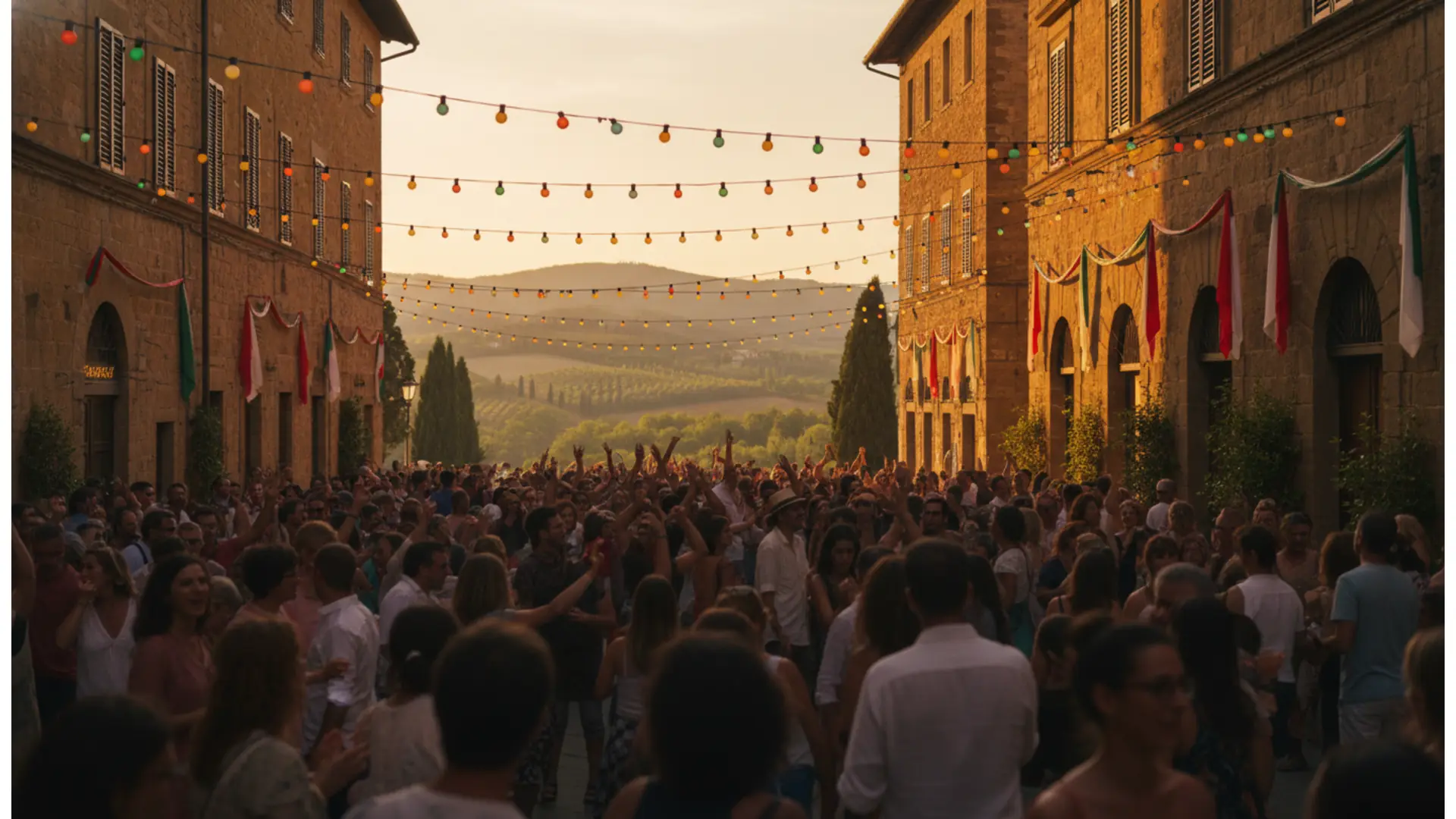
Hanukkah at Piazza Barberini (lighting of the Jewish candelabrum)
The grand menorah lit in the heart of Rome for the eight days of the Festival of Lights
Edition 2026 not confirmed to date
This edition has not been confirmed by the organiser to date. We recommend checking before going.
About Hanukkah at Piazza Barberini
A tradition illuminating the center of Rome
For nearly forty years, as December arrives, Piazza Barberini transforms: next to Bernini's Triton Fountain, a large menorah—the nine-branched candelabrum of the Jewish festival of Hanukkah—is installed. The initiative is promoted in Rome by the international Chabad-Lubavitch movement, which during the same week lights public candelabra in hundreds of cities worldwide, from London to New York, and from Moscow to Melbourne. In December 2025, the Roman event reached its 37th edition, cementing its place as one of the most recognizable religious and civic events in the Capital's winter calendar.
What is celebrated
Hanukkah commemorates the victory of the Maccabees over Hellenistic persecution in ancient Judea and the subsequent rededication of the Temple in Jerusalem, which had been profaned by pagans. According to tradition, the remaining oil—enough for only one day—miraculously lasted for eight days: hence the eight days of the festival and the eight lights that are lit progressively, one more each evening, using the ninth central candle, the shammash. It is a domestic festival that in Rome, as elsewhere, moves outdoors to become a public event: for the light to be a sign, it must be seen.
How the lighting takes place
The ritual is repeated every evening for eight consecutive days, with times following the Jewish calendar: the lighting at Piazza Barberini is traditionally set for 6:00 PM, moved earlier in the afternoon on the day preceding Shabbat, and shifted to the evening after sunset at the end of the Sabbath. The main evening, which sees the highest attendance, usually falls on the first Sunday of the festival: this is when the square is most crowded and institutional guests speak. The 2025 edition featured, alongside Rabbi Yitzhak Hazan, director of Chabad-Lubavitch of Rome, Mayor Roberto Gualtieri, the US Ambassador, a representative of the Israeli Embassy in Italy, the president of the UCEI Noemi Di Segni, and the president of the Jewish Community of Rome, Victor Fadlun.
A festive atmosphere, open to all
Around the lighting, the square becomes a space for popular celebration for a few hours: live music, songs and dances by children from the city's Jewish schools, distribution of traditional holiday treats—sufganiot (fried doughnuts) and potato latkes—and small gifts for the little ones. Participation is free and open to everyone, not just the Jewish community: passing tourists and Romans returning from work gladly stop in front of the illuminated candelabrum.
Jewish Rome, a two-thousand-year-old context
The event is part of a particularly long history: that of Rome, home to the oldest Jewish community in Europe, present in the city continuously for over twenty centuries. Those attending the lighting at Piazza Barberini can easily complete their day by heading down toward the Ghetto, between the Portico d'Ottavia and the Great Synagogue, where during Hanukkah, shop windows and bakeries offer traditional holiday sweets. On the final evening, Roman tradition also includes a closing ceremony in the area of the Colosseum, a place of strong symbolic value for Jewish history.
Why it is worth attending
- A short, intense, and visually memorable ceremony in one of Rome's most beautiful Baroque squares.
- A free, open-air event suitable for families with children.
- The opportunity to discover a millennial tradition explained in simple terms.
- A chance to combine the visit with the Barberini-Tridente district, between Via Veneto, Palazzo Barberini, and the Trevi Fountain.
Piazza Barberini is located in the Municipio I of Rome, Metropolitan City of Rome Capital, in the Lazio region: a central point, served by the metro and just a few minutes' walk from the main sights of the historic center.
Hanukkah at Piazza Barberini — edition 2026
Hanukkah 2026 in Rome
The Jewish Festival of Lights in 2026 takes place between the evening of Friday, December 4th and Saturday, December 12th, according to the Jewish calendar (25 Kislev 5787). This is the period when, for nearly forty years, the grand menorah has been lit in Piazza Barberini, in the center of Rome.
The detailed program for the 2026 edition has not yet been published by Chabad-Lubavitch of Rome. Pending the official announcement, the custom of previous years should be kept in mind: daily evening lighting, earlier times in the afternoon on the day preceding Shabbat, lighting after sunset at the end of the Sabbath, and the main evening usually held on the first Sunday of the festival, with the participation of city authorities, the Jewish Community of Rome, and diplomatic representatives.
Participation is traditionally free and open to all. Final dates and times will be confirmed by the organizers in the weeks leading up to the festival.
Programme Hanukkah at Piazza Barberini 2026
Highlights Hanukkah at Piazza Barberini 2026
Prices Hanukkah at Piazza Barberini 2026
Practical information — Hanukkah at Piazza Barberini
Location
Piazza Barberini, 00187 Rome (Municipio I, Barberini/Tridente district), next to the Triton Fountain.
How to get there
Metro: Line A, Barberini station, right at the square exit. Bus: Numerous lines along Via del Tritone and Via Barberini. Train: From Roma Termini station, take Metro A towards Battistini, two stops. Plane: Fiumicino (Leonardo Express to Termini) and Ciampino airports. By car, the area is a restricted traffic zone with limited parking: using public transport is strongly recommended.
Times and costs
Evening lighting, traditionally at 6:00 PM, with earlier times on Fridays (before Shabbat begins) and later times on Saturday evenings. Participation is free and open to all, no booking required. Precise times are published annually by Chabad-Lubavitch of Rome shortly before the festival.
Tips
December in Rome is mild but humid: dress in layers and bring an umbrella. The main evening is very crowded: it is best to arrive at least twenty minutes early to find a spot near the candelabrum. For those arriving from out of town, the area offers a wide choice of hotels between Via Veneto and the Tridente, though it is also the most expensive: valid alternatives can be found near Termini or in the Prati district.
Festival-goer photos
No photos yet. Share yours!
Share your photos
5 photos max, 5 MB per photo (JPG, PNG, WebP)
Noticed an error or missing information?
Help us keep this listing up to date. Every proposal is verified by our team before publication.
Festival-goer reviews
No rating yet — be the first!
No comments yet. Be the first!
Were you there?
Share your experience with the community.
Published by Valentin Contard, festival listings writer. Reviewed, corrected and approved by Christophe Contard, editor-in-chief. .
Where does it take place — Hanukkah at Piazza Barberini
Piazza Barberini
Piazza Barberini, 00187 Roma