Campagnolo Carnival
The historic carnival of the Southern Pontine area, featuring papier-mâché floats, the Pacchiana, and King Carnival
About Campagnolo Carnival
A historic carnival in the heart of the Southern Pontine
The Campagnolo Carnival in Santi Cosma e Damiano, in the province of Latina, is one of the oldest and most iconic carnivals in the Southern Pontine area and the entire southern Lazio region. Born in the late seventies, it traces its roots back to the post-war carnival parades, when village streets came alive with trailers loaded with masked revelers eager to celebrate. In 2005, the event was included in the list of Italy's Historic Carnivals, a recognition that certifies its cultural value and the continuity of its tradition.
The floats: papier-mâché, iron, and hydraulic movements
The heart of the festival lies in the allegorical floats created by master papier-mâché artists from the local districts: imposing sculptures on iron structures, many of which are animated by a PLC-controlled hydraulic movement system, a technique considered unique in Italy. The floats stand out for their grandeur, originality, satire, and scenic quality, and every year a technical jury appointed by the Municipality evaluates the works and draws up the final ranking. Alongside the large floats, the traditional "Eat and Drink" floats parade, representing the most convivial and popular side of the festival.
Angiolella, the Pacchiana and King Carnival
The godmother of the carnival and symbol of the village is Angiolella, a figure inspired by the Pacchiana, the smiling peasant woman of local tradition. Her embroidered dress tells the story of Santi Cosma e Damiano: the tower from the municipal coat of arms, ears of wheat, bread, olive trees, and the flowers typical of this hillside village. Seven satin ribbons in rainbow colors—a symbol of hope and renewal—descend from her black silk skirt, held by seven children, the Ninni, who represent the future of the village. Beside her parades Don Antonio, King Carnival, wearing a black silk velvet cloak embellished with astrakhan inserts and rainbow-colored rays.
The festival: parades, competitions, and community
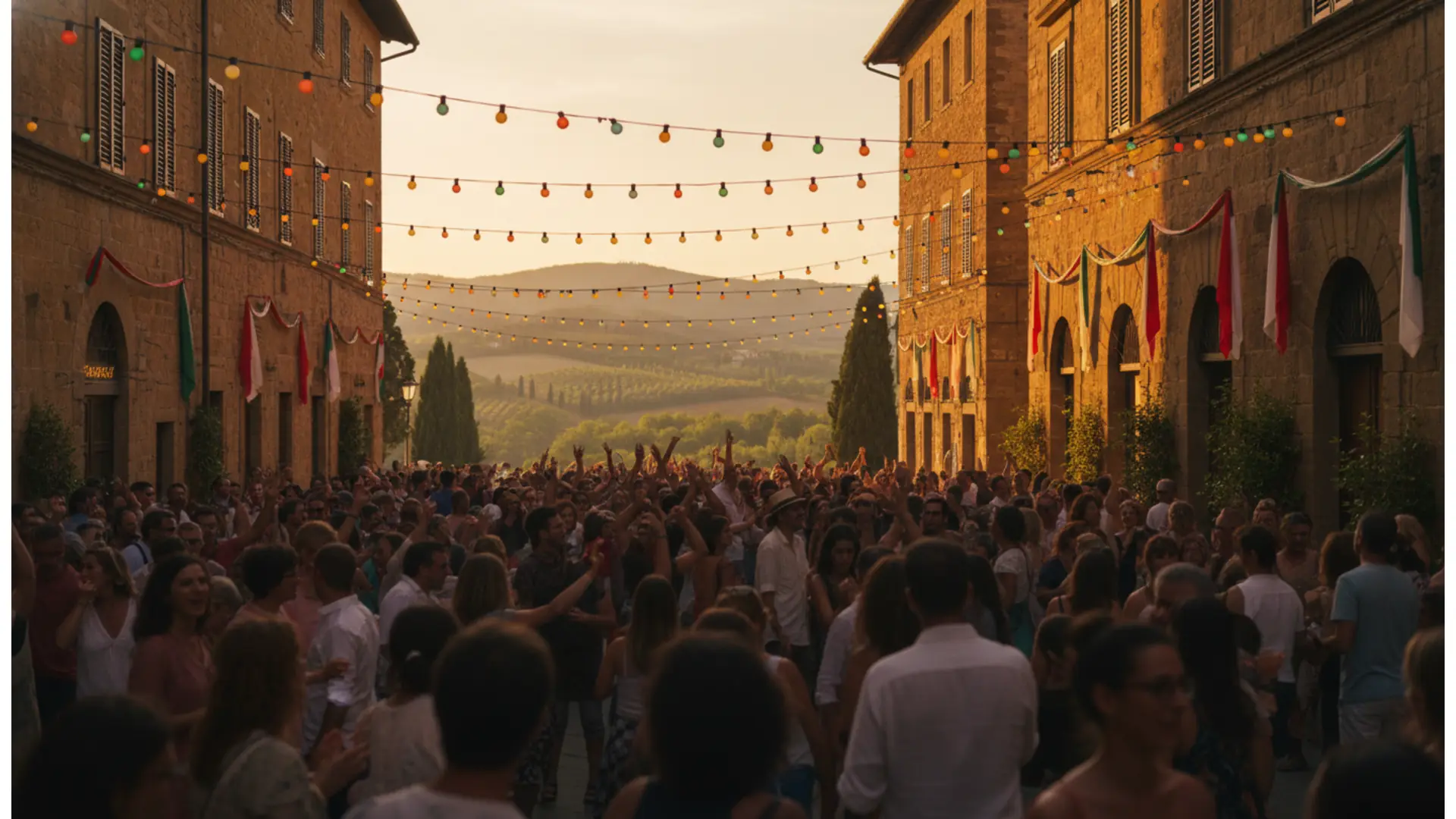
The procession, opened by the banners of the Municipality of Santi Cosma e Damiano and the Carnival flag featuring the Pacchiana, traditionally starts from Via Ausente to reach Piazza Campomaggiore, the heart of the event. Along with the floats, masked groups, cultural associations, folk bands, kindergartens, and organizations working with people with disabilities parade in an inclusive event suitable for all ages. The spectacle is completed by jugglers, stilt walkers, flag-wavers, fire-eaters, and street bands, while the "Most Beautiful Mask" and "Most Beautiful Shop Window" competitions involve families, groups, and local businesses.
A living heritage of the community
Organized by the Municipality of Santi Cosma e Damiano through a dedicated organizing committee, the Campagnolo Carnival is, in the words of Mayor Franco Taddeo, "not just a party, but a living heritage of our community," one of the most authentic moments of participation, creativity, and belonging. For the public arriving from the Gulf of Gaeta, the rest of the Latina province, and Lazio, it is an opportunity to discover a village where rural culture transforms every year into street art, papier-mâché craftsmanship, and a collective celebration.
Campagnolo Carnival — edition 2026
The 43rd edition
In 2026, the Campagnolo Carnival celebrated its 43rd edition with two Sundays of festivities, February 15 and 22, in the Campomaggiore area. The protagonists were the allegorical floats by local master papier-mâché artists, distinguished by their grandeur, originality, satire, and scenic quality, evaluated by a technical jury appointed by the Municipality: the final ranking of the floats was published on February 20, 2026.
The parade on February 15, opened by municipal banners and the flag featuring the Pacchiana, brought together floats, masked groups, cultural associations, folk bands, kindergartens, and associations working with people with disabilities, along with jugglers, stilt walkers, and street bands. On February 22, the floats, positioned at strategic points in the square, displayed their movements and choreographies, enlivened by local gyms and associations. On February 17, Shrove Tuesday, a delegation from the Campagnolo Carnival also paraded at the Formia carnival.
Programme Campagnolo Carnival 2026
Sunday, February 15, 2026 — Traditional Parade
- 12:00 PM — Parade departure from Via Ausente towards Piazza Campomaggiore: banners of the Municipality of Santi Cosma e Damiano and the Carnival flag with the Pacchiana, 13 floats (10 allegorical and 3 traditional "Eat and Drink" floats), masked groups, cultural associations, folk bands, kindergartens, and associations working with people with disabilities, with jugglers, stilt walkers, and street bands.
- "Most Beautiful Mask" competition, individual/couple and group categories, with awards for the best masks.
Tuesday, February 17, 2026
- Participation of the Campagnolo Carnival in the Formia carnival parade.
Sunday, February 22, 2026 — Closed circuit in Piazza Campomaggiore
- 3:00 PM — Performances: the floats, positioned at strategic points, display hydraulic movements and choreographies; entertainment by the Le Contrade Folk Group, nurseries, and local entities Urban Fit, Scuola Danza Respiro, and Eskhara Ballet.
- Award ceremony for the "Most Beautiful Shop Window" competition (2nd edition) dedicated to local businesses.
Highlights Campagnolo Carnival 2026
- 13 papier-mâché and iron floats, including 10 allegorical and 3 traditional "Eat and Drink" floats, with PLC-controlled hydraulic movements
- Inaugural parade from Via Ausente to Piazza Campomaggiore with folk bands, jugglers, stilt walkers, and street bands
- "Most Beautiful Mask" and "Most Beautiful Shop Window" competitions
- Final ranking of the floats drawn up by a technical jury and published by the Municipality
- Floats' participation in the Formia carnival on February 17
Prices Campagnolo Carnival 2026
Practical information — Campagnolo Carnival
Getting there
By car: Santi Cosma e Damiano can be reached via the SS7 Appia (exit for Castelforte/Santi Cosma e Damiano) or from the A1 motorway, Cassino exit, continuing towards Minturno. The parades take place between Via Ausente and Piazza Campomaggiore.
By train: the nearest station is Minturno-Scauri, on the Rome–Naples line via Formia; from there, continue by car or bus.
Admission
The Campagnolo Carnival parades take place along the village streets and access is free. During the festival days, traffic changes are expected in the Campomaggiore area: it is advisable to arrive early to find parking.
Festival-goer photos
No photos yet. Share yours!
Share your photos
5 photos max, 5 MB per photo (JPG, PNG, WebP)
Noticed an error or missing information?
Help us keep this listing up to date. Every proposal is verified by our team before publication.
Festival-goer reviews
No rating yet — be the first!
No comments yet. Be the first!
Were you there?
Share your experience with the community.
Published by Valentin Contard, festival listings writer. Reviewed, corrected and approved by Christophe Contard, editor-in-chief. .
Where does it take place — Campagnolo Carnival
Piazza Campomaggiore