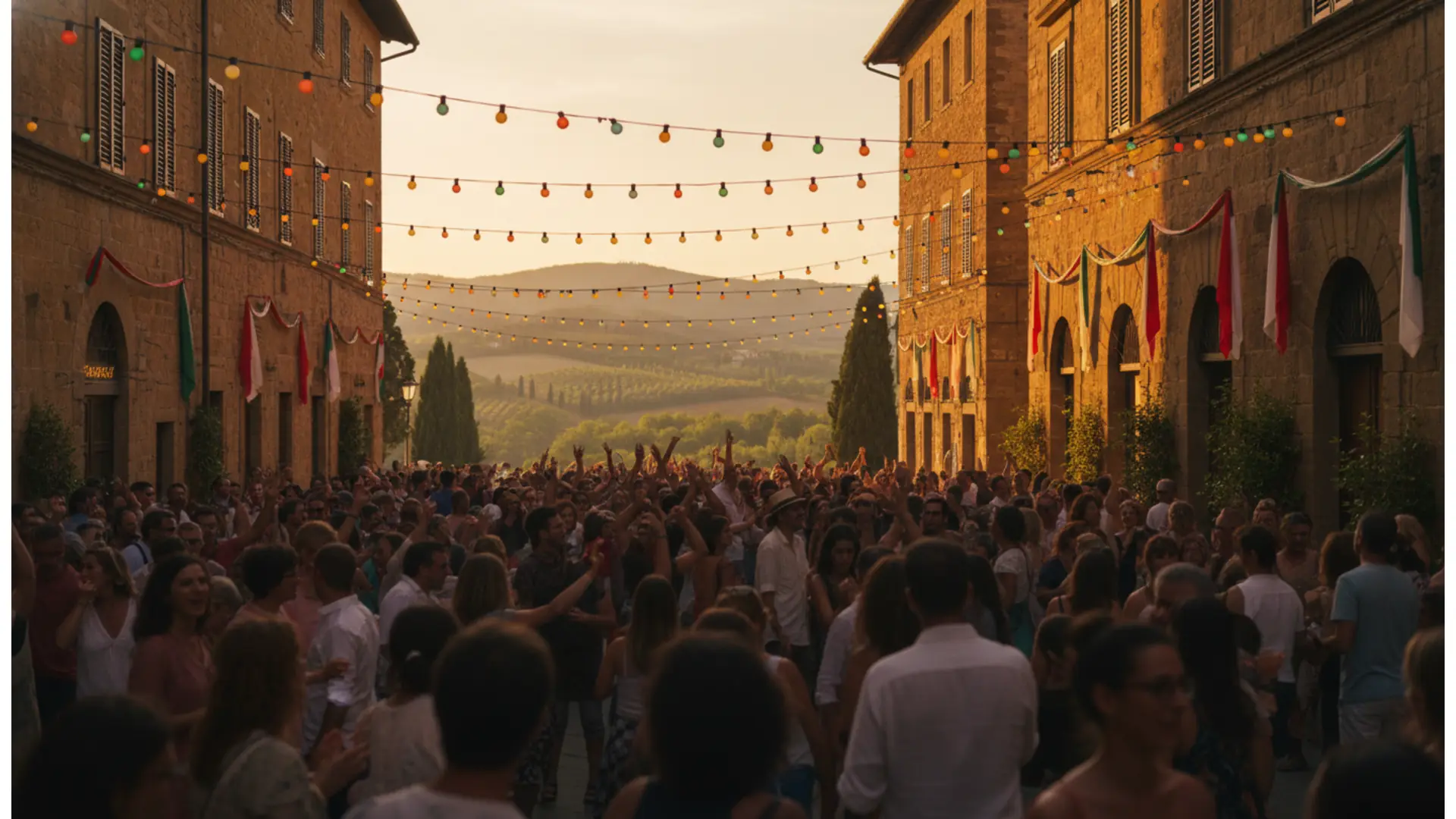
Zampaglione and Saint Anthony Abbot Rites
The Saint Anthony bonfire and the spirit of the woods between Ariano and Monticelli
About Zampaglione of Olevano
The Zampaglione and the Rites of Saint Anthony Abbot
In the heart of the Picentini Mountains, the municipality of Olevano sul Tusciano (Province of Salerno, Campania) preserves one of the most intense winter rituals in Southern Italy. Between January 17th and 18th, on the feast of Saint Anthony Abbot, the town divides itself between fire and masks: on one side, the great bonfire lit in the Ariano district, and on the other, the appearance of the Zampaglione, the spirit of the woods that crosses the ancient village of Monticelli amidst the clatter of chains.
'O Catuozzo, the January 17th bonfire
January 17th is dedicated to fire. Men dressed in traditional mountain clothing drag large tree trunks along the streets of the Ariano district to feed 'o Catuozzo, the great bonfire lit in honor of the Saint. It is a collective, strenuous, and noisy effort that renews the bond between the community and the forest every year: the timber is dragged in a procession to the district square and committed to the flames while the town gathers around the brazier on the coldest night of winter.
The fire of Saint Anthony, throughout Southern Italy, holds a purifying value: it burns away the old, warms the community, and symbolically opens the Carnival season. In Olevano sul Tusciano, this meaning has never become mere postcard folklore, because the preparation of the bonfire remains a community task, performed with the hands and the toil of those who still know the mountains.
The Zampaglione, the mask of the forest spirits
The following day, the scene shifts to the Ancient Village of Monticelli. In the afternoon, the Zampaglione appears: a wild figure, a spirit of the woods, wandering through the alleys of the old village amidst the clatter of chains, a call to ancient purification symbolism. Beside him, Olevano tradition preserves the figure of the 'Strascicone, the other protagonist of the ancestral rites linked to the Saint's feast.
First-time observers are struck primarily by the sound: before even seeing the mask, one hears the metal dragging on the cobblestones, and the village fills with a noise unlike any modern festival. This is one of the reasons why these rites are considered among the most authentic in the inland areas of the Province of Salerno.
Workshops, begging, and the threshold of Carnival
The day in Monticelli is not just about ritual: the village hosts workshops for children and the Carnival begging processions, the moment when masked groups reclaim the streets. These two days act as a threshold leading to the Carnival of the Poor, the other great tradition of Olevano sul Tusciano, featuring the parade of the twelve months on donkey-back and the funeral of King Carnival.
An intangible heritage recognized by the Campania Region
The Campania Region has recognized the cultural value of "The Zampaglione and the Rites of Saint Anthony Abbot," inscribing them—along with the Carnival of the Poor—in the IPIC, the Inventory of Intangible Cultural Heritage of Campania, the instrument used by the Region to catalog practices, knowledge, and traditions of Campanian communities according to the criteria of the 2003 UNESCO Convention. The two candidacies were advanced by the Municipality of Olevano sul Tusciano through the Department of Culture. Documentation of the rites is also monitored by the Documentation Center of the Picentini Ecomuseum.
Ariano, Monticelli, and Salitto: the town of rites
Olevano sul Tusciano is a scattered municipality in the middle valley of the Tusciano River, at the foot of the Picentini Mountains, formed by the hamlets of Ariano (municipal seat), Monticelli, and Salitto. The territory preserves the Castrum Olibani, the Lombard castle that dominates the valley from Monte Castello, and above all the Cave of Saint Michael the Archangel, a rock sanctuary with frescoes dating back to the 9th century. The surrounding hills produce Colline Salernitane PDO extra virgin olive oil: an agricultural landscape that explains well why the winter rites here still speak of wood, seasons, and community.
Tips for visitors
- These are two distinct days in two different locations: January 17th in Ariano, January 18th in Monticelli.
- These are street rituals: you watch outdoors in mid-winter, so wear heavy clothing and shoes suitable for stone alleys.
- The ancient village of Monticelli is explored on foot: it is best to leave your car at the entrance of the town.
- It is a community festival rather than a show: respecting the pace of the procession and the organizers' instructions is part of the experience.
Zampaglione of Olevano — edition 2026
2026 Edition: Two days between fire and masks
In January 2026, Olevano sul Tusciano renewed the ancestral rites of the Zampaglione and the 'Strascicone, now inscribed in the Inventory of Intangible Cultural Heritage of Campania. The program was spread over two days and two different locations in the municipality: the Ariano district on Saturday, and the Ancient Village of Monticelli on Sunday.
On January 17th, the feast of Saint Anthony Abbot, from 6 PM, men dressed in mountain attire dragged large tree trunks through the streets for 'o Catuozzo, the great bonfire lit in honor of the Saint. The following day, in the ancient village of Monticelli, the day was dedicated to children's workshops and Carnival begging, until 5 PM, when the Zampaglione—spirit of the woods—crossed the alleys amidst the clatter of chains, evoking ancient symbols of purification.
The 2026 edition was also an opportunity to showcase to the public the value of a tradition that the Campania Region has formally recognized, along with the Carnival of the Poor, as part of the regional intangible heritage.
Programme Zampaglione of Olevano 2026
Saturday, January 17, 2026 - Ariano District
- 6:00 PM - Men in mountain attire drag large tree trunks to feed 'o Catuozzo, the bonfire in honor of Saint Anthony Abbot, followed by the lighting of the fire.
Sunday, January 18, 2026 - Ancient Village of Monticelli
- Throughout the day - Children's workshops and Carnival begging in the ancient village.
- 5:00 PM - Appearance of the Zampaglione, spirit of the woods, crossing the village amidst the clatter of chains.
Program reconstructed from local press reports; times may be subject to changes decided by the organizers.
Highlights Zampaglione of Olevano 2026
- Dragging the logs and lighting 'o Catuozzo, the great bonfire of the Ariano district.
- The appearance of the Zampaglione, the spirit of the woods, amidst the chains of the Ancient Village of Monticelli.
- The figure of the 'Strascicone, the other ancestral mask of Olevano tradition.
- Workshops for children and begging processions that open the Carnival of the Poor season.
Prices Zampaglione of Olevano 2026
Practical information — Zampaglione of Olevano
How to get there
Olevano sul Tusciano is located in the Province of Salerno, in the hinterland of the Sele Plain. By car, take the A2 del Mediterraneo motorway (exit Pontecagnano or Battipaglia) and continue towards the Tusciano valley. By train, the nearest stations are Battipaglia and Pontecagnano, connected to Salerno; the final stretch must be covered by car or local bus. The reference airport is Salerno-Costa d'Amalfi in Pontecagnano.
Where it takes place
On January 17th, the bonfire rites are held in the Ariano district; on January 18th, the Zampaglione mask traverses the Ancient Village of Monticelli. Both locations are within the municipal territory, just a few minutes' drive from each other.
Practical tips
- Outdoor events in January: winter clothing and comfortable footwear are essential.
- Parking is recommended at the entrance of the villages, then proceed on foot.
- For final schedules and changes, it is advisable to check the official channels of the Municipality of Olevano sul Tusciano.
Where to stay
The area is served by accommodation facilities in Battipaglia, Eboli, and the coastal strip of Pontecagnano; Salerno, about half an hour away, remains the most convenient base for those who want to combine winter rites with a visit to the city and the Amalfi Coast.
Festival-goer photos
No photos yet. Share yours!
Share your photos
5 photos max, 5 MB per photo (JPG, PNG, WebP)
Noticed an error or missing information?
Help us keep this listing up to date. Every proposal is verified by our team before publication.
Festival-goer reviews
No rating yet — be the first!
No comments yet. Be the first!
Were you there?
Share your experience with the community.
Published by Valentin Contard, festival listings writer. Reviewed, corrected and approved by Christophe Contard, editor-in-chief. .
Where does it take place — Zampaglione of Olevano
Rione Ariano e Borgo Antico di Monticelli