Sant'Agnello di Maggio in Rodio
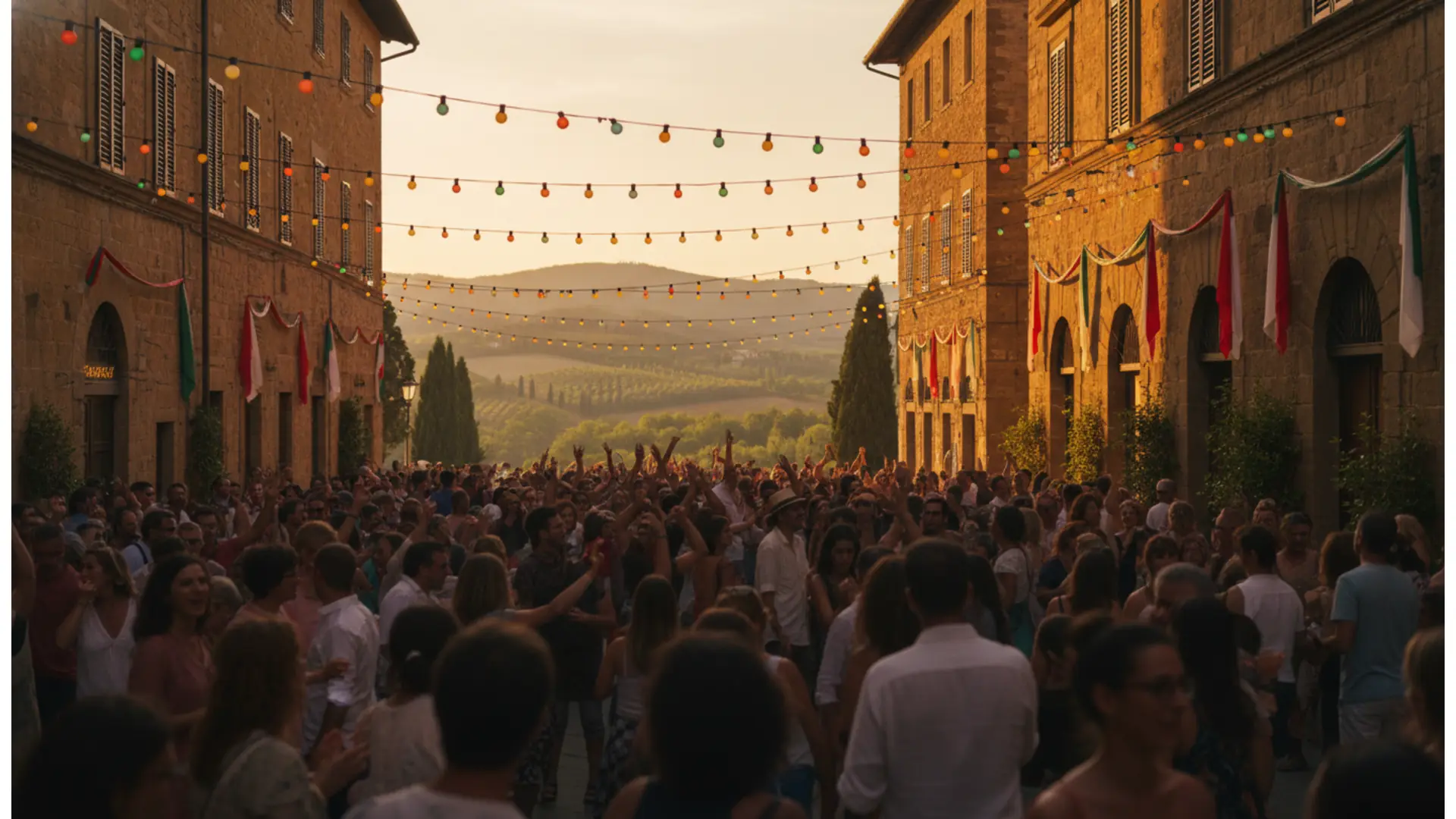
The votive feast of May 31st in the medieval village of Rodio, in the Cilento region
About Sant'Agnello di Maggio
A votive feast born among the vineyards
On May 31st in Rodio, a hillside hamlet of the Municipality of Pisciotta, in the province of Salerno (Campania), the village celebrates Sant'Agnello di Maggio: an anniversary that does not stem from the liturgical calendar, but from an event deeply etched in the village's collective memory. Tradition tells of a particularly rainy year when continuous downpours were compromising the vineyards and, consequently, the harvest. The inhabitants turned to their patron, Sant'Agnello Abate, and the rain ceased. Since then, the community has renewed its gratitude every year at the end of May, when the Cilento countryside is in full bloom.
Rodio, a medieval village at 350 meters
Rodio stands on a hillside ridge about 350 meters above sea level, within the Cilento, Vallo di Diano and Alburni National Park. It is a small village of stone houses, narrow alleys, and arches, dominated by the baronial palace of the Landulfo family and a medieval tower that once protected inhabitants from Saracen raids. The very origin of the name, according to local tradition, refers to the Knights of Rhodes, later the Knights of Malta, who were responsible for building the parish church in the 15th century.
The Diocesan Sanctuary of Sant'Agnello Abate
The heart of the feast is the parish church of Sant'Agnello Abate, recognizable by its square bell tower with an octagonal belfry and pear-shaped dome. On July 30, 2009, Monsignor Giuseppe Rocco Favale, Bishop of the Diocese of Vallo della Lucania, elevated it to a Diocesan Sanctuary, linking it specifically to the promotion and defense of nascent life: Sant'Agnello is, in fact, invoked as the protector of expectant mothers. Inside, a highly venerated relic is kept—a fragment of the saint's skull enclosed in a silver reliquary, which the faithful kiss at the end of the processions.
The day of May 31st
The celebrations are preceded by a deeply felt novena, which fills the church of Rodio in the days leading up to the feast. However, the most anticipated moment remains the procession: around noon, the statue of Sant'Agnello leaves the sanctuary and travels through the village streets, accompanied by the prayers of the devotees and the marches of the brass band. It is a genuine village procession, free of tourist filters, where the locals of Rodio reunite with pilgrims arriving from neighboring towns: Novi Velia, Ceraso, Moio della Civitella, and other communities in the district.
A cult that embraces the Cilento
Sant'Agnello, also known as Sant'Aniello, was born in Naples in 535 to a family of Sicilian origin and died there on December 14, 596, after serving as abbot of the monastery of San Gaudioso. In Rodio, he has been the patron saint since the early 15th century, and from here, the devotion spread to Pisciotta, Vallo della Lucania, Ascea, and other Cilento towns. For this reason, May 31st is not just a local hamlet celebration: the faithful travel to the village from a much wider territory.
Three appointments throughout the year
- May 31st — the votive feast of the miracle of the vineyards, the most significant in historical and social terms;
- August 8th — the summer celebration, the most crowded, linked to the safe return of the people of Rodio from Puglia; at the end of the procession, blessed bread and wine are distributed;
- December 14th — the liturgical memory of the saint, with a procession in the late morning.
Why it is worth visiting
Those who arrive in Rodio on May 31st will find an authentic feast, one that tells the story of the Cilento hinterland better than any guidebook: the bond between the village and its land, the vineyard as an asset to be protected, and the memory of a miracle passed down from generation to generation. After the procession, the village remains lively with groups of people gathering in front of their homes, and it is well worth taking the opportunity to explore the alleys, the chapels of Sant'Antonio and the Madonna del Carmine, and the panorama that descends from the hill down to the sea of Pisciotta.
Sant'Agnello di Maggio — edition 2026
Sant'Agnello di Maggio 2026 in Rodio
On Sunday, May 31st, 2026, the hamlet of Rodio, in the Municipality of Pisciotta (Salerno, Campania), celebrated its oldest votive feast in honor of Sant'Agnello Abate. The anniversary, fixed for centuries at the end of May, recalls the moment when the community invoked the patron saint to stop the rains that were destroying the vineyards: from that gratitude was born the feast that still opens the Rodio summer today.
The rhythm of the day
The celebrations were preceded by the novena in the Diocesan Sanctuary of Sant'Agnello Abate. On May 31st, after the Eucharistic celebration, the statue of the saint went out in a procession around noon, crossing the alleys of the medieval village amidst the prayers of the faithful and the marches of the brass band. Upon returning to the church, as tradition dictates, the devotees were able to venerate the relic kept in the silver reliquary.
A devotion that transcends the hamlet's borders
Even in 2026, the feast did not remain a purely local affair: every year, faithful travel to Rodio from Pisciotta, Vallo della Lucania, Ascea, and other Cilento towns where the cult of Sant'Aniello is rooted. May 31st remains, on a historical and social level, the most representative of the three Rodio anniversaries, along with August 8th and December 14th.
Programme Sant'Agnello di Maggio 2026
Highlights Sant'Agnello di Maggio 2026
- The midday procession on May 31st through the alleys of the medieval village of Rodio.
- The novena of preparation in the Diocesan Sanctuary of Sant'Agnello Abate.
- The veneration of the saint's relic, a fragment of the skull kept in a silver reliquary.
- The story of the miracle of the vineyards, the origin of the end-of-May votive feast.
- The influx of pilgrims from the Cilento towns where the cult of Sant'Aniello is most deeply felt.
Prices Sant'Agnello di Maggio 2026
Practical information — Sant'Agnello di Maggio
Where it takes place
Rodio, a hamlet of Pisciotta (province of Salerno, Campania). The center of the celebrations is the Diocesan Sanctuary of Sant'Agnello Abate, in the historic village, at an altitude of about 350 meters.
How to get there
- By car: from the SS18 Cilentana road, continue towards Pisciotta; Rodio can then be reached via the internal road that climbs the hill, a few kilometers from the municipal seat.
- By train: Pisciotta-Palinuro station on the Tyrrhenian line, then road transfer to the hamlet.
- Parking: the village is small and the alleys are narrow; it is advisable to leave the car at the edge of the village and continue on foot.
Costs
Participation in the celebrations and the procession is free and open to all.
Tips
The procession takes place around noon: it is best to bring water and a hat. For the exact times of the novena, masses, and the procession, it is advisable to contact the parish-sanctuary of Rodio in the days prior.
Festival-goer photos
No photos yet. Share yours!
Share your photos
5 photos max, 5 MB per photo (JPG, PNG, WebP)
Noticed an error or missing information?
Help us keep this listing up to date. Every proposal is verified by our team before publication.
Festival-goer reviews
No rating yet — be the first!
No comments yet. Be the first!
Were you there?
Share your experience with the community.
Published by Valentin Contard, festival listings writer. Reviewed, corrected and approved by Christophe Contard, editor-in-chief. .
Where does it take place — Sant'Agnello di Maggio
Santuario diocesano di Sant'Agnello Abate, Rodio