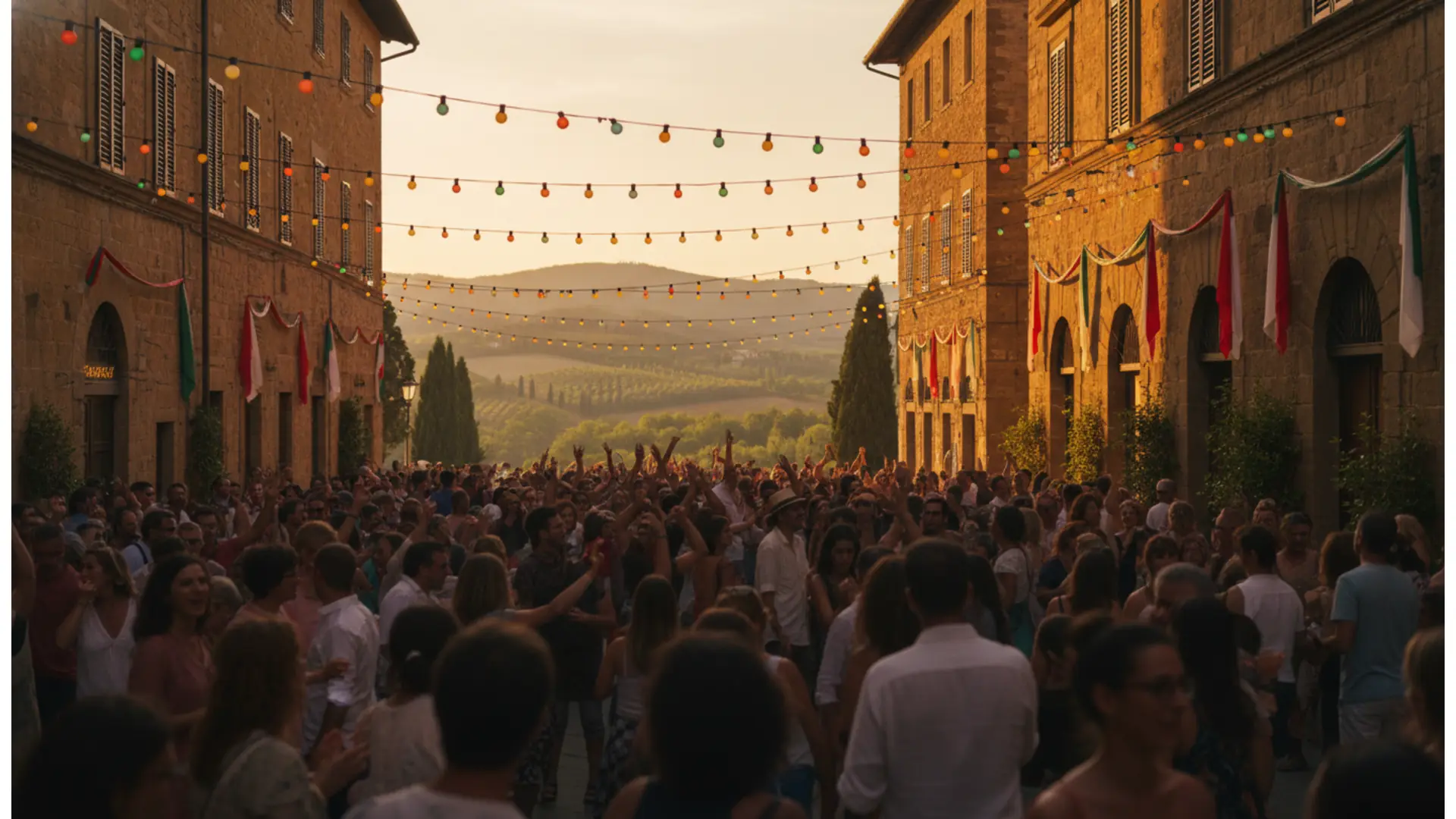
Procession of the Madonna delle Grazie (Black Madonna of Santomenna)
The July 2nd ritual featuring the dressing of the statue, gold ex-votos, and the centa from Laviano
About Black Madonna of Santomenna
An ancient rite on the border between Campania and Basilicata
Santomenna is one of the smallest municipalities in the province of Salerno: just over four hundred inhabitants, located at an altitude of about 540 meters, with a territory of barely 8.8 square kilometers nestled between the Marzano massif and the Conza pass, near the border with Basilicata and a stone's throw from Castelnuovo di Conza, Laviano, and Pescopagano. Yet, every July 2nd, this village in the Upper Sele Valley becomes the center of one of the most heartfelt devotions in the Campanian hinterland: the procession of the Madonna delle Grazie, which everyone here simply calls the Black Madonna.
The statue and its history
The village's mother church houses a statue of the Virgin with a dark face and the Child in her arms, whose origins date back to the 13th century. Local chronicles recall that the building, repeatedly struck by earthquakes that have scarred this part of the southern Apennines, has never lost its structure nor the image it guards. The dark color of the complexion—a common trait among many Black Madonnas of the South—is an integral part of the village's devotional identity. The same sources note that the history of Santomenna has deep roots: as early as 800 AD, bishops from nearby Compsa, modern-day Conza della Campania, established a Benedictine convent there, which later became Capuchin in 1582.
From the crypt to the altar: when the festival truly begins
The festival does not begin on July 2nd, but on the last Sunday of June: the bells ring out to announce that the statue has been moved from the crypt to the foot of the high altar. From that moment, the village enters a suspended time of preparations, visits to the church, and anticipation.
The dressing, a ritual reserved for the village women
On the morning of July 2nd, the most intimate rite takes place: the dressing. The statue is covered with an antique silk and satin mantle, onto which jewels and ex-votos donated by the faithful are attached. This task is reserved for the women of Santomenna, who have learned over time to sew rings, necklaces, chains, and pendants onto the silk: each piece corresponds to a grace received, a prayer answered, or a fragment of family history entrusted to the Protectress. It is not mere decoration, but an archive of collective memory worn by the Madonna.
The procession through the village streets
The most anticipated moment is the departure of the Virgin. The statue, fully dressed and adorned with gold jewelry, is carried on shoulders through the streets of the village. Children lead the procession, followed by candle structures and authorities; then comes the Madonna, accompanied by traditional chants and litanies, while fireworks mark the stages of the route. Along the way, the crowd tries to touch and kiss the statue: a gesture that, more than any other, tells of the direct and physical relationship between this community and its sacred image. Some rejoice, some pray in silence, others simply seek comfort: every believer carries their own story.
The centa of Laviano and the pact between two towns
The element that makes this procession different from all others is the participation of nearby Laviano. According to an ancient tradition, the entire Lavianese community accompanies the religious procession and marches while offering the centa to the Madonna: a monumental votive structure, typical of the Campanian tradition, made with decorated candles and ribbons. It is not just a simple devotional tribute, but the seal of a pact of brotherhood that has united the two towns since time immemorial—a bond that, in these mountain lands, holds as much value as an administrative border.
A community that has also rebuilt its own memory
On November 23, 1980, the Irpinia earthquake struck Santomenna with extreme violence: the municipality was among the most damaged, with almost the entire building heritage destroyed or severely damaged. In such a context, the continuity of a rite like that of July 2nd has a meaning that goes far beyond the religious dimension: it is the thread that has held together a village rebuilt almost from scratch. It is no coincidence that the feast of the Madonna delle Grazie rivals in solemnity and devotion that of the patron saint, San Menna, celebrated on November 11th.
What to expect
Those arriving in Santomenna on July 2nd will not find a large, spectacular event, but something rarer: a popular festival that has remained authentic, where the sacred and the profane intertwine without filters and where the rural dimension of inland Campania shows itself as it is. It is a precious opportunity for those traveling in the Salerno hinterland in search of living traditions, far from the beaten paths of the coast.
Black Madonna of Santomenna — edition 2026
Santomenna, July 2, 2026
In 2026, the Black Madonna procession once again illuminated the streets of Santomenna, bringing with it the burden of faith, emotion, and proud tradition that has characterized it for generations. The day followed the usual pattern: in the morning, the dressing of the statue with the silk mantle covered in gold jewelry donated as ex-votos, followed by the departure of the Virgin, carried on shoulders through the town center.
The procession was accompanied by traditional chants and litanies, while fireworks marked the stages of the route. As is customary, the community of Laviano marched alongside the Santomennesi, offering the centa, the monumental votive structure of decorated candles and ribbons that seals an ancient bond between the two municipalities of the Upper Sele Valley. The local press covered the event in the days immediately following, portraying a village of a few hundred inhabitants capable of attracting both the faithful and those who have emigrated elsewhere.
Programme Black Madonna of Santomenna 2026
The ritual schedule (2026 edition)
- Last Sunday of June — bells ring out to announce that the Black Madonna statue has been moved from the crypt to the foot of the mother church's high altar.
- Thursday, July 2, morning — dressing of the statue: local women cover the image with the antique silk and satin mantle and attach jewels and ex-votos donated by the faithful.
- Thursday, July 2 — celebrations in honor of the Madonna delle Grazie in the mother church.
- Departure of the Virgin — the statue, fully dressed and adorned with gold jewelry, is carried on shoulders through the village streets. Children lead the procession, followed by candle structures and authorities.
- Along the route — traditional chants and litanies accompany the procession, while fireworks mark the stages; the faithful approach to touch and kiss the statue.
- Arrival of the Laviano community — the Lavianesi march while offering the votive centa to the Madonna, renewing the pact of brotherhood between the two towns.
Precise times for the celebrations were not officially released online: for the schedule, it is advisable to contact the parish or the Municipality of Santomenna.
Highlights Black Madonna of Santomenna 2026
- The dressing of the statue, a morning rite reserved for the village women.
- The gold ex-votos sewn onto the silk mantle: every ring, necklace, or pendant tells of a grace received.
- The departure of the Black Madonna carried on shoulders through the streets of Santomenna.
- The centa of Laviano, a monumental votive structure of candles and ribbons, symbol of the pact between the two communities.
- Traditional chants, litanies, and fireworks along the procession route.
Prices Black Madonna of Santomenna 2026
Practical information — Black Madonna of Santomenna
How to get there
Santomenna is primarily reached by car: the village is located at an altitude of about 540 meters in the Upper Sele Valley, between the Marzano massif and the Conza pass, near the border with Basilicata and a short distance from Laviano, Castelnuovo di Conza, and Pescopagano. The town center is small and largely walkable: during the procession, it is advisable to leave the car at the edge of the village and walk to the mother church.
Costs and access
Participation in the procession and celebrations is free. There are no tickets or reservations required.
Tips
- The dressing of the statue takes place on the morning of July 2nd; the departure of the Madonna is the highlight of the day.
- This is a deeply felt religious rite: modest clothing and respectful behavior are appropriate, especially during chants and litanies.
- July at this altitude can be hot during the day and cool in the evening: it is best to bring something light to wear after sunset.
- Accommodation in the village is minimal: those staying overnight usually rely on nearby towns in the Upper Sele Valley and eastern Irpinia.
Information
Municipality of Santomenna, Piazza Municipio 1, 84020 Santomenna (SA) — tel. +39 0828 911004 — [email protected]
Festival-goer photos
No photos yet. Share yours!
Share your photos
5 photos max, 5 MB per photo (JPG, PNG, WebP)
Noticed an error or missing information?
Help us keep this listing up to date. Every proposal is verified by our team before publication.
Festival-goer reviews
No rating yet — be the first!
No comments yet. Be the first!
Were you there?
Share your experience with the community.
Published by Valentin Contard, festival listings writer. Reviewed, corrected and approved by Christophe Contard, editor-in-chief. .
Where does it take place — Black Madonna of Santomenna
Chiesa madre di Santomenna e vie del centro abitato