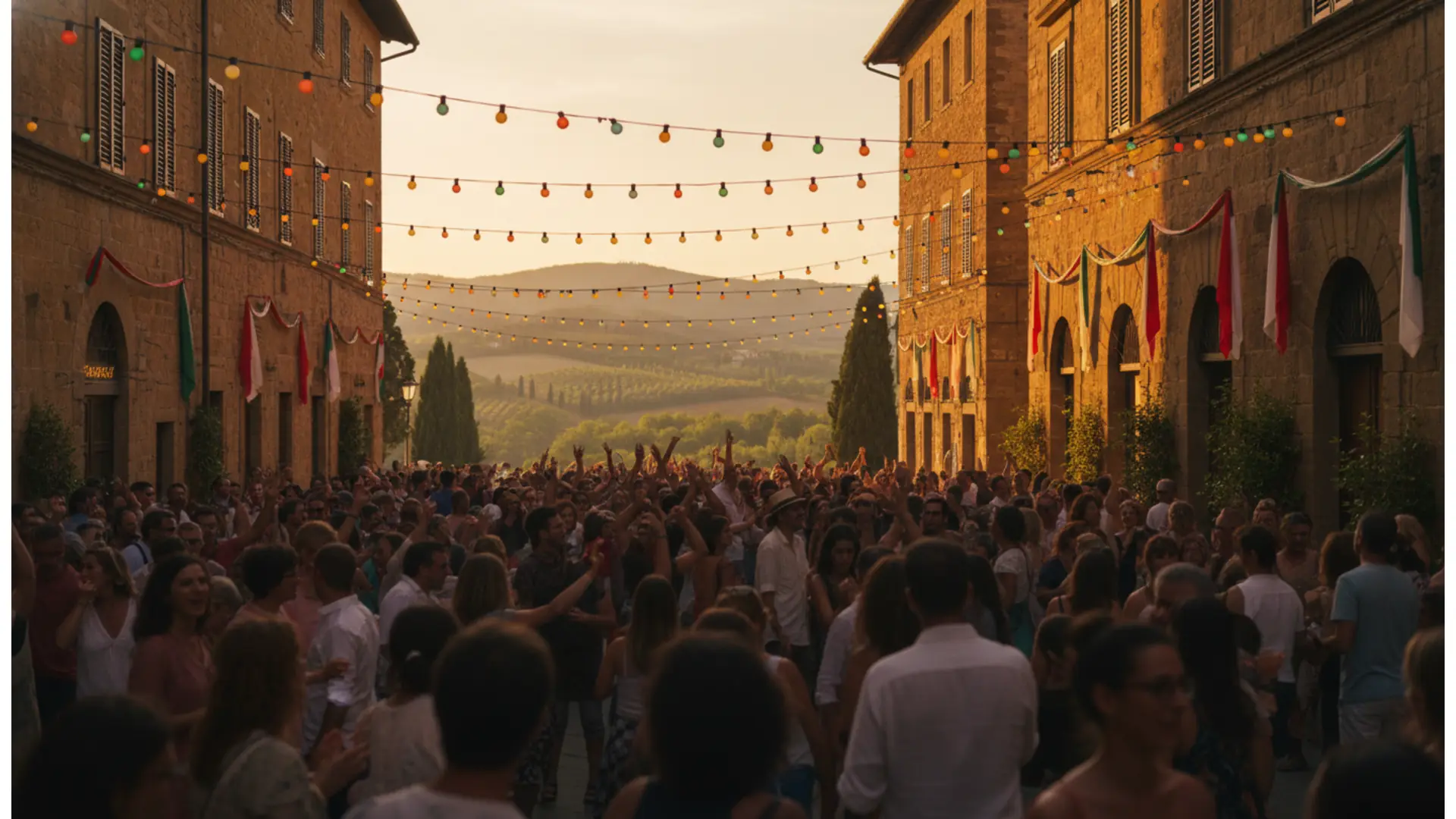
Patronal Feast of San Toribio (San Turibio de Mogrovejo)
On March 23rd, Cannalonga celebrates its patron saint, the Archbishop of Lima, with a novena, triduum, and procession
About San Toribio Feast
A patronal feast in the heart of Cilento
Cannalonga is a small town in the Province of Salerno, Campania, nestled at the foot of Mount Gelbison in the heart of the Cilento region. Every year on March 23rd, the town gathers around its patron saint, San Toribio Alfonso de Mogrovejo—known locally as San Turibio—with a festival that weaves together liturgy, historical memory, and community life. This is not an event staged for tourism: it is a tradition that belongs first and foremost to the people of Cannalonga, which is precisely why it retains an authenticity that strikes anyone witnessing it for the first time.
Who was San Toribio
Toribio Alfonso de Mogrovejo was born in Mayorga de Campos, Spain, on November 16, 1538. After becoming the Archbishop of Lima, Peru, he was respected and loved by the local populations, who were often oppressed by the conquistadors; he commissioned catechisms and prayer books in indigenous languages. He dedicated himself to the people struck by the plague that broke out in Lima until he fell ill himself, passing away on March 23, 1606. Canonized by Benedict XIII in 1726, he is the patron saint of Lima and Peru. That a saint so closely linked to Latin America became the protector of a Cilento village of just over nine hundred inhabitants remains one of the most fascinating aspects of this festival.
Devotion in Cannalonga
Cannalonga has recognized San Toribio as its patron saint since the first half of the 18th century: it was the community itself, in 1738, that chose him by popular vote as their heavenly protector, succeeding Saint Onuphrius, whose veneration has nonetheless continued over time. The official proclamation, however, arrived nearly two centuries later: on January 5, 1938, Pope Pius XI proclaimed San Toribio the Heavenly Patron and Protector of Cannalonga, as commemorated by the plaque in the Church of Santa Maria Assunta. In the same parish church, next to the high altar, the statue of the saint is kept and carried in procession every year.
The rhythm of the festival
Preparation is long and deeply felt. The feast is reached through the novena, nine days of prayer during which the community raises traditional songs dedicated to the patron, and through the solemn triduum of the three days immediately preceding. In recent years, the calendar has included a community lunch, a convivial moment that brings together residents, emigrants who have returned for the occasion, and guests.
The highlight is the solemn Holy Mass on March 23rd, followed by the procession with the statue of San Toribio along the streets of the town: it is, on every occasion, the most significant and well-attended moment of the entire festival.
Two times of celebration: March and September
Until a few decades ago, religious celebrations in honor of the patron were distributed over two times of the year: in March, coinciding with the liturgical memorial, and in September, as a votive event, in conjunction with the town's historic fair, the famous Fiera della Frecagnola. Today, the devotional focus has returned firmly to March 23rd, while the September event has taken on a primarily commercial and gastronomic profile.
What to see in Cannalonga
- Church of Santa Maria Assunta, the heart of the festival, housing the patron's statue and the 1938 plaque
- Piazza del Popolo, the town's living room and meeting point during the festivities
- The Ducal Palace, a testament to the town's feudal history
- The chapel dedicated to the Madonna del Carmine, near the reservoir
- Mount Gelbison and the trails of the Cilento, Vallo di Diano and Alburni National Park
Why visit
Those looking for an unadulterated patronal feast, where ritual matters more than spectacle, will find a rare opportunity in Cannalonga in March. The season is still cool, the Cilento hinterland is far from the summer crowds, and the town experiences the day with full participation. It is also a good excuse to discover an inland area that usually remains in the shadow of the coast.
San Toribio Feast — edition 2026
The 2026 San Toribio festival in Cannalonga
The 2026 edition of the patronal feast took place in Cannalonga, in the Province of Salerno, spanning three days of religious and community events. The preparatory triduum began on Friday, March 20th and accompanied the community until the liturgical anniversary.
On Sunday, March 22nd, the program included a community lunch, a highly anticipated convivial moment that brought together residents, families, and guests. The highlight arrived on Monday, March 23rd, the day of the liturgical memorial of San Toribio Alfonso de Mogrovejo, with the solemn Holy Mass and the procession with the statue of the patron saint, kept in the Church of Santa Maria Assunta next to the high altar.
As every year, the procession was the most well-attended moment: a gathered cortege that crosses the historic center of the town and preserves the devotional character of the recurrence intact. The celebrations were preceded, according to custom, by the novena with traditional songs dedicated to the saint.
Programme San Toribio Feast 2026
Friday, March 20, 2026
- Start of the solemn triduum in preparation for the patronal feast
Saturday, March 21, 2026
- Continuation of the triduum with celebrations in the parish church
Sunday, March 22, 2026
- Community lunch — convivial moment open to the town
- Concluding celebrations of the triduum
Monday, March 23, 2026 — liturgical memorial of San Toribio
- Solemn Holy Mass in the Church of Santa Maria Assunta
- Procession with the statue of San Toribio through the streets of the historic center
The exact times of the celebrations are announced year by year by the Parish of Santa Maria Assunta.
Highlights San Toribio Feast 2026
- The procession of March 23rd with the statue of San Toribio: the most deeply felt and well-attended moment of the feast
- The triduum starting Friday, March 20th, preceded by the novena with traditional songs
- The community lunch on Sunday, March 22nd, which brings the town together
- The Church of Santa Maria Assunta, with the 1938 plaque commemorating the proclamation of the patronage
- The context of the Cilento hinterland, at the foot of Mount Gelbison
Prices San Toribio Feast 2026
Practical information — San Toribio Feast
How to get there
Cannalonga is located in the Cilento hinterland, in the Province of Salerno. By car, it can be reached from the SS18 Tirrena Inferiore road, taking the Vallo della Lucania exit and continuing inland for a few kilometers. The nearest train station is Vallo della Lucania-Castelnuovo, on the Naples–Reggio Calabria line, from which you can continue by bus or taxi. The reference airports are Salerno-Costa d'Amalfi and Naples-Capodichino.
Admission and costs
Religious celebrations and the procession are free and open to the public. Any convivial moments, such as the community lunch, may require registration or a contribution: it is best to inquire at the parish or the Town Hall.
Tips
- At the end of March, at an altitude of over 500 meters, the temperature can still be chilly: bring warm clothing.
- The historic center is compact and partly uphill: wear comfortable shoes and park in the areas outside the ancient core.
- During the procession, you will pass through narrow streets: please maintain behavior respectful of the religious nature of the event.
- For overnight stays, it is advisable to look in Vallo della Lucania or at the agritourism facilities in the area.
Contacts
Municipality of Cannalonga — www.comune.cannalonga.sa.it. For updated mass times, please refer to the Parish of Santa Maria Assunta.
Festival-goer photos
No photos yet. Share yours!
Share your photos
5 photos max, 5 MB per photo (JPG, PNG, WebP)
Noticed an error or missing information?
Help us keep this listing up to date. Every proposal is verified by our team before publication.
Festival-goer reviews
No rating yet — be the first!
No comments yet. Be the first!
Were you there?
Share your experience with the community.
Published by Valentin Contard, festival listings writer. Reviewed, corrected and approved by Christophe Contard, editor-in-chief. .
Where does it take place — San Toribio Feast
Chiesa parrocchiale di Santa Maria Assunta e centro storico