Patronal Feast of Saint Sebastian the Martyr (The Majo and the Fucarone)
The arboreal rite of the Majo and the great Fucarone bonfire in honor of the patron saint in Avella
About Majo and Fucarone of Avella
An arboreal rite in the heart of Lower Irpinia
In Avella, a town in the province of Avellino, Campania, the patronal feast of Saint Sebastian the Martyr is more than just a religious anniversary: it is the moment when the entire community gathers around a tree. The Majo—from the Latin major, meaning the largest tree—is selected and cut from the mountains surrounding the town, dragged to the historic center, and raised in the square as an offering to the Patron Saint. It is one of the most distinctive arboreal rites in inland Campania, suspended between Christian devotion and ancient propitiatory rituals linked to the fertility of the land and the abundance of the harvest.
Cutting and raising the Majo
Everything begins at dawn on the Sunday preceding January 20th. At the Collegiate Church of Saint John, Holy Mass is celebrated with the blessing of the tools; immediately after, members of the committee and dozens of faithful head up toward the heights of the Partenio Mountains to identify and fell the tallest and most majestic tree, following practices passed down from generation to generation and rooted in the history of this Irpinian town.
In the afternoon, the trunk, now stripped of its branches, is dragged along the town streets in a procession animated by songs, 'tammorre' drums, and dances: these are the so-called figli del Majo (children of the Majo), joined by women who accompany the tree's descent. The arrival in Piazza Primo Maggio coincides with the most anticipated moment, the raising of the Majo: the trunk is hoisted by sheer force of arms and ropes, amidst held breath followed by the applause of the entire square. It is a collective test of strength that renews the pact between the community and its Saint every year.
The Fucarone on January 20th
On January 20th, the liturgical day of Saint Sebastian, the feast reaches its climax. After Holy Mass and the procession with the statue of the Patron Saint, as evening falls, the Fucarone is lit—the great ritual bonfire that illuminates the center of Avella. Its meaning is twofold: to ward off epidemics and diseases from families and livestock, and at the same time, to thank the Saint for the abundant harvest and the prosperity of the coming year.
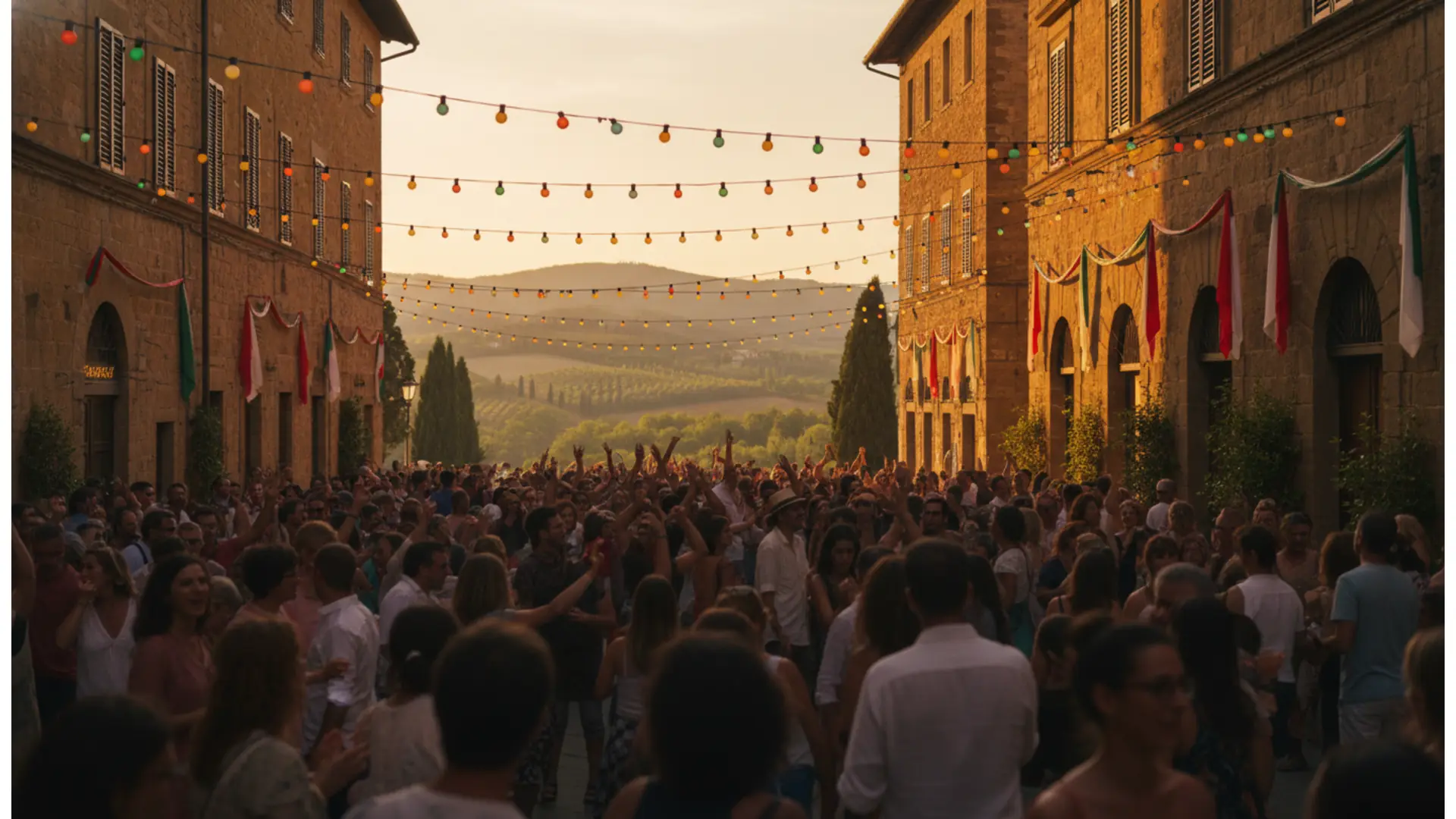
Around the flames, the evening turns into a popular celebration. Groups of bottari, who strike barrels, vats, and scythes, transforming them into percussion instruments, mark out ancestral rhythms; food stalls managed by local associations fill the air with the scents of traditional peasant dishes; children wander about with colorful balloons and cotton candy. It is the moment when devotion becomes collective energy, and the town, usually quiet on January evenings, fills with people until late at night.
A legend and a recognized heritage
Local tradition says that Saint Sebastian became the protector of Avella when his statue, during a procession interrupted by a violent storm, was contested by the neighboring town of Sperone and ultimately remained in Avella. Beyond the legend, the arboreal rite of the Majo—along with the Avellian carnival rites of the Zeza, the Mesi, and the Laccio d'Amore—is now listed by the Campania Region among the assets of intangible cultural heritage: a recognition that certifies its anthropological value and its uninterrupted transmission across generations.
Who organizes the festival
The organization is entrusted to the New Comitato Pro Majo Avella, which works together with the patronal feast committee, the parish, and local associations. In recent years, the event has also attracted hiking enthusiasts: the Italian Alpine Club – Avellino Section organizes an excursion to the Partenio Mountains to witness the cutting and descent of the tree in person.
Why it's worth the trip
- Authenticity: This is not a re-enactment built for tourists, but a living rite that the Avella community celebrates for itself.
- Two different days: The toil and celebration in the woods on Sunday, the religious solemnity and the fire on January 20th.
- Folk music: The 'bottari' and 'tammorre' provide a powerful sonic heritage of Campania.
- Free admission: All moments of the festival are free and held outdoors.
- Archaeological surroundings: Avella preserves a Roman amphitheater, a Lombard castle, and the funerary monuments of the road to Abella, perfect for completing your day.
Majo and Fucarone of Avella — edition 2026
The 2026 Majo in Avella
The 2026 edition confirmed the double appointment that has always marked the feast of Saint Sebastian the Martyr in Avella, in the province of Avellino. On Sunday, January 18th, the town woke up before dawn: at 6:00 AM, the Collegiate Church of Saint John hosted Holy Mass with the blessing of the tools, then the New Comitato Pro Majo Avella and numerous faithful climbed toward the heights of the Partenio to choose and fell the largest and most majestic tree, according to ancient practices rooted in the history of this Irpinian town.
In the afternoon, the trunk was dragged along the town streets in a festive procession to Piazza Primo Maggio, where the ceremony of the raising of the Majo took place. On Tuesday, January 20th, the liturgical day of the Patron Saint, after Holy Mass and the procession, the Fucarone was lit: from 7:30 PM, the great bonfire illuminated the square while the Bottari of Macerata Campania struck barrels, vats, and scythes in ancestral rhythms, with colorful balloons and cotton candy for the little ones.
For mountain enthusiasts, the Italian Alpine Club – Avellino Section organized a dedicated excursion on January 18th along the CAI Trail 232, to witness the cutting and descent of the Majo in person.
Programme Majo and Fucarone of Avella 2026
Sunday, January 18, 2026 — The cutting of the Majo
- 6:00 AM — Collegiate Church of Saint John: Holy Mass and blessing of the tools.
- Following — Ascent to the heights of the Partenio Mountains for the selection and ritual cutting of the Majo, the largest and most majestic tree.
- 7:45 AM — Excursion by the Italian Alpine Club, Avellino Section: meeting at Fontana Campo Piano, departure at 8:00 AM. Loop on CAI Trail 232 (difficulty E), 12 km, 500 meters elevation gain, about 6 hours, passing through Trombetta di Castellone, Vallone delle Rape, Fossa delle Ortiche, and the woods of Salmola and Carrata. Packed lunch, water points at the start of the trail.
- Afternoon — Descent and transport of the Majo along the streets of the historic center, up to the raising of the tree in Piazza Primo Maggio, near the church of Saint John.
Tuesday, January 20, 2026 — Saint Sebastian and the Fucarone
- Afternoon — Religious celebrations in honor of Saint Sebastian the Martyr with Holy Mass and procession.
- 7:30 PM — Lighting of the Fucarone, the great ritual bonfire, in the heart of the town.
- Following — Performance by the Bottari of Macerata Campania: ancestral rhythms with barrels, vats, and scythes.
- For children — Colorful balloons and cotton candy.
Highlights Majo and Fucarone of Avella 2026
- Holy Mass at dawn and blessing of the tools at the Collegiate Church of Saint John.
- Cutting of the Majo on the Partenio Mountains and descent of the tree toward the town.
- Popular procession and raising of the Majo in Piazza Primo Maggio.
- Lighting of the Fucarone on January 20th, from 7:30 PM.
- Concert-show by the Bottari of Macerata Campania.
- Excursion by CAI Avellino on Trail 232 to follow the rite at altitude.
Prices Majo and Fucarone of Avella 2026
Practical information — Majo and Fucarone of Avella
How to get there
By car: A16 Naples–Canosa motorway, exit at Baiano, then follow signs for Avella (a few kilometers away). From the Nola area, it is also easily accessible via the SS7 bis.
By train: Avella is served by the EAV Naples–Baiano line (formerly Circumvesuviana), with a station a short distance from the center; the journey from Naples takes just over an hour.
Where it takes place
The heart of the festival is Piazza Primo Maggio, where the raising of the Majo and the lighting of the Fucarone take place. Religious rites are held in the Collegiate Church of Saint John and in the historic center; the tree is cut on the heights of the Partenio Mountains.
Costs
All events are free. Only food and drinks at the stalls are paid.
Tips
- It is January and mostly outdoors: wear heavy clothing, comfortable shoes, and non-slip footwear.
- To follow the cutting in the mountains, you need hiking boots and a packed lunch.
- The historic center is closed to traffic during the procession: it is best to park on the outskirts and continue on foot.
- For updated information, it is best to follow the social media channels of the New Comitato Pro Majo Avella.
Festival-goer photos
No photos yet. Share yours!
Share your photos
5 photos max, 5 MB per photo (JPG, PNG, WebP)
Noticed an error or missing information?
Help us keep this listing up to date. Every proposal is verified by our team before publication.
Festival-goer reviews
No rating yet — be the first!
No comments yet. Be the first!
Were you there?
Share your experience with the community.
Published by Valentin Contard, festival listings writer. Reviewed, corrected and approved by Christophe Contard, editor-in-chief. .
Where does it take place — Majo and Fucarone of Avella
Piazza Primo Maggio e centro storico di Avella
Piazza Primo Maggio, 83021 Avella