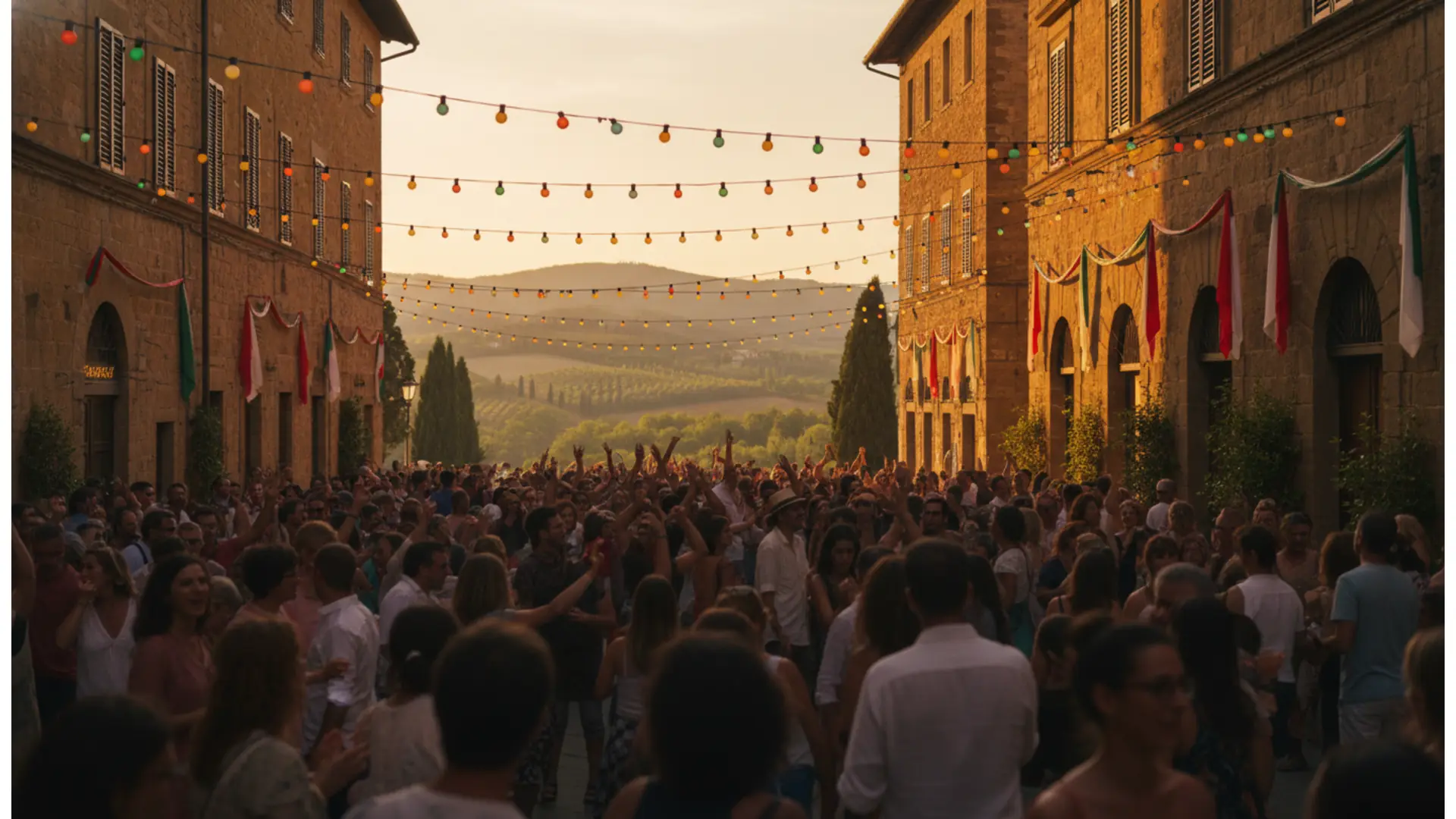
Patronal Feast of Saint Philip Neri
The Irpinian village of Candida honors the saint of joy with a solemn mass, procession, and brass band
Edition 2026 not confirmed to date
This edition has not been confirmed by the organiser to date. We recommend checking before going.
About Saint Philip Neri Feast
May 26th, the day of Saint Philip Neri
The Patronal Feast of Saint Philip Neri is the most cherished event of the year in Candida, a small municipality in the Province of Avellino, Campania. The village—home to just over a thousand residents perched at an altitude of 579 meters, about fifteen kilometers from the provincial capital—comes to a standstill to honor its patron saint, whose liturgical feast falls every year on May 26th.
This is not a festival staged for tourism: it is the day the town reaffirms its identity, welcoming back those who live elsewhere and reviving customs passed down through generations. Visitors will find an authentic celebration, perfectly scaled to the village, free from crowds or artificial structures.
Saint Philip Neri, the apostle of joy
Founder of the Congregation of the Oratory, Saint Philip Neri is known as the "apostle of joy." A popular and ironic figure, close to the youth and the marginalized, he left a deep mark on Italian devotion. In Candida, his cult has been rooted for centuries and is expressed through simple religiosity, centered on community prayer, singing, and collective participation rather than spectacular displays.
The procession through the village streets
The heart of the day is the solemn mass in the parish church, followed by the procession of the Saint's statue along the streets of the historic center. The parade is accompanied by a brass band and the faithful, winding through the alleys and small squares of the town, past decorated balconies and stops for prayer.
- Solemn Eucharistic celebration in the village's mother church
- Procession of the statue of Saint Philip Neri through the historic center
- Musical accompaniment by a brass band, an essential element of Irpinian patronal feasts
- Community celebrations in the village's public spaces
Candida, the town of the "chiodaroli"
The setting makes the festival even more compelling. Candida first appears in documents in 1045 as a hamlet of the County of Avellino during the Lombard era, growing around its castle, later a fiefdom of the Filangieri family, who elevated it to a barony in 1340. A devastating fire in 1426 almost entirely destroyed the town: from that event, the phoenix was born, which still appears on the town's coat of arms as a symbol of rebirth.
For centuries, the local economy was tied to ironworking, particularly the production of nails—a trade that earned the inhabitants the nickname chiodaroli (chiovaruli in the local dialect), practiced until the mid-twentieth century. While strolling before or after the procession, you can encounter the ruins of the Filangieri castle, the mother church of Santa Maria Assunta in Cielo (opened for worship in 1540), the church of the Conception of Mary linked to an ancient monastic settlement, and the 18th-century Palazzo Iorio.
A land of great white wines
Candida lies in the heart of the production area for Fiano di Avellino DOCG, one of Italy's most celebrated white wines, alongside Aglianico. The hills surrounding the town alternate between vineyards, hazelnut groves, and chestnut woods, and the Irpinian table complements the feast with traditional peasant dishes like fusilli with pork rinds or baccalà alla pertecaregna. Those planning a trip for the patronal day can easily combine it with a visit to local wineries.
How to experience the day
The festival is concentrated into a single day and requires no tickets: participation in the celebrations and the procession is free. It is advisable to arrive early, as the historic center's streets are narrow and closed to traffic during the procession. For precise times and any secular program, it is best to check with the parish or the Municipality of Candida in the days immediately preceding the event.
Saint Philip Neri Feast — edition 2026
The patronal feast of Saint Philip Neri in Candida, in the Province of Avellino, is tied to the Saint's liturgical feast, which occurs on May 26th. For the 2026 edition, however, it has not been possible to find an official program or an announcement from the parish or the municipal administration online.
Based on documentation from previous years, the day traditionally revolves around a solemn mass in the village's mother church and the procession of the Saint's statue through the streets of the historic center, accompanied by a brass band and the participation of the faithful.
We recommend contacting the parish or the offices of the Municipality of Candida directly to learn about times, the procession route, and any related secular events.
Highlights Saint Philip Neri Feast 2026
Prices Saint Philip Neri Feast 2026
Practical information — Saint Philip Neri Feast
Getting there
Candida is about 14 km from Avellino and can be reached by car in about twenty minutes from the capital by taking the A16 Naples-Canosa motorway, exiting at Avellino Est, and continuing along the provincial road that climbs toward the Fiano hills. The reference railway station is Avellino, connected to the province by regional bus lines.
Parking
The village is small and the historic center has narrow alleys, partially closed to traffic during the procession: it is best to leave your car in the spaces on the outskirts of the town and continue on foot.
Costs
Participation in religious celebrations and the procession is free of charge.
When
The liturgical feast of Saint Philip Neri falls on May 26th: this is the date around which Candida's patronal feast is organized.
Tips
Check times and events with the parish or the Municipality of Candida before traveling, as the program may be subject to change. On the same day, it is worth combining your visit with a tour of the ruins of the Filangieri castle and the Fiano di Avellino wineries.
Festival-goer photos
No photos yet. Share yours!
Share your photos
5 photos max, 5 MB per photo (JPG, PNG, WebP)
Noticed an error or missing information?
Help us keep this listing up to date. Every proposal is verified by our team before publication.
Festival-goer reviews
No rating yet — be the first!
No comments yet. Be the first!
Were you there?
Share your experience with the community.
Published by Valentin Contard, festival listings writer. Reviewed, corrected and approved by Christophe Contard, editor-in-chief. .
Where does it take place — Saint Philip Neri Feast
Centro storico di Candida